The third chickadee


The chickadee is cute, abundant, and a pleasant visitor at home feeders. Of course, what is being discussed is the ubiquitous Black-capped Chickadee. However, we also have three other species of chickadee. In the order of most to least commonly seen, the four chickadees are: black-capped, chestnut-backed, mountain, and boreal. 

While this posting records my first observations of the Mountain Chickadee, I will start by showing what I have seen earlier: the two more common chickadees. I have yet to spot the Boreal Chickadee.

This is the rather common Black-capped Chickadee, seen here excavating a nest. It has a black cap that extends to the bottom of its eye, and a black bib. It is widespread across the continent.

The somewhat less common Chestnut-backed Chickadee has both of those features, but also has chestnut-coloured feathers on its back and belly. It favours conifer forests and so is confined to the far west.

This is the best shot I managed during a rather brief encounter with some Mountain Chickadees. The white line above the eye is visible here, but not its black cap. This chickadee favours not only conifer forests, but those at a high altitude. So, when it sometimes descends to the valley bottoms in the winter, it still visits conifers for seeds.

My daughter, Cynthia, managed a far better shot of one of the Mountain Chickadees. Not only is the white separation between the eye line and the cap clearly visible, but the bird is also extracting a winged seed from a (female) cone of a Douglas-fir tree.

Cynthia also managed this grand shot of the Mountain Chickadee leaving with a seed in its bill. 

Cynthia Fraser’s images are used with permission.


Posted in birds | 2 Comments

Bird brains


They are variously known as suicide birds and grill birds (owing to their propensity to be smashed by vehicular grills). These are the finches of winter, and primarily they are Pine Siskins.

Pine Siskins seem to crave salt, and highway maintenance provides salt in abundance (to melt snow on the roads). So, flocks of finches settle on the highways and feed, temporarily ignoring the danger. Along comes the traffic; the finches panic and lift off. Inevitably, some of them don’t leave quickly enough and become road kill. 

That any little birds are mashed by traffic is sad. However there is an interesting pattern to be seen here. The deaths do not appear to be random, but are skewed towards inept birds. In 2017, a study was made of data assembled over many years by a taxidermist. He had listed organ weight and the cause of death of 3521 birds across 251 species. An analysis showed that birds killed in traffic had relatively smaller brains. While this may seem to be natural selection at work, these deaths are hardly desirable.

In this instance, Pine Siskins have alighted beside the highway to feed on salt.

At the first sign of a threat, the birds take to the air, but some do not react quickly enough to escape being smashed by oncoming traffic.

Around where the siskins had been feeding on the highway there were many dead birds. Some were on the pavement; others had been tossed by the traffic onto adjacent snowbanks. Sigh.

A side note: I have sometimes read comments by birders who wonder why birds in a flock never collide. (Strangely, they don’t ask if birds collide, they assume an answer and ask for an explanation.) Actually, birds in a flock often seem to collide, however they recover quickly and carry on. Here, three panicky siskins are in a aerial pileup.


Posted in birds | 8 Comments

Red-capped visitor


A visitor wearing a red cap arrived through the air this morning and then hung around eating snacks. It all seemed to fit the legends of the day.

The red-capped visitor was a female Pileated Woodpecker and the snacks were rowan berries.


Posted in birds | 13 Comments

Barred Owl


The last time I saw a Barred Owl in Kokanee Creek Park was a dozen years ago. Subsequently, I have seen a few Pygmy Owls and even Great Horned Owls there, but not a Barred. So, it was unexpected today when I spotted a protruding telephoto lens — a sure sign that there was something interesting to be seen. The camera belonged to a friend who had a Barred Owl in his sights. 

The Barred Owl lives year-round in mixed forests where large trees are found in the vicinity of water. While that is a good description of the local terrain, finding an owl in the trees is a real challenge.

Daytime is a drowsy time for a Barred Owl.

With its eyes sort of open, the Barred Owl stares dreamily from its perch in a Douglas-fir tree.

Posted in birds | 7 Comments

Rip


This topic is probably of little interest to non-boaters. Indeed, it isn’t even of much interest to boaters on most of the lakes of the world. However, for our boaters — bingo.

The topic is the rip. 

not the topic at hand: A rip current is a strong, narrow current of water which moves directly away from the shore, cutting through the lines of breaking waves like a river running out to sea.

If one does a web search on the word, rip, what comes up are discussions of rip currents (see side box). This is NOT what is being discussed here. Curiously, the meaning I want is closer to the dictionary’s: “a stretch of … rough water … caused by the meeting of currents.” But, even this falls short of the physics (as a dictionary’s proffered explanations often do). The rough water of the rip results when waves must adjust to an increasing counter current.

Boaters on the ocean refer to this problem as “wind against tide” and discuss ways to minimize the difficulties. But, while significant, theirs is merely a particular example of the problem of waves adapting to an increasing counter current.

OK, what has any of this have to do with Kootenay Lake? Well, we have rips. Further, I have been in a small boat that has been tossed around in a rip. Here is how it is usually manifested on Kootenay Lake, and in particular on the West Arm (although I have seen it on the Main Lake).

Producing a Rip: Longer water waves travel at a greater speed. If the waves move into a region with a strong counter current, they are abruptly travelling too fast for the flow. So, wavelength decreases to match the new situation. To conserve energy, amplitude increases. The locally rough water is called a rip. So, a rip results when waves must adjust to a region with a lower wave speed. 

The West Arm of Kootenay Lake is divided into lakelets by narrows (which are, in turn, caused by peninsulas resulting from creek deltas). Now, consider a west wind causing gentle waves to travel eastward across a lakelet, but against the weak flow of water. The waves soon move into the adjacent narrows where now the stronger flow is opposite to the wave propagation. The result is that wavelength shortens, amplitude increases, and many waves break as whitecaps. Produced is a region of rough water: the rip.

This is a stretch of water on the west side of the Harrop narrows. In the lakelet to the west, the waves are gentle, but as the waves enter the fast flowing water of the narrows, a rip is produced. 
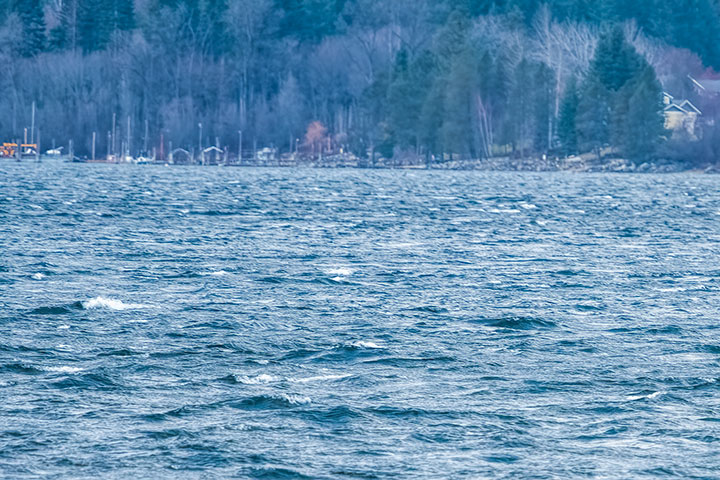
It is rather difficult to get a contextual picture of a rip: one that shows both the calmer inflow to the west and the turbulent entrance region. This is a view looking west through the nine-mile narrows. Beyond the dolphin is the rip. Beyond that is the gentler surface of the lakelet. 
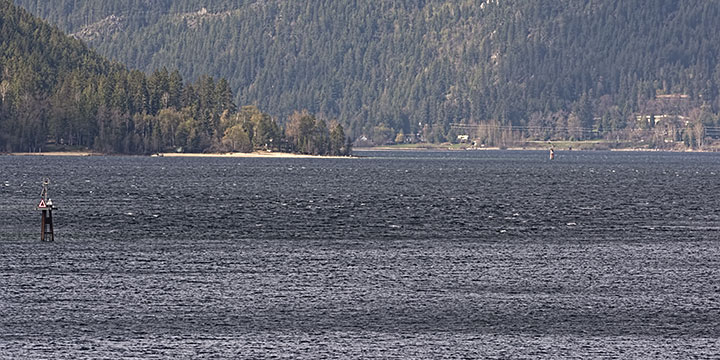
I mentioned earlier that I had seen a rip on the Main Lake. How can that be when there are no narrows to locally increase a flow against the wind? Well, the rip was seen at the north end of the Lake where the Duncan River entered. Southerly wind-driven waves were flowing towards the estuary. When the waves encountered the rapid outflow of the river, they had to adapt to the counter current and a rip was produced. 

It was noted earlier that: “a rip results when waves must adjust to a region with a lower wave speed.” The situations described are not the only ones that produce this. When I said earlier that “Longer water waves travel at a greater speed“, I was describing waves in deep water. In shallow water, wave speed is proportional to the square root of the water depth. So, as waves flow up a sloping shore, they are constantly adjusting to a region with a lower wave speed. And, of course, we regularly see waves breaking along a sloping beach. However, at the shore, such waves do not get called a rip — yet, it is the same phenomenon, but one so familiar that it is no longer noticed. 

Finally, I have seen a rip in the shallow water over a submerged sand point. In those shallows the lower wave speed prompted incoming waves to adjust and become chaotic.
 

Posted in weather | 3 Comments

Otter romp


Three of the four otters that visited in late November.

That we have river otters in Kootenay Lake is irrefutable. However, they are few in number and, alas, they rarely visit. It had been many months without seeing them when they stopped by in late November. That was that. I expected to not see them again for many months.

However, in the remarkably low light of a predawn snowstorm this morning, one otter appeared on the dock. Why it was there soon became evident: play. It raced along the dock, dropped its head and body and pushed off so as to slide across the snow-covered surface. It dawned on me that an otter has remarkably few opportunities to play this sliding game. Most of the time, surfaces are just too rough to enable even a thin layer of snow to allow playful sliding. However, even a thin surface of snow on the nearly smooth surface of a dock is ideal. In this way, otters seemed to have welcomed the presence of humans into their domain.

Soon, the one otter was joined by three others. They slid, they frolicked and just played.

Then, a fifth otter turned up, but it brought along a fish (a sucker). Now, this breakfast treat really did distract the other four from their games.

At this point, the thought of having breakfast dominated and all the otters abandoned their play to go and search for fish. Yet, my favourite part of this romp was the otters running along the dock and sliding in the snow.


Posted in mammals | 6 Comments

Redpoll, irruptive


For nearly a month, I have been keeping my eyes open for Bohemian Waxwings. They are beautiful irruptive birds that sometimes come here to feast on rowen berries. An irruptive bird is one that occasionally bursts from the north in large numbers to feed in more southern latitudes. They come, feed, and vanish again for a few years. 

As I had set my sights on waxwings, I hadn’t expected redpolls. The redpoll is a finch that I last saw a couple of years ago. When here, it feeds on seeds such as the common tansy. This morning, I saw a half-dozen redpolls. They must have just arrived as they didn’t seem to have found a good food source yet. So, how long will they stay, and how many will come?

This Common Redpoll sits with others in a flock in a black hawthorn bush.


Posted in birds | 9 Comments

Hare splitting


Perhaps my favourite set of tracks to find in snow are those of the snowshoe hare. This might be because the tracks are distinctive and not nearly as common as, say, are a deer’s. Indeed, as the snowshoe-hare population is cyclic, their numbers are locally down at the moment. I have not found hare tracks in my yard for some time, but today, deep in the upland woods, some were found. 

Now begins a game: what can I read from the tracks? The most obvious question is: Which way was the animal travelling? Look at the image.

The question is: was the hare accelerating as it traveled to the right, or was it decelerating as it traveled to the left. Owing to the hare having large hindpaws, but small forepaws it should be simple to determine the hare’s direction of travel. 

In today’s tracks, the hindpaws are on the left and the forepaws are on the right. This makes it easy to conjecture that the hare was traveling to the right.

Yet, a cursory view of an actual snowshoe hare hopping gives one pause. In this picture from July 14, 2015, it seems that at the end of its hop, it swings its hindpaws out in front of its forepaws.

This behaviour is confirmed in a picture from Jan. 17, 2018. When travelling, the hindpaws land in front of the forepaws. (This hare is in its white winter pelage.)

We return to this morning’s tracks. This snowshoe hare was decelerating as it travelled to the left.


Posted in mammals | 5 Comments

Lake stars in ice


This is the month for star patterns to be seen in the ice of lakes and ponds. This is an early season phenomenon. When the ice becomes thicker, they can’t form.

I offered my first posting about these star patterns a year ago, at which time I discussed some misconceptions about their formation. Now, at the beginning of this season of lake-star formation, I discuss the sequence of events that causes them to form. 

When the freezing season begins, a thin layer of clear ice can form on ponds and along lakeshores. What is needed now is for the ice to be covered by some snow. However, the snow must be of uneven thickness, probably as a result of wind drift. Where the snow is thickest, it weighs down more on the ice and causes it to sink lower in the water than where the snow cover is thin. 

What happens now is a bit subtle. The water immediately under a flat surface of ice has a temperature of 0 °C. However, just below that, the temperature is +4 °C (which is actually denser water). Wherever the weight of snow has depressed the ice and pushed it down into that lower and warmer water, the ice immediately above it melts, and a hole forms in the ice. 

The overlying snow has yet another role to play in the formation of the star. Snow now wicks that warmer water up through the hole and onto the ice and this causes that warm water to flow up through the hole and to then radially percolate outwards to form stellar arms.

The lake stars in ice have formed. Later in the season, the greater thickness of ice doesn’t permit it, but for now, we see the patterns.

Stars appear in a pond, but the snow has largely melted.

And again.


Posted in weather | 3 Comments

Coyote poop


Recently, a friend sent me some pictures from the Comedy Wildlife Photographic Awards from 2017

Interesting.

OK, when I take shots of wildlife, my objective is to understand their world — not to poke fun at it.

Yet, have I ever taken a picture worthy of showing on comedy wildlife? Likely not. However, among the 2017 winners there is a picture of a (female) fox piddling in a golf hole. Devoid of the caption, (“Must have a three putter” — Huh?) is it funny? Hard to say. Incongruous is probably a better description. 

Now, I have taken a number (to my mind of non-funny) of shots of animals pooping (context may matter here): a moose piddling and birds defecating. Could it be that someone would find one of them funny? 

The closest I could come is this picture of a coyote.

A coyote expresses contempt for humanity by pooping in the middle of a highway (8 May 2015).


Posted in mammals | 2 Comments