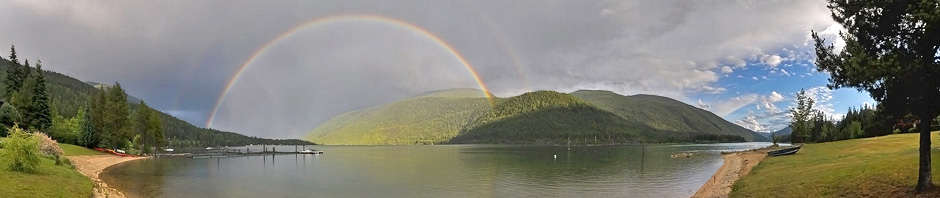
Light play


The play of light in the atmosphere is an endless source of fascination for me. The blue of the sky and the colours of the sunset are just the beginning of a cornucopia of optical phenomena. This morning’s walk along the lakeshore revealed three others.

The Harrop ferry appears as a two-image inferior mirage. It results from the refractive bending of light by the strong temperature gradient that accompanies cold air over warmer water. The term, inferior, is not an editorial comment, but a statement that the position of the image (what is seen) is lower than that of the object (what would be seen in the absence of refraction). Both the erect and inverted images have been displaced downwards, and parts of each have vanished, as has the lake surface in the distance. Incidentally, a mirage is not an optical illusion any more than is, say, an image in a mirror or binoculars. It is merely an image formed when the atmosphere acts as a lens — although a mirage’s appearance is more akin to those of a carnival house of mirrors.

A sundog (or parhelion) was seen about 22° to the left of the sun. This is an image of the sun that has been displaced and dispersed (colours separated) by hexagonal ice crystals, each of which was acting as a prism. That the sundog appears to the left or right of the sun, but not elsewhere is a result of these crystals being large enough to become aerodynamically oriented so they fall rather like dinner plates on a table. Incidentally, the name sundog was gained because this phenomenon follows the sun around the sky, rather like a dog following its master. The formal term, parhelion, just means beside the sun.

Iridescence. Appearing much closer to the sun than a sundog and caused by water drops rather than ice crystals is iridescence. And unlike a sundog, the light does not pass through the drops, but is merely deviated as it flows around them as obstacles. However, the amount of deviation is dependent upon the wavelength of the light, so colours are separated in the cloud.


Posted in weather | 3 Comments

Pygmy Owl


Pygmy Owls are altitudinal migrants: high country in the warm months; valley bottoms in the cold months. Although seen, the Pygmy Owl has not been as common this winter as some other years. It may be that this year’s sparsity of irruptive birds, upon which this owl feeds, has prompted it to not bother with visiting the valleys.

A Pygmy Owl hunts from a power line.


Posted in birds | 4 Comments

Grouse in tree


The Ruffed Grouse that visit my yard have long been a staple of my observing, and so is their consistent behaviour: It is a ground-foraging bird. Even with snow, grouse find clearings under trees. In a dozen years of watching them in my yard, yesterday was only the third time I have seen a grouse in a tree. What possessed it to perch on this occasion?

A Ruffed Grouse perches in a tree.


Posted in birds | 6 Comments

Bohemian Waxwings


The rowan trees (mountain ash) remain heavily loaded with berries. Often by this time of year, many trees are depleted and birds have spread their seeds widely. A few rowan berries are being eaten by robins, but the many irruptive birds (sometime visiting northern species) that often feed on them have been remarkably sparse this year. They have been seen, but not with the plentitude of some other years. 

Finally, I saw a small flock of Bohemian Waxwings. This beautiful bird is named for the red, waxy tips on some wing feathers (seen here). In previous irruptive years, it has frequently been seen gorging on rowan berries and wax berries. So, I have been watching those berries, but without a sighting. So, what was this small flock of waxwings doing?

The flock seemed to be hunting insects! This was really odd. While there probably were a few insects around, they are hardly plentiful, it being January. Further, waxwings typically only consume insects during the breeding season. I am confused by this behaviour; Have these birds not read their own wikipedia page?


Posted in birds | 5 Comments

Herons on ice


The Great Blue Heron is with us year round. It eats almost anything it can swallow: fish, voles, frogs. But how does it find food in the winter when frogs are hibernating, voles are under snow, and fish are under ice? 

If the truth be told, Kootenay Lake does not freeze over — at most it has a bit of border ice in the coldest weather. However, the smaller, shallower, lakes around it do freeze over, and they present the heron with problems. 

This last weekend I watched a half-dozen or so herons ice fishing. They were monitoring leads in the ice. It was the first time I had noticed this winter activity.

Two out of a number of Great Blue Herons watch for fish at a lead.


Posted in birds | 1 Comment

Raptors flying


On Saturday, I watched three flying raptors.

The closest and most difficult to record, was a falcon: a female kestrel as it left its perch.

While I saw four Red-tailed Hawks, this soaring one was the only one that made for a good image. So, why does it lack its eponymous red tail? It is a juvenile. Next year it will sport a red tail.

The observational gem, however, was this Rough-legged Hawk.


Posted in birds | 3 Comments

Finch harvesting


Finches crave salt. To satisfy this, mixed flocks of hundreds of them will alight on salted winter roads and feast. There is, of course, a problem with this: traffic. Indeed, some truckers refer to them as grill birds, owing to their propensity to be collected by the grills of passing vehicles. 

It turns out that highway traffic is not the only thing that collects finch carcasses. 

This is a view into the midst of perhaps a hundred finches on the highway. Both Pine Siskins, and Cassin’s Finches are seen here as they land, feed, and take off.

The problem, of course, is traffic. The birds try to lift off. While many escape, only to return, not all make it. There is a corpse in the lower left. 

As the finches feed, ravens assemble and watch for roadkill. When it is spotted, they sweep down and carry off the corpses. This raven has a male Cassin’s Finch. 

This one is packing a female Cassin’s Finch. As the raven flew off, it collided with a male Cassin’s Finch trying to escape the mayhem. (I interviewed one of the ravens about this. It prevaricated: “We have a contract with Highways to keep the roads clear of bird carcasses — yum yum.”)


Posted in birds | 8 Comments

Lake-surface oscillation


The varying patterns that can be seen on our lake are endlessly fascinating. Photographers often seek out particularly beautiful ones, as do I, but I also seek the beauty of its physics.

Pop pattern posting: With over 6500 viewings spread over a decade, the posting about Lake-surface patterns during rain is uncomfortably close to being viral for this unpretentious blog.

On occasion, this blog and website have treated various lake-surface patterns: ripples, gravity waves, wind-driven waves, wakes, beach cusps, convergence, divergence, long-shore drift, and patterns from rain. The latest observation was prompted by thoughts about the patterns produced by katabatic winds.

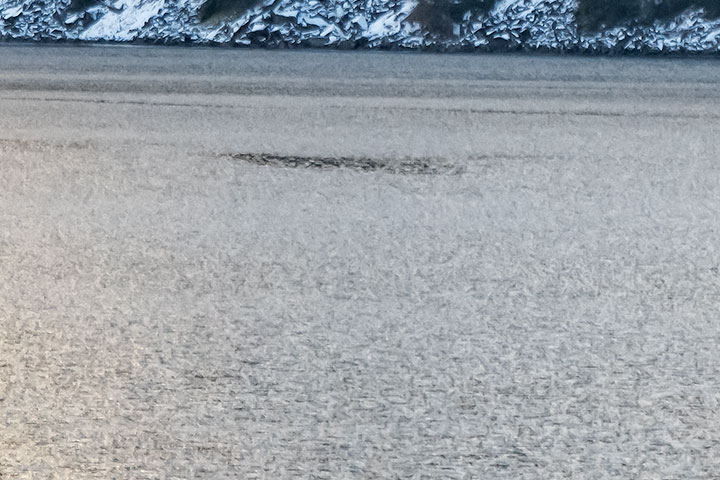
The pattern of interest is this unremarkable-looking patch of calm water amidst a wind ruffled surface. For reference, I note that there is a gentle flow of water from left to right, and a gentle flow of air (wind) from right to left. The calm patch could have resulted from either a locally decreased water or air flow. Either could produce the calm patch because a (relative) wind over the water of less than 23 cm/s cannot produce waves. Why is this?

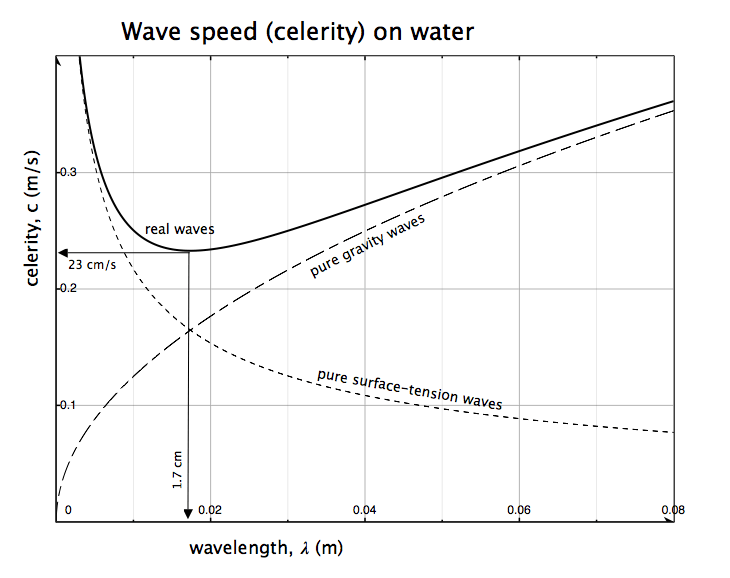
A wave on the surface of water can be characterized by its wavelength and its speed. For the most familiar form of waves that buffet a boat or shore, gravity is the restoring force. For these waves, speed increases with increasing wavelength. Another (much shorter) form of waves are variously called ripples, capillary waves, or surface-tension waves. For these waves, speed decreases with increasing wavelength. The result is that there is a minimum speed, 23 cm/s, and a minimum wavelength, 1.7 cm, for waves travelling on water. An object travelling through the water, or a wind pushing on it that has a speed of less than 23 cm/s leaves no waves. This light breeze is a ghost — it travels over the water without disturbing it.

So, if the wind is < 23 cm/s, the water is smooth; if the wind is > 23 cm/s, the water is ruffled. But, how does the wind temporarily change from the higher speed to the lower one and then back again so as to produce a limited patch of calm water?

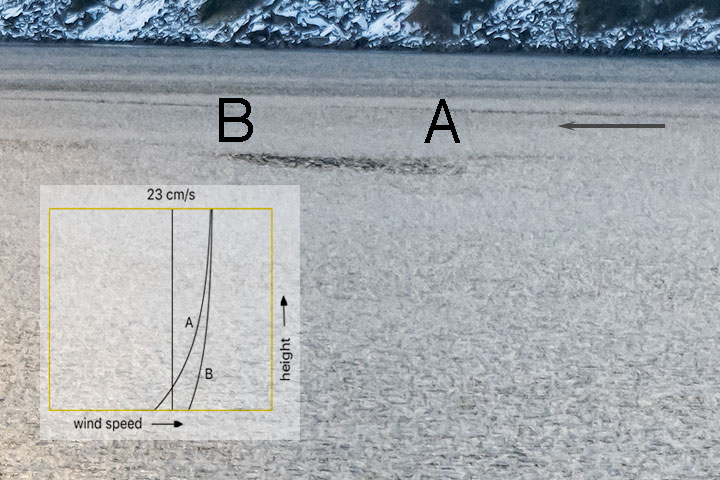
For this, we need to know something about the wind profile, the way the wind changes with height above the surface. A bit above the surface (in this case, maybe only 10 cm above) the wind is stronger. It is slowed at the surface by friction, but that slowing depends upon the roughness of the surface. A general rule is: the rougher the surface, the slower the surface wind; smoother the surface, the faster the surface wind.

The previous image is repeated and labeled. The arrow shows a gentle wind of somewhat more than 23 cm/s coming from the right. The water waves it produces roughen the surface and this slows the wind so that at A the speed has dropped below the wave-cutoff speed. However, that smoother surface allows the surface wind speed to increase so that at B waves are again produced.

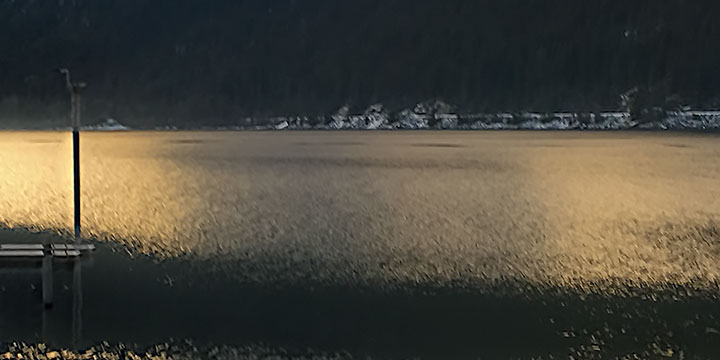
What happened with that patch of smooth water can happen again and again to produce an oscillation between rough and smooth water. In the picture of ruffled water, below, there is a train of six smooth patches with a spacing of fifty to a hundred metres. 

Many of the oscillatory forms seen on a lake have been given names. I have been unable to find a name for this pattern, and indeed do not even know if it has been described previously.

Mind you, it is understandable if no one has bothered with it. After all, the pattern is inconsequential for water management, hydroelectric production, fishing, boating, and ecology.

But, it is a delight.


Posted in weather | 3 Comments

Chips fly


What is a resting grub going to do to protect itself when it merely wishes to sleep through the winter inside an old tree? Apparently, nothing. When the Pileated Woodpecker finds you, it’s lights out.

A female Pileated Woodpecker was probing an old cottonwood tree.

The wood chips flew as the woodpecker attacked the trunk.

Posted in birds | 1 Comment

Blue wake


Just goldeneye ducks.

A jaunt began with a female goldeneye expressing (what looks like) joie de vivre.

It ended with two male Barrow’s Goldeneyes leaving blue wakes across golden waters.


Posted in birds | 6 Comments