Post-posting ponderings


The majority of my postings stand alone. Yet, sometimes following a posting, I continue to ponder it. This is a collection of five further ruminations made this last year.

Speeding hare, Jan. 17, 2018
I was struck by the speed of a snowshoe hare as it easily outpaced two dogs chasing it across a snow-covered field. What I did not appreciate at the time was how superb was this feat. Popular media will assure you that the fastest land mammal is the cheetah. This is true — when the cheetah’s top speed is measured in metres per second. However, biologists compare animals’ speeds in terms of their body lengths travelled per second. The cheetah has an impressive top speed of 23 body lengths per second. The hare trounces it by hitting a top speed of 37 body lengths per second. The hare besting the dogs was a truly impressive sight.

 
Golden Eagle, February 3, 2018
What was a Golden Eagle doing cruising the valley bottom? It normally prefers the uplands and leaves the valley bottoms to the Bald Eagle. My suspicion is that its presence was a result of the unusual large number of snowshoe hares that winter.

 
Cormo_rants, March 7, 2018
The Double-crested Cormorant is an interesting and uncommon bird around the Lake, so when the opportunity arises, I like to watch and photograph its behaviour. It was unexpected to discover that among some folk, the cormorant is demonized for everything from stealing fish, to destroying trees. There is a discussion of this at Why People Kill Cormorants. It seems that some people don’t feel complete until they know just what it is that they should hate. 

 
Horaltic vultures, September 1, 2018
The classic picture of a vulture is one of it perched with its wings spread. It is clear why a bird has spread wings when flying, but why does it sometimes do so when perched? In the posting, I noted that a number of large birds will do this to: dry wings, raise body temperature after a cold night, bake parasites. Indeed, in the picture, below, the vulture on the left is having an early morning warming, while the one on the right is baking its parasites. However subsequent to this posting I realized I have also seen spread-wing perching as: a threatening posture to other birds, a way to shake water drops from the wings, and a way to cover food to avoid the avarice eyes of other birds.

 
Waltz of wind, water, & waves, September 20, 2018
The posting discussed a katabatic wind that flows off the beach and out over the Lake. Initially, the wind velocity at the water’s surface was below the cutoff speed for the production of waves, 23 cm/s, so, although the wind blows, the water just offshore is smooth. Then I  wrote: “But, as the air moves out over the water, it accelerates and at the threshold speed of 23 cm/s, it begins to abruptly ruffle the water’s surface….” This comment was both correct and glib. After all: Why should the wind accelerate a bit offshore? First, the picture, then the discussion.
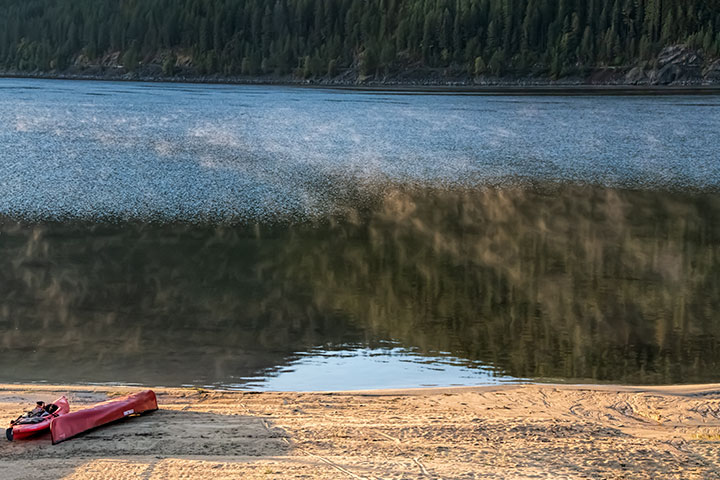
All winds are stronger a bit higher up but are slowed by friction at the surface. In the case of the gentle katabatic winds here, that higher up might be only 20 or 30 cm above the surface. The wind in the bottom centimetre flowing off the beach has clearly been slowed to below the wave cutoff speed. But as the air flows out over the warmer water, convection causes not only the steam fog, but also a mixing that brings the slightly stronger winds from higher up down to the surface. The surface winds now move faster than the cutoff for waves and so the water becomes disturbed.

This leads to another insight. The wind at the surface is slowed by friction by an amount that depends upon surface roughness. Change the underlying surface and the surface wind changes. (The velocity exchange through the wind profile is facilitated by a mixing from either convection or mechanical turbulence.)

Now consider a wind speed just above the cutoff speed for wave formation, so the water is ruffled. The rough surface now drags on the wind so that its speed then drops below the cutoff, and the water becomes smooth. The smooth water allows the wind speed to increase to above the cutoff and the water becomes ruffled again. And so it goes, back and forth.

I believe I have seen this oscillatory behaviour but have yet to get a compelling picture. Something to watch for.


Posted in birds, mammals, weather | 7 Comments

December goulash


This is a compilation of a few images, none of which had its own posting in December. Indeed, December could be characterized as a month of sparse observations.

Early in the month, Trumpeter Swans came through, but were often distant.

Another distant observation was that of two otters fishing through an opening on a mountain lake.

Not seen at all was a snowshoe hare, but its tracks abounded. On the left are the prints of its two hind feet. This seems to suggest that the hare was travelling from left to right, but the reverse is true — it is hopping from right to left. Its two front paws arrived first and made a single hole on the right. Then its two hind paws swing past them and made the holes in front of them. 

This is a pattern I sometimes see at this time of year: rime decorating the trees in a draw. A draw is a steep valley at right angles to the ridge line. It is carved by the water flowing in a creek. A draw also serves as a drainage path for cold air, and when that air contains a supercooled fog, some droplets collide with the trees and freeze there as rime.

I have been watching for irruptive birds all month, but have seen very few of them. These irruptives are a flock of Pine Siskins. This bird uses flap-gliding flight — a strategy that conserves energy. Some siskins are seen flapping; some are seen gliding.

These two siskins are flying off after scrounging for seeds on the ground.

A siskin in a douglas-fir has pried a seed from an adjacent cone and is about to swallow it. 

This is one of four Ruffed Grouse seen together in my yard. All were of the greyish colour morph, although the brownish morph seems more common around here.


Posted in birds, mammals, weather | 5 Comments

Crossbill flicker


Experienced birders might suspect that today’s posting is a hoax — it is not. The picture of the crossbill flicker at the bottom is real. 

Crossbills are finches whose bills are adapted to prying seeds from cones.

Flickers, however, are woodpeckers and have parallel mandibles used for carving cavities.

This recently spotted flicker has an unusually long bill that is crossed. While the bird looks healthy, it is unclear how it is able to indulge in a normal flicker’s behaviour with such a bill. I have not previously seen a woodpecker that looks like this, but Gary Davidson tells me that there is an uncommon syndrome known as Avian Keratin Disorder. See also, Deformed Bill Research. First seen twenty years ago among chickadees in Alaska, the disorder has spread to other species and has clearly reached Kootenay Lake.


Posted in birds | 4 Comments

Trumpeter visit


On their annual migration south, Trumpeter Swans are visiting the Lake in threes and fours.

These trumpeters are in the waters beside Kokanee Creek Park.

To my surprise, these swans took flight. The trumpeter is a big bird and must run across the water to pick up the speed necessary to become airborne. This gave me the unusual opportunity to photograph the liftoff. But, why did they take flight? Usually when a swan spots a beach walker, it just lazily moves slightly offshore, so this abrupt departure was unexpected.

Now airborne, one of the Trumpeter Swans flies past.


Posted in birds | 5 Comments

Rowan robin


The rowan trees are many and heavily laden, but where are the irruptives?

At this time of year, I watch for irruptives. These are birds that don’t visit us each year, but occasionally do so as a result of dramatic, irregular, food-seeking, migrations. So far this season, I have caught glimpses of only White-winged Crossbills, Pine Grosbeaks, and Pine Siskins. 

However, I am really looking for large flocks of either Pine Grosbeaks or, in particular, Bohemian Waxwings. Some other years, I have seen them feeding on rowan berries (mountain ash), so I have been watching such trees.

Alas, I have not seen any irruptives on our rowan trees as yet. But, the trees have been attracting robins. I will continue to watch.

A robin manoeuvres among the rowan berries.


Posted in birds | 4 Comments

Elk browsing


The elk were browsing.

Generally, cervids (the deer family) partition their resources between grazing (root meaning: grass) and browsing (root meaning: buds) so as to limit competition in feeding. Grazers, such as elk, primarily eat grass; Browsers, such white-tailed deer and moose primarily eat buds and leaves. 

The key word here is primarily. When the season changes and their favourite food is scarce, cervids will adapt. So it is that elk, which previously I always had seen grazing had begun to browse.

Elk will graze on grass when it is available (April 30, 2012).

However, this week elk were seen browsing on the needles of Douglas-fir trees.

“Well, what did you expect? I was hungry.”


Posted in mammals | 3 Comments

Cormorants three


Who can plumb the cormorant’s mind?

Two perched cormorants croak at a third as it flies past. Were they warning it to stay away? Were they welcoming it? Who knows?

Two Double-crested Cormorants react to a third’s flyby with croaks.


Posted in birds | 5 Comments

Kingfisher’s plunge


Sometimes a picture is posted merely because I like the action displayed.

A male Belted Kingfisher plunges. It passed out of view before hitting the water.


Posted in birds | 8 Comments

Dipper’s bluff called

Spread-wing dipper posted Nov. 6.


Joanne was right.

Earlier this the month, I posted the image shown to the right. I wondered about the dipper’s spread-wing stance. Large birds do this to dry their wings, warm their wings, or cook their parasites. None of these seemed to apply to dippers. Why was it doing this?

Joanne Siderius is the Senior Naturalist at Kokanee Creek Park, where the picture was taken. She said, “Oh, that is a territorial threat posture directed towards another dipper.” Interesting — there was, indeed, another dipper present.

Yesterday’s observations produced a technically poor (sloppy framing, one bird out of focus), but striking image that underscores Joanne’s contention. It shows the aggressive reaction of one dipper to being challenged by the other. Yet, as quickly as tempers flared, they passed. Moments later both dippers were foraging quietly on adjacent portions of the creek. 

(Before showing the attack picture, there is the challenge and surprise picture.)

Two dippers had moved close as they foraged. So, one faced the other and spread its wings in a territorial challenge. This picture was taken just as it realized that the other dipper wasn’t about to cede what it thought was its portion of the creek.

“Yikes, it is calling my bluff. I’m outa here.”


Posted in birds | 4 Comments

Buffleheads


The Bufflehead Duck is a small waterbird of winter. It has been around the Lake for nearly a month now, and is likely to stay through April of next year.

The striking black and white plumage of the male actually shows iridescent blues and greens.

The female bufflehead (right) has a more muted plumage.


Posted in birds | 1 Comment