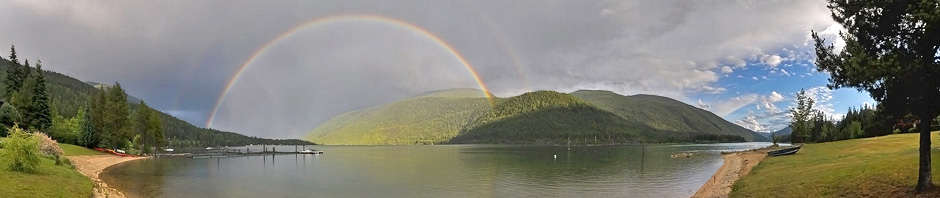
It is mid-July. The time has come to see the ghost plant (formally called the Indian pipe).
The ghost plant is in fact a herbaceous perennial plant (not a fungus), but its strikingly white colour means that it lacks chlorophyll, the substance responsible for the absorption of light to provide energy for photosynthesis. So how does does it manage to get the energy required for growth?
The ghost plant is parasitic; it gets its energy indirectly from trees through fungi. This means that it can prosper in the deep shaded area of a forest where other plants may struggle.
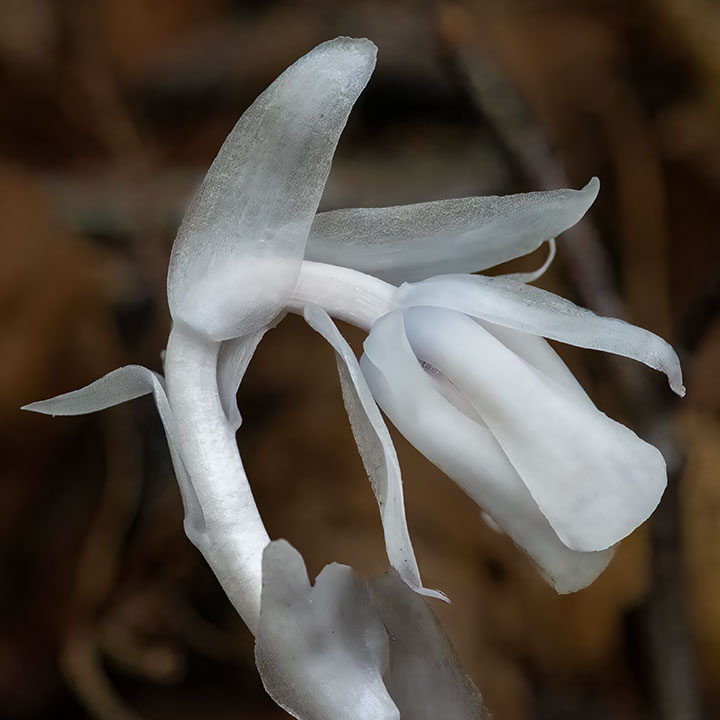
It looks as if it has leaves, yet they are not leaves as they contain no chlorophyll. These structures are often described as scales, but their presence is probably an accidental holdover from an earlier time when the plant needed chlorophyll.
The ghost plant has only one flower per stem, but is often seen together with others.
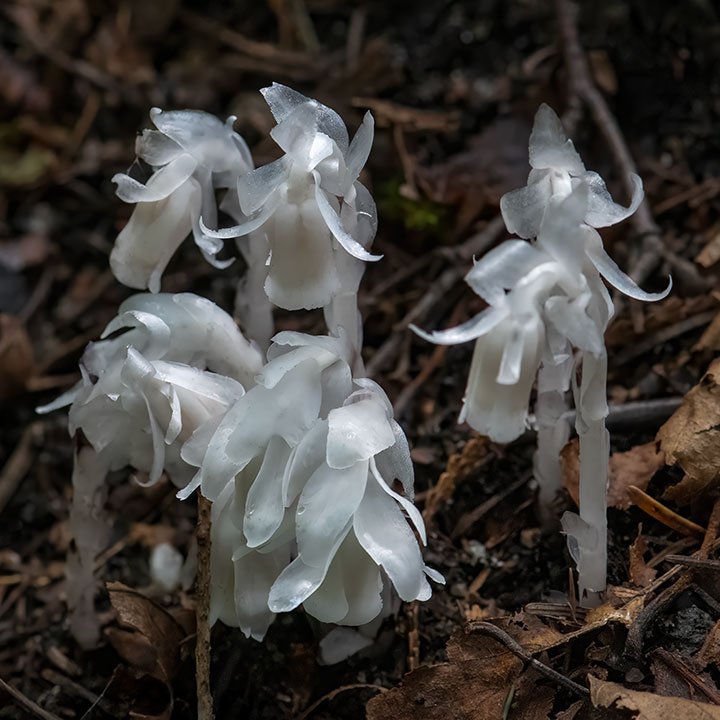
Yet, it is sometimes seen alone. I have watched a bee pollinate it.
The only place I have seen this plant is along the path to the swimming area at Blanket Creek Campsite
Your close up is remarkable….showing the plant detail and translucency.
In our Kaslo neighbourhood these are fairly common so nice to see your focus on it.
Certainly is remarkable, thanks so, Alistair! I always love finding them on my hikes, and expect to see them on my forest walks now, which are profuse on the trails near, where I showed you those Orchis rotundifolia a few springs ago.
I also didn’t know of the name change! I read backwards!
Quite a treat to see them!
Moist shady areas in Riondel as well ..
Splendid photo! Being white helps them to show well in a photo in their damp and darkish habitat. I have found them more common, along with Pinesap, in the north Kootenay Lake Region. In the south KL-C area they are getting less common due to drier conditions.
Monotropa uniflora, spoken of here as “Ghost-plant has” several common names, the most common one of which is “Indian Pipe”. According to Parish, Coupe and Lloyd (Plants of the Southern Interior BC and . . .” other common names are Corpse-plant, Ice-plant and Ghost-flower of which the latter has been the most commonly used, along with Indian Pipe. That’s OK Karen Pidock I hadn’t heard of that name either, just “Ghost-flower”. – Ed McMackin / “Kootenay Lake-Creston Wildflowers” FB
We have seen several just across the creek at Sharp Creek campground on Slocan Lake