Billows


I don’t understand why I don’t see (cloud) billows as often around here as I have seen them elsewhere. These billows are formed in a thin atmospheric layer where the temperature and wind change markedly with height. The airflow is almost as it looks: a series of rollers. Billows can form on a wave cloud, which is the case here.

This morning’s billows on a wave cloud were seen for only about fifteen minutes and then they vanished.

Posted in weather | 1 Comment

Replacement grouse


For some years, a Ruffed Grouse has been a regular visitor to my yard. Then all visits stopped. Subsequently, I learned that a local dog had been its executioner. 

Two days ago, I heard the wing beats of a flushed grouse in my yard. Today, I saw it. I think it is female.

From this view, I would not be able to tell whether this Ruffed Grouse beside my house was male or female. 

However, an indicator of the sex is revealed by a spread tail, such as seen in this shot from the side back. The evidence is in the tail’s terminal black band. If the band is continuous across the full width of the tail, then the bird is male. If there is a break in the middle as seen here (lower right of picture), the bird is probably a female.

Despite the loss of the previous grouse, the arrival of a new female just might bring chicks.

Posted in birds | 2 Comments

Celebrity endorsement


It seems that the Kaslo Chamber of Commerce has hired the ultimate celebrity endorsement: a Great Gray Owl has arrived to promote local businesses. It hardly gets any better than this. Yesterday, upon seeing this rare celebrity in town, Dirk Pidcock, an enthusiastic local fan exclaimed, “Indeed it is a very special day! … After years of longing and searching, … I see a Great Gray for the first time this morning….” 

Pidcock’s pictures of this celebrity owl were posted yesterday. Today, I went to see it myself, and it quickly became clear that this celebrated owl was in full endorsement mode as it drew attention to local businesses. 

I spotted the Great Gray promoting a business that I never did recognize. This is clearly the downside of going with a really big-name celebrity: the mere presence of the owl has eclipsed the endorsement it offers.

This was not the case when the Great Gray moved to endorsing the Kaslo Hotel; I have had a few meals there.
greatgrayowl140214cs

Alas, the mere presence of a Great Gray Owl in Kaslo outshone the businesses it (seemingly) promoted.

This is, after all, the celebrity owl.


Posted in birds | 3 Comments

Great Gray Owl


The Birds of British Columbia (Vol. 2, 1990) describes the Great Gray Owl as:

An uncommon resident in the northern interior and rare resident to the southern interior.

Few bird enthusiasts around here have seen one, but today in Kaslo, Lorraine Symmes spotted one and alerted Dirk Pidcock, who took these pictures. He kindly let me post them so some of the rest of us could enjoy this rarity.

Two views of the same Great Gray Owl

Dirk Pidcock’s pictures are used with permission.

Posted in birds | 3 Comments

Kill, pose, limn


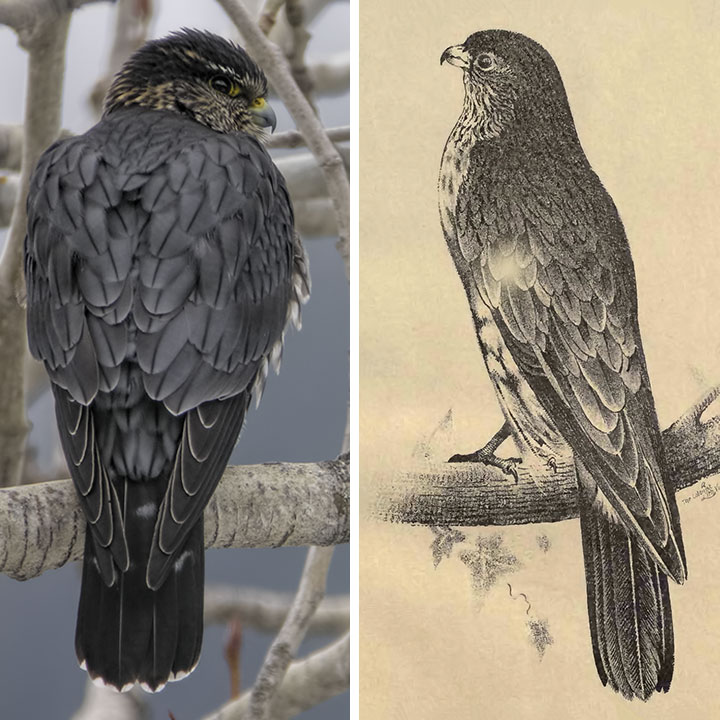
I was perusing a digital copy of John Fannin’s Checklist of the birds of British Columbia (1891), when I ran across an illustration of a Merlin (well, it was often called a Pigeon Hawk, at that time).  

The Merlin’s pose looked familiar. I had photographed a somewhat similar view a few years ago. So, I looked more closely at the description, which read:

Common east and west of Cascades, and ranging well up into the Rocky Mountain District, in which locality I have taken it in its most perfect plumage. 

“Taken”? That word clearly had a different meaning for birders in the nineteenth century. Indeed, Fannin had shot the Merlin! The dead bird was then presented to an illustrator who posed it in a lifelike manner, and sketched it. 

That is how it was done.

The renowned illustrator of birds in the United States, John James Audubon, would (as he said) harvest the birds he painted. His harvesting tool of choice was a rifle. In short: he shot them, then posed them, and then painted them. Curiously, he also then ate (or tried to eat) each of the birds he had harvested.

Audubon’s work predated photography and there were few other options open to him if he wished to limn birds. While Fannin’s work postdated photography, it probably wasn’t until a century later that camera technology would consistently outclass a rifle in the acquisition of good images of birds. We now have high-quality, long-focus, image-stabilized, lenses mounted on high-resolution cameras. Taking a bird in its most perfect plumage, now has a photographic meaning. 

Here are two Merlins recorded in British Columbia (with only slightly different poses). On the left is a bird I photographed a few years ago. It was unaware of my presence. On the right is the one Fannin had taken. It too was unaware of Fannin’s presence, but that is because at the time of the illustration, it was dead.

Posted in birds, commentary | Comments Off on Kill, pose, limn

Dipper’s Goldilocks


It has been cold (as my recent postings about ice on the Lake and creeks attest). Weather forecasts suggest that the air temperature is about to rise and is unlikely to plummet as low again this winter. This may be the last time this season to visit the freezing-weather travails of a dipper caught between the twin scourges of surface and anchor ice.

Surface ice and anchor ice form in different portions of a creek. Where the flow is gentle, such as near the creek mouth, ice will cover the water’s surface, but anchor ice will not form. Where the flow is turbulent, such as where the creek is steep, anchor ice covers the creek bottom, but surface ice is inhibited from bridging across the water. 

What is a poor dipper to do? It normally finds its food anywhere along the length of the creek bottom, whether the flow is smooth or turbulent. It is now blocked by twin barriers.

Curiously, at present temperatures, Kokanee Creek (where I make these observations) has a Goldilocks zone: one that is not so turbulent that anchor ice forms, and not so smooth that surface ice bridges across. That is where dippers go—where the turbulence and ice are just right. Would the dipper’s Goldilocks zone vanish with another 10C drop in temperature? We are unlikely to find out this winter.

Do other local creeks have a Goldilocks zone for dippers? I have no idea. But, the existence of such a zone may play a role in the long-term suitability of a creek for dippers.

Where the flow is turbulent, anchor ice covers the creek bottom, but surface ice has difficulty bridging the stream. Dipper foraging is out of the question here. 

This dipper has been foraging in the waters of Kokanee Creek’s Goldilocks zone: the flow is too calm for anchor ice, but too turbulent for ice to bridge the surface. It is just right for dippers.

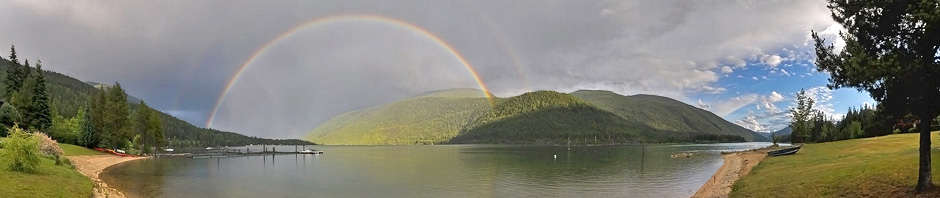
After posting the material, above, I realized that I should show a picture near the creek mouth where the flow is so gentle that surface ice covers everything. So, I visited the creek again and took this panorama. The marks are from boots and skates. They certainly show that, under the dusting of snow, there is a solid cover of ice. No dippers can hunt here. Yet, when I walked past the Goldilocks zone again, three dippers were foraging.

Posted in birds, weather | Comments Off on Dipper’s Goldilocks

Frazil on waves


Frazil ice is a collection of loose, randomly oriented flakes of ice in water. Frazil resembles slush and has the appearance of being slightly oily when seen on the surface of water. 

In a recent posting, it was noted that frazil can consolidate to produce skim ice and subsequently border ice. Carlo commented on the picture of skim ice (a portion shown to the right) that,

The ice crystals in the … photo show a conspicuous preferred orientation with long elements left-right in the image. This indicates that forces at the water’s surface were not equal in all directions. When I mentioned this to Alistair, he suggested that there may have been a very gentle swell impinging on the shore. This would tend to orient the free-floating frazil with their long dimension parallel to the shore, accounting for the observed directed pattern. Neat!

Yesterday, I saw it happening. Frazil along the shore was becoming oriented by waves.

First, an overview. Waves with whitecaps (left) are washing into a bay. There is ice along the shore where the water has washed up from earlier waves and frozen. The frazil is in the centre.

A closer view shows the frazil to be grains of ice floating on the water and moving up and down with the waves.

This view, elsewhere along the shore, looks directly into the approaching frazil-carpeted waves. The frazil is becoming oriented in a manner consistent with Carlo’s suggestion.

Posted in weather | Comments Off on Frazil on waves

Keeping Warm?


Why would a Heron stand half submerged in the water on one of the coldest days of the winter? 20140205_0167

Note the pupil sizes in each eye. The one facing the sun is smaller.

Posted in birds | 1 Comment

Border ice


Ice is endlessly fascinating; its various forms are a frequent topic for this blog in the winter.

As the air temperature now ranges between -15C and -10C, ice is making its appearance along the shoreline. It forms where the water is shallow, flow is minimal, and waves aren’t disruptive. Initially, it is frazil: individual crystals floating freely. These proliferate and consolidate to form skim ice, which now covers the water surface, but lacks strength. These are stages in the formation of the border ice that clings to the shoreline.

Frazil ice has consolidated to form some chaotic-looking skim ice.

Elsewhere, border ice has formed so slowly that it contains few bubbles and so is almost transparent. It looks dark because we are looking through it into the water below. The white crystals are frost growing atop the border ice.

Posted in weather | 2 Comments

Four curious birds


The weather has turned cold and the temperature is expected to drop further. Yet, as the wind is gentle; walks are pleasant. What might one see along the lakeshore? My curiosity was peaked by the four birds shown here.

The first is curious for being unexpected: Black-billed Magpies along the West Arm of Kootenay Lake. These birds prefer open country with thickets and scattered trees, a description that does not fit the heavily forested West Arm. Certainly, it characterizes the Creston Flats (south end of the Main Lake), where I saw my last magpie. Yesterday, there were five of these frenetic birds roaming around Harrop; I only managed a modest shot of one of them. Yet, it is enough to show that the birds I saw were magpies.

Not far from the magpies was a solitary Bald Eagle. This was to be expected because a perennially active eagle’s nest was nearby, and the nesting season is approaching. The curious thing is that the nest has abruptly vanished! What happened to it? What will happen to the eagles? This story is unfolding.

Another curious observation for this time of year on the West Arm was a Red-tailed Hawk. It just seems to have turned up a month, or so, early.

This morning’s observation of a Northern Pygmy Owl is curious primarily because such sightings have become strangely tedious. The odd thing is that most winters I would get to see only one or two; this winter, I and others are seeing them with startling regularity. These birds don’t migrate from afar; they descend from the mountains. Why have so many of them visited the valleys this year?
  

Posted in birds | 6 Comments