Waxing alliteratively


It was a most elegant symphony of visual alliteration: waxwings wolfing waxberries. 

A flock of many dozen Bohemian Waxwings landed on a staging tree above a bank covered with rose hips and waxberries (aka, snowberries). They flew in waves to the waxberries, but ignored the rose hips. They plucked berries from bushes and fallen ones from the snow. They then flew back to the staging tree to eat their prizes while the next wave of birds flew in.

I have watched mammals and wild turkeys eat these berries, but the sight of waxwings doing so was particularly appealing to my sense of linguistic symmetry.

A waxwing has scrounged a barely discernible snow-covered waxberry from the snow pack.

A waxwing returns to the staging tree to eat its prize. The name, waxwing, comes from the the waxy red shafts of some its wing feathers. These red shafts are easily seen in these pictures.

Having plucked a waxberry from the bush, some waxwings then had to navigate branches.

Posted in birds, wildflowers | 4 Comments

Keep looking


“Look, I know my phone is around here someplace, so keep looking.”

Posted in birds | 1 Comment

Goshwk & Lucy Goosey


The month and year end with a contrast: a goshawk and a goose.

The goshawk is an opportunistic predator that takes small mammals and birds often on the edge of forests. Its name means goose hawk, and apparently it will go after geese. I see a goshawk perhaps once a year.

A goshawk may be uncommon, but a goose is not. It is so common as to be almost boring — except for one leucistic female. Her lack of a pigmented crown and nape makes her identifiable. She is an individual and clearly deserves a name. How about Lucy? It is for leucistic (making her full name, Lucy Goosey, chuckle). When seen first in March 2012, Lucy already had a mate so she was probably hatched two or three years earlier. She was seen with chicks in June 2014. Canada Geese mate for life and can live for two dozen years. As Lucy is now five or six years old, there may be many more years of Lucy watching — as long as she avoids our local goshawk.

Posted in birds | 2 Comments

Winter tranquility


Yestermorn’s simple view of the Lake may constitute one of the oddest versions of a scene I have posted. I will explain that below. First, there is the story of why I took the picture.

About a decade ago, I began reading about water, waves, and beach formation. There were endless insights obtained into wave formation, reflection, and diffraction, followed by those of sand erosion, sorting, and longshore drift. Most of this helped me to understand the interesting behaviour and appearance of the beaches around Kootenay Lake. 

Yet, one portion of the reading made no sense to me. I learned about the winter storms that eroded beaches and steepened the transition to the backshore. I soon realized that the writers dealt exclusively with the majority of the world’s beaches: those around oceans or lakes having little surrounding relief. There the winter winds build waves that pound and erode the shoreline; this just does not happen around here. 

Kootenay Lake lies in a deep mountain valley. To a good extent, the winds of winter storms roar across the mountain tops without penetrating valley bottoms. Valley winter is often a time of tranquility. It is the downdraughts from summer thunderstorms that rake the valley bottoms with winds that generate the biggest waves. 

How does one represent the tranquility of winter in a single picture? Can one do so with a picture showing a simple reflection in the Lake? Well, sort of. The trouble is that we are so used to seeing even a moderately good reflected image that has been dragged out by ripples that we readily accept minor departures from a perfect reflection. So, how could I show that the shapes in this morning’s scene were virtually the same either way up?

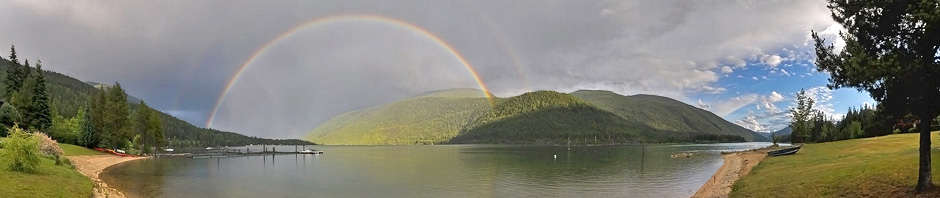
I will explain what appears in this image without explaining how it was created. First, this is a single picture (one click of the camera). Second, the left quarter of picture is normal and the right quarter is upside down. The central half is a gradual transition (one pixel at a time) from being normal to being upside down.

The plausibility of this picture is a measure of the tranquility of winters around the Lake.

This picture transitions from being correct (left) to upside down (right), yet it appears natural.
Posted in weather | 3 Comments

Also watching


In the winter, I watch berry-laden trees because they are beloved by the fruit-eating birds I would photograph.

I am not the only one to realize the appeal of such trees for small birds — so do owls.

Therefor, in addition to watching berry-laden trees, I now also search nearby for those watchful owls.

A Northern Pygmy Owl watches from high above a rowan tree. Apparently, it and I both like the same little birds.

Posted in birds | Comments Off on Also watching

Yule red


A Varied Thrush scarfs rowan berries.

A male Pine Grosbeak chows down on crab apples.

A robin contemplates plentitude.

A male Pine Grosbeak munches crab apples.

A female Pine Grosbeak twists to reach the berries.

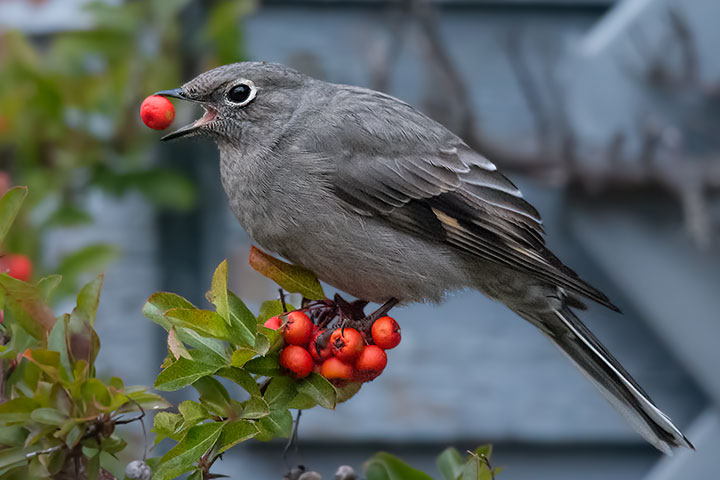
A Townsand’s Solitaire eats a cultivar.

A male Pine Grosbeak twists to reach crab apples.

Posted in birds | 7 Comments

Picky dippers


I have watched a number of feasting animals — birds, bears, coyotes, deer, wasps, spiders — and at no time have the words, picky eater, sprung to mind. That is, with one exception: a dipper. 

An uncommon bird of western North America, the American Dipper can sometimes be found hunting in clear, fast-moving mountain streams. Fortunately, I live near a creek where there is often a concentration of dippers (eight seen last Saturday), so I get to watch its behaviour. This easy access to the bird has enabled me to write an article for the BC Field Ornithologists about the way dippers handle surface and anchor ice in cold weather: dippers and ice. I have even watched it tending its chicks

The dipper is an unusual songbird. It flies underwater to capture aquatic larva and fish eggs from the creek bed. Occasionally it will even capture fry swimming within the stream.  About a year ago, I was watching a dipper collect kokanee eggs from the creek bed and was struck by the fact that it would retrieve a group of them, but would then place them on a surface so it could eat them one at a time

This time, I was struck by the dipper’s behaviour where it would retrieve a clutch of kokanee eggs, but not swallow them upon bringing them to the surface. Rather, it would pause and examine them.

As before, it would first place them on a surface.

It then tried to pick them up one at a time, but unfortunately they were clumped together. So it tried to separate the eggs by twisting and shaking its head. Why it had to eat them individually rather than all at once is unclear. But, having failed to separate them, it then put them down on the rock again.

Oh well, it is time to start all over again. It stuck its head back in the water and this time seems to have grabbed a grub. Food must be plentiful for it to afford to be so picky.

Posted in birds | 1 Comment

Redpoll poll


The Common Redpoll is a finch of the Arctic tundra that now and then comes south in the winter to feed. I previously saw them nearly four years ago. I start with a picture from then which enables me to poll both redpoll frequency and evolving image quality. 

Of course, I wondered what was the relationship between the words redpoll and poll (as in, take a). Poll is a middle English word meaning head. That accounts for the name of a bird with a red crown. The modern use of the word, poll, comes from the idea of a head count.

A Common Redpoll forages for seeds on January 27, 2012. Obtaining a good picture of such a frenetic bird is always a matter of happenstance, but clearly this image is not as detailed as are yesterday’s, below.

This is one of three female redpolls seen yesterday. The out-of-focus background is lakeshore snow and water. I wonder if this will prove a good winter for seeing redpolls.

Here is a detail of the red poll of a redpoll.

“I’m outa here.”

Posted in birds | 3 Comments

Rudolph’s apprentice


I have seen few birds around of late. While the geese remain plentiful, ravens seem sparse. Even trees with red berries seem to get few visitors. However, a few did come.

This is a Pine Grosbeak female feasting on rowan berries. I waited for more to turn up; they did not.

A Townsend’s Solitaire was helping itself to some berries from a unknown cultivar.

“I could lead a sleigh.”

Posted in birds | 1 Comment

Snow or rime?


If one is walking through a whitened forest on a mountainside, it is easy to tell if the trees are covered with snow or rime. From a distance, though it is often more difficult as details vanish and both merely look white.

Following my last posting about the appearance of the snow to rain transition in the air, it seemed appropriate to treat the transitions on the surface which can be seen with either fresh snow or fresh rime. Later in the season, the whole mountainside will be covered with snow and the transitions I discuss here will not be evident.

The first picture shows snow on the mountainside. Snow is made up of large ice crystals that fall from the cloud. When they fall below the melting level in the atmosphere, the smaller ones melt quickly while the large ones keep falling a bit farther. The result is that the transition between snow and no snow on the mountainside is gradual.

Rime comes about in a different way. A cloud of water drops has been drifting alongside the mountain. Some of the cloud drops bump into tree branches and are collected. Below the melting level, the droplet temperature is above 0 °C and the drops merely wet the tree. Above the melting level, the droplet temperature is below 0 °C and is thus supercooled. When that droplet hits the tree, it promptly freezes to give rime.  The visual consequence is a rather sharp transition from no rime below the 0 °C isotherm to rime above that looks different than the gradual transition resulting from falling snow.

Posted in weather | 1 Comment