Lying in the sand is a male Mallard — at least it used to be.
Standing over it, the Merlin looks at me and says:
“If you try to take my breakfast, I will eat you, too.”

Lying in the sand is a male Mallard — at least it used to be.
Standing over it, the Merlin looks at me and says:
“If you try to take my breakfast, I will eat you, too.”
Seasonal bunny: This hare showed insensitivity to mythology by neither laying nor hiding eggs.
A hare’s hair moults.
Our local snowshoe hare (we don’t have rabbits around here) is white in winter and rusty brown in summer.
The transition between white and brown is determined by day length, rather than snow cover, so sometimes there is a mismatch with surroundings that makes a hare vulnerable to predation. Indeed, it can live or die when its coat does, or does not, provide adequate camouflage.
This was the first time I had seen a hare midway in its moult from white to rusty brown.

Why watch for Mountain Bluebirds each spring?
They are stunning beautiful.
Typically, Mountain Bluebirds arrive to breed in late March or early April. This year, a few turned up on schedule, but the insects they feast upon were tardy. Jaunts to see bluebirds found numbers to be sparse — until this last weekend.
How could this creature be named anything other than bluebird?

The muted colour of the female gives better camouflage from predators.

A male had flown down to the dried grass in an unsuccessful raid on an insect.

“You needn’t even try to photograph me in flight; I am way too fast for you.”

A travelling animal can employ various gaits, a word that describes the pattern of movement of limbs during locomotion. A bipedal human might walk, hop, or run, each a different form of propulsion. The transition from one gait to another takes place when the energy it takes for, say, a fast walk begins to exceed that of a slow run. Quadrupeds, such as a horse, deer, or dog often have a wider range of choices which might include: walk, amble, pace, trot, canter, gallop, run, or stot.

A trotting mule deer is in suspension (2011).
A characteristic of some of the faster gaits is a period of suspension: a time when all four feet are off the ground. It seems that the faster the animal moves, the longer the period of suspension: Aerial time matters for speed.
Many rapidly moving quadrupeds exhibit a period of suspension.
Do otters?
A 2002 paper that studied the running energetics of the River Otter noted that:
… the ability to incorporate a period of suspension during high speed running was an important compensatory mechanism for short limbs…. Such an aerial period was not observed in river otters….

An otter family walking; None are in suspension (2015).
It is interesting that the authors of this study did not see a running otter in suspension. I do not know how the paper’s authors motivated the otters to run, yet that motivation clearly wasn’t sufficient to prompt them to excel.
I recently watched two otters in suspension while they were running and the motivation seemed to be purely that of having fun — otters, after all, will be otters.
This running otter is in suspension. It was racing along a dock before making a great leap into the water — rather like a child racing up a diving board before leaping off the end. The first otter was followed by a second that did likewise. It seems that pleasing a researcher isn’t as important to a River Otter as having fun.

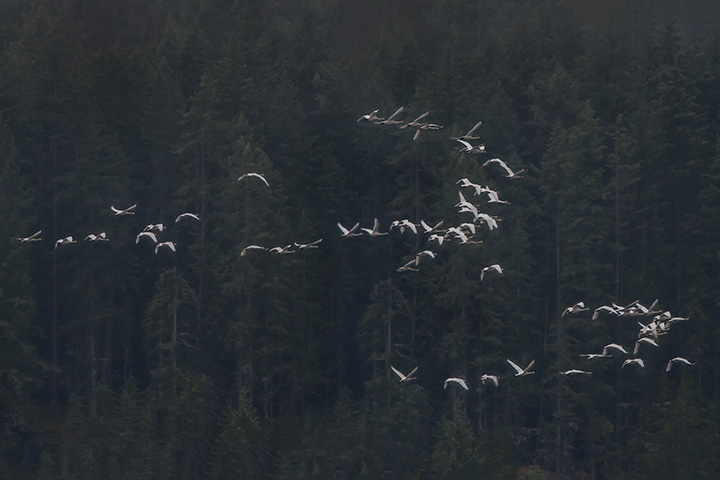
What had been planned for today’s posting was upstaged when about 80 swans (probably Trumpeters) flew down the Lake heading west. It was the best flyby I have seen.
The picture, below, shows the first seventy or so of them. Another dozen or so swans following behind were out of the picture. They will all head to the High Arctic to breed.
When climbing out of the Lake, many animals disperse water by twisting and shaking. Dogs do it, eagles do it, and otters do it.
While I had seen otters spin their heads to shake off water, I had not photographed it — that is, until two days ago.
Two River Otters frolicked on a dock. In turn, each twisted to shake off water from immersion.

This is a month’s end collection of images, none of which has had a posting of its own. They are all local birds as other topics were treated earlier in the month.
Birds, yes, but what are these distant ones flying over a ridge of Mount Loki? Geese?

Northern Flickers (female, left; male, right) are setting up spring housekeeping.

A Merlin watching for prey from a treetop voices its objection to anyone watching it.

A Red-breasted Nuthatch flies by.

A crow starts eating a vole, but soon the meal was stolen from it by another crow.

A Common Goldeneye courts his inamorata with a head-pumping display.

A Rough-legged Hawk flies by. Soon it will leave for the High Arctic to breed.

This goulash comprises images that had not rated their own postings. However, it might be that this shot of Trumpeter Swans deserved to have made the cut.

Now begins the season of the attack robins.
Robins are territorial nesters and will attempt to drive off all rivals, including those that are merely reflections of themselves as seen in a window. Further, as the mirrored robin is equally aggressive, the contest can proceed almost interminably with no clear winner.
To get a head-on image of a robin attacking a window’s reflection, this picture was taken from inside the house and so shows all the blotches and strangely coloured reflections of such a view.

Sometimes camouflage allows wildlife to pass almost unnoticed.

Tomfoolery
I commented that we should keep an eye out for male Wild Turkeys in display. It is that time of year. And there they were: not one, but two.
After watching the two toms for a while, it struck me that there was something odd about their behaviour. Each was decked out in its striking courting plumage and there were a number of females in the neighbourhood. Yet, rather than seriously approaching the ladies, the two toms stuck so closely together that they were almost always touching.
Were they more interested in each other than the ladies? Well, sort of. Neither seemed interested in the other sexually, but saw him as competition. It seems to have been a example of
which was memorably stated by Micheal Coreleone in the movie, Godfather, Part II (1974), but which originated in Niccolò Machiavelli’s, The Prince (1513).
The two turkey toms appeared inseparable.

Females were plentiful, but so obsessed were the males with blocking the other’s access, that neither made conquests. It was all rather funny and pathetic.

So the toms wandered away loveless, each presumably pleased the other had been thwarted.
