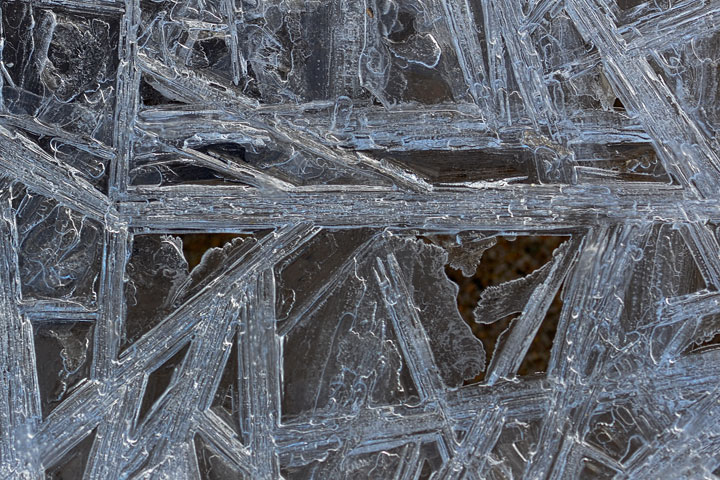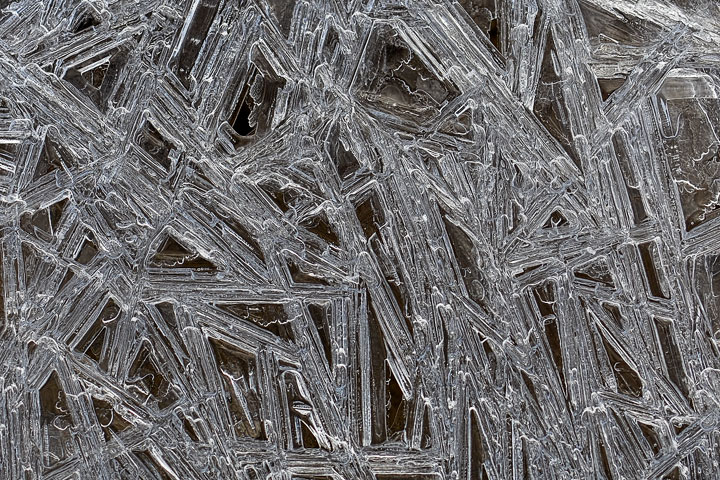
This is a good time of the year to admire border ice—the ice that forms along the calmest portions of the lakeshore as the air temperature drops.
On a cold, clear night, the top few millimeters of the lake surface will be cooled: by conduction to the colder air, by evaporation, and by (infrared) radiation loss. But, whether this cooling is sufficient to produce ice depends upon what is going on just below the surface. Is the cooling from above counteracted by warming from below. Still water is not a very good thermal conductor and so the temperature of the water along the shore can drop without being warmed from below. Far from the shore (or at the shore if there are waves) the cooling of the surface water is counteracted by heat moved up from below by both convection and waves. So, ice forms preferentially on the borders of a lake, or stream, where the water is still.
Alas, an understanding of the places ice forms does not equip one to understand the beautiful patterns it assumes. About all that can be said is that in these conditions, the border ice always seems to take the form of needle crystals oriented randomly in the horizontal.
Ah well, even if we don’t understand these intricate structures, it is fun to admire them (two pictures, below).