Muskrat hull speed


As I watched a muskrat swimming a bit offshore, I wished I had a better grasp of naval architecture (watercraft design) for it looked as if the muskrat were travelling at approximately its hull speed. Its concave body seemed to be draped between two wave crests of its own making.

An object (boat, muskrat) travelling across the surface of water creates a bow wave that necessarily travels at the same speed as the object. However, a bow wave is a wave so its subsequent troughs and crests will extend back alongside the hull. The wavelength depends on the wave speed and thus the boat speed. A slowly moving boat will produce a slowly moving, and thus a short wave. If the boat is long, this leads to many distinct waves along the hull. With greater and greater boat speed, and thus wave speed, there comes a time when the wavelength of the water wave has grown to equal the length of the hull. That speed is called the hull speed and the boat now sits neatly between the wave crests it created, just as did the muskrat I was watching.

For an animal moving across the surface, its hull speed may well constitute a practical speed limit. If it attempts to swim faster, the wavelength increases and the animal must now struggle to continuously travel uphill between the trough and crest of its own bow wave. In a boat, when sufficient power is applied, the bow will first tip up as that hill is climbed, but soon, with even more power, the boat is up and planing. About the only animals that seem to be (temporarily) capable of planing are birds landing on water. Apparently a muskrat swims at a speed just below its hull speed. (Fish, 1993). But what is that speed?

The relationship between wave speed and wavelength in a deep–water wave is,

c = √(g λ/2π), where c is wave velocity, λ is wavelength, and g is gravity.

If we put metric (MKS) numbers in this we get c = 1.25√λ and if λ = 0.3m, the average length, ℓ, of a muskrat body, we get a velocity of 0.7 m/s or about 2.5 kph.

Of course, estimating the actual speed of an object moving in the distance is difficult, so I will play a trick. Again set λ = ℓ, the muskrat’s body length, but now divide through by ℓ so the velocity, V, is expressed as the number of hull lengths travelled per second. We now get,

V = √(g/2πℓ).

Numerically, this is V = 1.25/√ℓ, and with ℓ = 0.3 m, we get that the muskrat travels at about two body lengths each second. 

Indeed, that is what the muskrat appeared to be doing; travelling at its hull speed of about two body lengths per second. Incidentally, when travelling underwater, an animal will not encounter this problem with waves and so can travel faster than it can on the surface. Now, if only it didn’t have to return to the surface to breath, it could move really quickly.

The concave body of a muskrat is suspended between the crest of two waves of its own making as it travels at about its hull speed of two body lengths each second.

Posted in mammals | Comments Off on Muskrat hull speed

Representation afar 2


This is the second posting where I represent the delights of Kootenay Lake to folks attending a meeting some nine time zones away. The first discussed my situation and my photography, this one presents features of the lake itself.

When I explore Kootenay Lake, I do it with a camera. The resulting pictures enable me to study discoveries at my leisure, and then report on them on my blog.

The pictures I show here are only a peek into the delights of the region.

The interaction of the water and shoreline is endlessly fascinating to me. Here is the beautiful, but uncommon pattern known as beach cusps.

Equally ephemeral delights are the many wild orchids found around the shores. The Giant Helleborine is only found in Western North America.

Kootenay Lake plays host to two species of swan, one of which, the Trumpeter is the world’s largest waterbird. It has a wing span of over two metres.

We also have two species of bear. The grizzly is our counterpart of Europe’s brown bear,

and the Black Bear, which despite its name, comes in a striking array of colours. Here is a cinnamon version,

and a blue one.

Seven species of ungulates (hoofed animals) wander our mountains, two of which I show. Our mountain goat, which is distantly related to Europe’s chamois, spends its time on the protective narrow ledges of mountain cliffs.

The bighorn sheep is unique to the mountains of western North America. They are noted for the enthusiasm with which they fight for their mates.

I am fascinated by the interactions of various species. Sometimes this takes the form of mating, such as these copulating Spotted Sandpipers.

Sometimes the interest is the nurturing of offspring by a parent: This Tree Swallow is bringing food to its chicks.

Often it is food gathering, such as this White-tailed buck taking apples from a tree.

And a grizzly sow eating black hawthorn berries.

Here a River Otter is eating a fish it captured.

For a long time, I tried to get a shot of an osprey lifting a fish from the lake. This picture marked success.

Another delight was watching an eagle eating a large rainbow trout at the edge of the water.

In the end, my favourite shot is of a vole facing death in the bill of a heron. As the vole stares into the eyes of the heron, does it know that in less than a second it will vanish down that heron’s gullet?

My penultimate offering is a curiosity. In the mountain lakes of British Columbia, there are legends of a large serpentine lake monster. It is our counterpart to the Loch Ness Monster. Known as the Ogopogo, stories of it predate European settlement and it has continued to be spotted perhaps in every decade since. I have seen it swimming across the lake from my home on two occasions. On this occasion it caught and crushed a fish as it undulated up the lake.

When it spotted me watching from a distant dock, it headed straight at me with the loops of its snake-like body rising and falling in the water.

When it neared me, it turned out to be a family of River Otters.

It seems that our lake monster is just a distantly seen family of travelling otters, but observed by someone who just does not not understand otter behaviour. Here is the ogopogo when it is not coursing down the lake, but resting on an ice shelf — not all that scary.

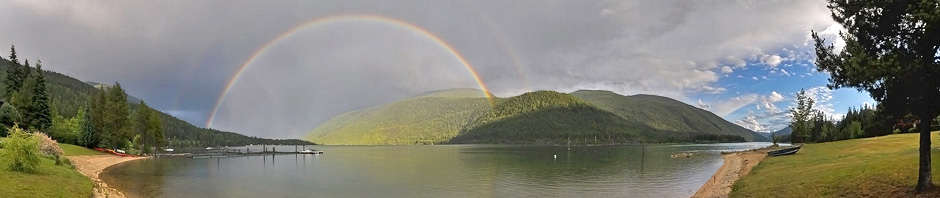
I end with a picture I tried to get for decades — and when I managed it, it was taken in front of my home. It is a low-sun rainbow with the circle completed by its reflection in the calm waters of the lake.

Posted in commentary | 5 Comments

Representation afar 1


There are a number of organizations whose purpose is to promote the fortunes of local businesses, particularly businesses that cater to tourists, one being Nelson Kootenay Lake Tourism. An interesting variant is the job of Nelson’s Cultural Ambassador, a person who promotes local artists. 

My website and blog do not lie within this group for, although I present Kootenay Lake, I don’t promote it. I merely offer a collection of personal reflections about where I live.

Yet, while not promoting the region, I am aware that my site does represent it — particularly given that it averages about five-thousand visitors a month from around the globe.

Techie stuff: The pictures to be shown have already been transferred and will be presented through one projector. I will appear through another projector via FaceTime from my living room. My host will provide a running translation into the local language. The interview is Thursday.

The breadth of my site’s footprint was brought home to me when, from a distance of nine time zones, I was asked if I would be willing to be interviewed at a meeting and show some of my pictures of Kootenay Lake. 

As such, it appears that I will be representing us from afar. What follows in this first posting are the notes I shall follow when talking about why I explore my locale with a camera. The next posting will be my take on the Lake, itself.


******* Below are the opening notes and images that set the stage.  *********


My front yard touches a large lake; my back yard abuts a mountain forest. I explore both.

This is a tiny portion of the extensive lake that fills 400 square kilometres of the valley floor.

The forest sweeps up the mountainside

to alpine meadows, glaciers, and mountains reaching over 3000 metres.

The lake and creeks contain fish.

The forest contains wildlife.

And both forest and lake are awash with birds.

This is Kootenay Lake. It is a minor lake in the Canadian context, yet it has an area larger than the Swiss portion of Lake Geneva. It lies in the Kootenay Districts of British Columbia, sparsely populated mountainous regions that have an area over twice that of Switzerland but with fewer than 2% of its people.

The Kootenays in Canada are Switzerland without the Swiss.

Before I retired to my lakeshore, a corner of my career had been spent making sense of small-scale meteorological phenomena. For example, the appearance of the uncommon but delightful frost flowers. These do not come about from the expected process of vapour cooling, but from vapour mixing.

Then there were steam devils: vortices from obstructions that are revealed by steam fog rising from warm water.

Two of my favourites were the green flash, a momentary island of emerald green light atop the low sun.

And walking on water: a vision where people appear to be strolling out over a water surface and among boats.

Now in my retirement I have sought to learn about the world of Kootenay Lake. It has turned out to be as rich as anything I might have imagined (to be continued in the next posting).

Posted in commentary | 7 Comments

Bufflehead landing


Despite some range maps that suggest otherwise, the Bufflehead Duck is a winter resident of Kootenay Lake. It is also both our smallest and (some have asserted) our cutest duck. 

Curiously despite an initial assessment that the male plumage is strictly black and white, it can be surprisingly colourful. In some lightings, the black on its head becomes iridescent. See pictures in a CBC trifling, and fetching birds. Indeed, even in the picture below, some green appears on an otherwise black neck. 

Are those characteristics the reason I have made this posting? Well, no. I just was captivated by this view of a male Bufflehead Duck landing on the water near the mouth of Kokanee Creek.

Posted in birds | 1 Comment

Snow Goose


It is not that the Snow Goose is rare. In the right place, such as along a migration route from the Arctic coast to the US and Mexico, the abundance of Snow Geese can saturate one’s eyes and ears. There is a migration route along the BC coast where the numbers can be sufficient to dull the senses. 

Around here, a migrating Snow Goose is really uncommon. It gets reported now and then, probably only because it wandered far off course. 

Consequently, when yesterday I was watching our local aves non grata, I was surprised to see a stranger in their midst. It was an immature Snow Goose, the first such bird I had seen here.

This first picture could not have been taken around Kootenay Lake. It is a view of Snow Geese taken along the coastal migration route (in Ladner, BC) a few winters ago. I leave the cacophony to the imagination.

Yesterday, I saw my first local Snow Goose as it hung out with a few dozen Canada Geese.

Posted in birds | 2 Comments

Pileated eats rowan


I only manage to spot a Pileated Woodpecker a few times a year, usually when it is probing for grubs, but sometimes when it is eating them. In the fall, I have seen it eat elderberries.

Yesterday was the first time I watched one feast on rowan berries. (It is difficult enough getting a shot of any backlit bird deep inside a tree’s canopy, so the feeding was a bonus.) 

A female Pileated Woodpecker picks a rowan berry and eats it.

Posted in birds | 1 Comment

Sodden grouse


Birds do not have expressive faces, so normally one has to judge their thoughts by their actions. However, there is an occasion when a bird gives the appearance of being downright miserable. (Two pictures, below.)

A Roughed Grouse was spotted perched in a tree as it waited out an interminable downpour.

With sodden and matted feathers, the grouse looked as if it were miserable.

Posted in birds | 3 Comments

Kingfisher


The kingfisher is restless when fishing and skittish when approached. So on the rare occasion when one is close, a picture is in order.

The kingfisher has been described as cute, probably because its oversized head and disheveled hair remind us of children.

Posted in birds | 7 Comments

Carbon antlers


The title, carbon antlers, is easy to misread as caribou antlers. Yet, they are not real antlers, but a fungus, Xylaria hypoxylon, that grows on decaying wood. The common names, carbon antlers, stag’s antlers and candlestick fungus, come from the fruiting portion, which extends above the ground often in branched columns redolent of antlers or candlesticks.

Carbon antlers grow amongst moss. Although they don’t look carbon black now, they will turn so at a later stage.

Posted in wildflowers | 3 Comments

Icebreakers


Kootenay Lake has three (semi?) aquatic mammals. By medium weight they are: the beaver (~ 23 kg), otter (~ 8 kg), and muskrat (~1.2 kg). 

It is difficult enough to obtain decent pictures of any of the three, but obtaining shots of each interacting with ice is distinctly less likely. So, when I realized that with last week’s picture of a muskrat, I had an example of each, I felt that it was worth a posting. 

How each mammal interacts with ice probably depends upon its weight and ice thickness, but my sample of pictures is too small to allow anything but anecdotal comments. 

The heaviest of our aquatic mammals, the beaver just plowed through the grease ice. (Jan. 16, 2015)

This otter is dealing with much thicker ice, but keeps the dive hole open by stirring the water even while apparently napping. (Dec. 27, 2013)
 

Weighing little more than a kilogram, this muskrat tried to break the freshly formed ice with its claw. Failing to do so, it then dived and swam underwater to the shore. (Nov. 4, 2015)

Posted in mammals, weather | Comments Off on Icebreakers