Seasonal raptors


One of the interesting features of birds is how many of them change with the season.

Merely consider two raptors: the Osprey and the Rough-legged Hawk. These two species might well never meet. The osprey spends the summer here, but winters in Central America. The Rough-legged Hawk spends the winter here, but summers in the arctic tundra. Even if they were to overlap briefly, they occupy different local niches: the Osprey captures fish in the Lake and the Rough-legged Hawk captures rodents in fields.

In honour of the seasonal return of the Rough-legged, I show composite images of each bird as it flew past me.

This is a composite image of a single osprey flying past at the end of July.

And this is one of a Rough-legged Hawk seen earlier this week.

Posted in birds | Comments Off on Seasonal raptors

Coyote’s delight


“Grasslands are vast; voles are abundant; sunlight is warm — life is good.”

Posted in mammals | 3 Comments

Frost patterns


This is the time of year to watch for patterns in frost. Viewing is best around sunrise following a clear night.

The patterns of frost, dew, and snow melt have been discussed other years (e.g., IR snow melt) and so explanations will not be repeated.

These are footprints on a sandy beach. The frost-covered ridges are colder than the valley floors.

The frost-covered lawn surrounding a small tree is colder than that under the tree.

Posted in weather | Comments Off on Frost patterns

Morph, not moult


For some time, I fancied that I had a residential Ruffed Grouse — or at least my yard lay within its limited range. Maybe it stuck around because it viewed my yard as a sanctuary.

Alas, reality has undercut both conceits. First to go was the matter of a safe haven when a neighbourhood dog executed the bird. Second, was the fact that the grouse continued to appear. Apparently, I was not observing a single bird, but a few of them. 

Certainly, I had noticed that the colour of the grouse did not remain constant, but then the lighting varied, and besides all birds moult and sometimes can change their plumage in spectacular ways. The problem was that while the Ruffed Grouse moults, it retains the same look. Further, its breeding plumage is available at any time of the year merely by erecting its ruff and fanning its tail. The variations I was seeing were not a result of moulting.

It turned out that the Ruffed Grouse has two colour morphs (or phases), rufous and grey, where the frequency of each depends upon climate and habitat. We have both morphs here, and this simple fact made it clear that I was seeing more than one grouse in my yard. 

The Ruffed Grouse has his display plumage available whenever he wishes to threaten another male or attract a female. He does not have to moult into it. (Oct. 10, 2014)

This is a rufous morph wandering through my yard. (Feb. 2, 2014)

And here is a grey morph seen yesterday. Ah well, I watch; I learn.
 

Posted in birds | 2 Comments

October goulash


This is an end-of-the-month collection of nine images, none of which rated a posting on its own. 

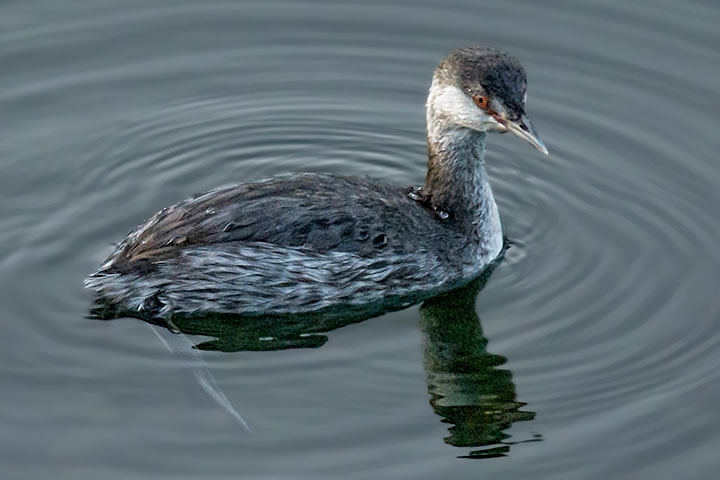
In its winter plumage, a Horned Grebe does not look as grand as when it’s in its breeding plumage.

I enjoyed the contrast between the youth of the juvenile heron and the decrepitude of the ancient dock.

When spooked, many animals face the choice of whether to flee, fight or freeze. This chipmunk froze in the hope that it wouldn’t be noticed. It stayed this way for a while before bolting.

A Kingfisher dived, entered the water on the left, but emerged without a fish.

A juvenile gull is not high on the list of exciting wildlife observations, yet I liked the view of a black-and-white bird seen against the wine-coloured leaves of October’s Red Osier Dogwood.

We think of colourful fall leaves on trees and on the ground, But what about the leaves under water? Here a dipper is probing the creek’s bounty amidst a scene of submerged autumnal leaves.

That a male Shadow Darner was still hunting in mid-October was unexpected.

A Ring-billed Gull coming in for a landing tips back, spreads its tail, and deploys is alulae.

Carmine dominates as the Varied Thrush visits rowan berries.

Posted in birds, mammals | 5 Comments

Swans


We receive welcome visits from swans twice a year when they stop by on their migrations, usually centred on March and November. So, this morning’s visit of some swans was timely. 

But, which of our two species appeared, Tundra or Trumpeter? Although they differ in a number of ways, it is difficult to tell them apart from a distance. That this family of four were Trumpeters was decided by:

  • the heavy bills that lacked yellow lores;
  • the calls they made to one another;
  • the way the neck was kinked when they were in the water.

Four Trumpeter Swans flew westward to Kokanee Creek Park from the Main Lake.

I have seen swans many times, but this was the first time I listened to them calling to one another.

Posted in birds | 3 Comments

Iris’s art


While I could offer an explanation for this morning’s cloud iridescence, instead I am going to give all the credit to its ancient eponym, Iris, the Greek goddess of sky, rainbow, and the messenger of the gods. (Two pictures, below.)

Posted in weather | 4 Comments

Snowberry eaters


What eats snowberries?

Most types of berries are colourful, sweet and juicy, a persuasive combination that prompts birds to eat them and consequently to spread the seeds. In stark contrast, snowberries (waxberries) are white, tasteless and dry. As snowberries are both widespread and common, they have clearly evolved an effective strategy for propagation, but what is it? What eats snowberries and disperses their seeds?

A web search for snowberry eaters produces a list of frugivorous (fruit-eating) birds. There were also suggestions, such as that of Wayne Weber, that snowberries aren’t the preferred food of birds and that most of them probably fall to the ground before they get eaten.

Terry Taylor takes this idea further and argues that: by not being juicy, they avoid the competition of the fall berry season; by not being sweet, they resist mould and so extend seed dispersal into the hungry time of winter; by being white, they are more readily visible on the ground at night where they can be eaten by mammals. He suspects that the seeds are spread primarily by rodents.

Taken together, these nice bits of biological detection suggest that, while birds occasionally eat them, snowberries evolved to appeal primarily to mammals.

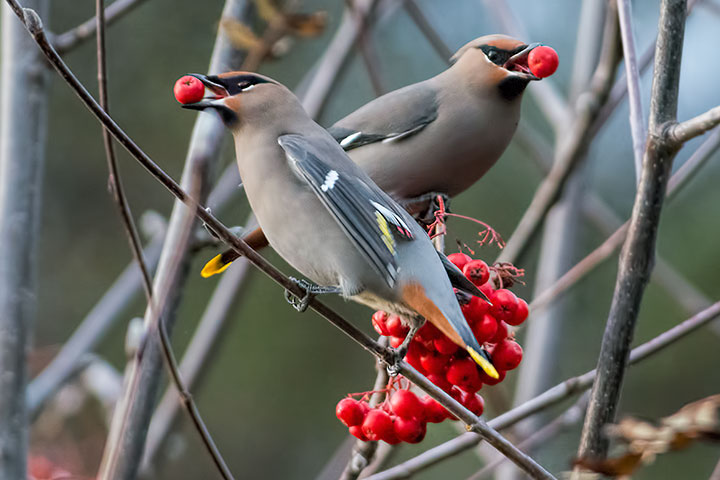
In the fall, most berries compete for the attention of birds by being colourful, sweet and juicy. These rowan berries (mountain ash) have attracted Bohemian Waxwings (November 18, 2014).
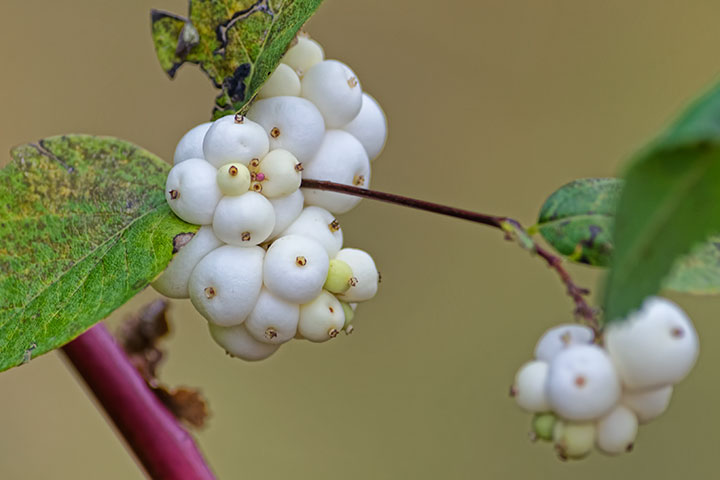
Snowberries avoid the fall competition by being white, tasteless and dry, but they last into the hungry season when they have the stage to themselves (October 18, 2012). Although occasionally birds eat them, I have yet to see this.
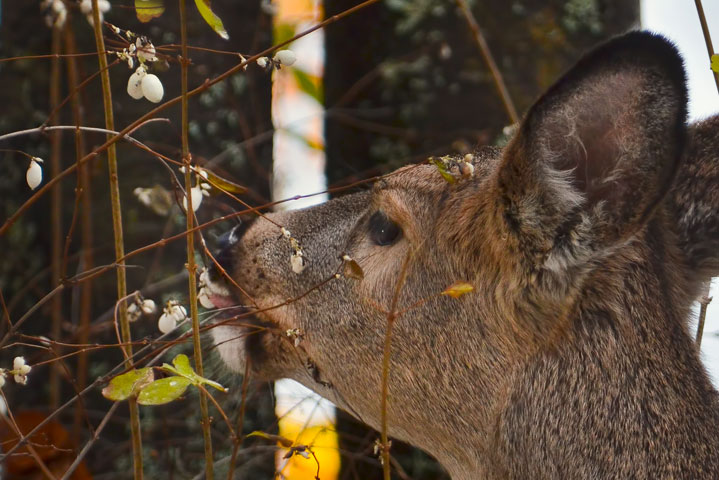
However, I have seen mammals eat them. This is a White-tailed Deer (November 11, 2011).
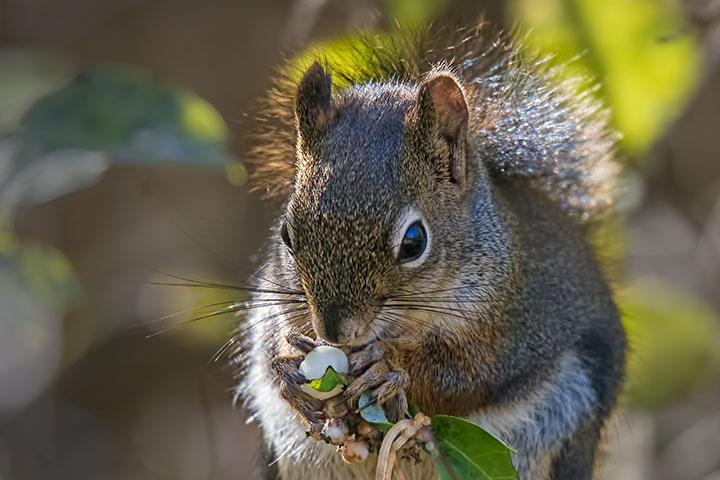
And, here is yestermorn’s observation of a Red Squirrel.
Posted in commentary, mammals, wildflowers | 2 Comments

Altitudinal migrant


When one thinks of the migration of a species, the first thing that comes to mind is one that moves horizontally across the globe. An osprey moves from the Kootenays to Central America for the winter and back here to breed in the summer. Caribou in the Arctic make migrations of thousands of kilometres. Birds and mammals cover vast distances during their seasonal migrations. 

However, in mountainous regions, there is another option: altitudinal migration. Indeed, the local Mountain Caribou don’t travel vast distances horizontally, but do move upslope in the winter (to escape predators) and downslope in the summer. Pygmy Owls spend the winter in the valleys, but the summer at high altitudes. The list of altitudinal migrants is fairly long and includes the Varied Thrush, hummingbirds, various insects, Dark-eyed Juncos, both species of local bears, and coyotes. They can accomplish quickly that which latitudinal migrants take far longer to do.

The attitudinal migrant du jour is the Pacific Wren. In the summer and fall, I have only seen it above a thousand metres or so. In the winter, it is down along the lakeside at under 600 metres.

The Pacific Wren is a secretive bird of the forest. It creeps about near the ground almost unseen beneath dense tangles, but betrays its presence by being delightfully boisterous about it.

Posted in birds | 1 Comment

Haloes


This morning’s haloes, forming over the Lake, might have been expected. After all, a storm is moving towards us and is expected to bring rain overnight and tomorrow. Often such events are presaged by a canopy of cirrus, which is just the thing to give haloes. Yet the sequence of a halo preceding a storm, while common on the Coast, is not all that common around here.

The appearance of these circles, arcs and spots in the sky requires the ice crystals to have simple shapes. The stellar crystals, beloved of shop decorators around Christmas, just don’t do it. Rather, what is needed is either a hexagonal column (somewhat like a wooden pencil with a hexagonal cross section), or a thin slice through that (somewhat like a hexagonal dinner plate). The growth of these shapes results from the small supersaturations that are characteristic of the slowly ascending air found as a storm approaches from the ocean. The more chaotic air motion over the mountains seems to favour higher supersaturations and the more complex crystal forms. 

Sometimes we do see the simple crystal forms in the sky. What was interesting about this morning’s haloes was that they only resulted from columnar crystals, not plates. Which form appears depends not only on the humidity, but also the temperature in the cloud. 

In the scene, below, the 22° halo is the smaller one centred on the Sun. It is formed by quite small crystals that assume a wide range of orientations as a result of the Brownian motion in the air. Sunlight passing through the 60° prisms presented by alternative crystal sides is deviated by a minimum angle of about 22° to give the halo. As the columnar crystals grow larger they become horizontally oriented by aerodynamic forces during their descent. These crystals give the upper tangential arc that appears as the bird wings touching the top of the 22° halo.

At about twice the distance from the Sun as the 22° halo is another one. This is explained by sunlight refracting through the 90° prism ends of columnar crystals. If these crystals were small and assumed a wide range of orientations, they would produce the 46° halo. It is more likely that what we are seeing is the result of larger columnar crystals producing the supralateral tangential arc. 

Be that as it may, the features that would be caused by hexagonal plate crystals — sundogs, circumzenithal arc — are missing. To see a posting with some of these other features, visit celestial splendour.

Posted in weather | 3 Comments