
It is late September and Ospreys are migrating south to locations such as Costa Rica and Venezuela. Ospreys migrate as individuals — not as a flock or even as pairs. Adults depart first leaving juveniles to find their own way, often weeks later. Most of the ospreys around for the next couple of weeks will be juveniles. These are birds that will only return as adults in two or three years. So, now is the time to see the distinctive markings of the juvenile.
Three features distinguish the juvenile from the adult:
• Feathers atop the wing are edged with white. It is imperfectly seen here owing to the oblique view of the top of the left wing. It is more evident in a shot from an earlier year, riveting orange.
• The adult’s eyes are yellowish; the juvenile’s eyes are somewhat orangish.
• The juvenile’s breast is buff, a feature that fades within weeks.
A juvenile Osprey was hanging out in the vicinity of its nest, although its parents seemed to be long gone. In response to a nearby human, an adult would usually fly away, but when this juvenile spotted me walking along the beach, it twice circled close overhead. Maybe it is still exploring the features of its new world.

Falcons are small raptors built for speed. We have two: Merlins and Kestrels. I watched each this last week.
A Merlin was harassed by three Crows. They were merely a nuisance for this highly manoeuvrable killing machine.

After driving off the Crows, the Merlin seemed to assess the photographer as an unworthy target.

Similarly, a Kestrel spent a moment apparently deciding if the photographer were worth eating.

However, if capturing a photographer was not one of the Kestrel’s skills, capturing a vole was.

There was a pleasant consistency in seeing the eponym and its namesake in quick succession. First seen was the Wild Turkey; next was the Turkey Vulture. The vulture was named for the resemblance of its featherless head and dark plumage to those of the turkey.
A flock of Wild Turkeys was foraging in someone’s yard.

Soon afterwards, three Turkey Vultures were seen flying over open fields as they looked for carrion. This is one.
This is another.

In response to an overflight by a Red-tailed Hawk, Red-winged Blackbirds took to the air. My guess is that they did so because a perched bird is an easy target, whereas a small airborne bird is a difficult capture. The smaller bird is more manoeuvrable than the hawk. Seemingly realizing the difficulty, the hawk left the blackbirds alone.

Flying is arduous, particularly for large birds which have less muscle power per unit weight than small birds. However, little birds cannot soar, big birds can.
If any bird stops flapping its wings, it will glide to a lower elevation — unless there is an updraft in the air that counteracts its descent. Then it can stay aloft for hours. After days of rain, some days of sunshine have provided these big birds with thermals. Thermals are large bubbles of buoyant air that rise from the sun-warmed surface. While soaring in a thermal, birds fly in circles so as to stay within the ascending air of the thermal. Below, three birds soar in the thermals of recent days.
Although a passerine, the raven often soars. Its cousin, the crow, only manages it for short stints.

In addition to hunting from a perch, a Red-tailed Hawk often hunts while soaring.

A frequent sight is that of a soaring Bald Eagle. This is a juvenile.

Clear fall mornings are a good time to enjoy the tranquility of ground fog. However, the view from my home is of the Lake rather than of a grassy valley bottom, so I don’t get to see it. Rather, I am more likely to see the frenetic sprites of steam fog. More about this below.
I normally constrain the pictures in this blog to those taken in the vicinity of Kootenay Lake. A picture, rather like the one shown here, could have been taken at either end of the Main Lake, but I am never at those places at the right time. So I am using one taken by Rick Howie near Kamloops, about 300 kilometres to the west.
The fog in this picture is called either radiation fog or ground fog. The first name implies a process (the discussion of which is usually blotched); the second name simply says where it occurs; (and can hardly be faulted).
Condensation
Fog, clouds, dew, and frost all involve the condensation of water vapour to form liquid drops or ice crystals. There are two processes that give rise to condensation: vapour cooling, vapour mixing. Each is distinct (neither is a consequence of the other) and each is well understood.
Typical explanation
A typical explanation of ground (radiation) fog is that offered by Wikipedia in its article on fog.
Radiation fog is formed by the cooling of land after sunset by thermal radiation in calm conditions with clear sky. The cool ground produces condensation in the nearby air by heat conduction.
There are two problems here: 1) The author thinks that the condensation is the result of the cooling of the air (supposedly air is being used as proxy for the vapour); 2) When air is cooled by conduction, it is also dried. Because there is a downward flux of both heat and moisture onto a surface, the result of the described process is dew, not fog. Although superficially compelling, this explanation is physically wrong.
What happens
Notice, when you see such a fog, that it does not actually touch the ground in most places, but appears in layers slightly above it. The formation sequence is as follows:
Finally
Why does my home not afford such a lovely view? It looks out over the a water-filled portion of the valley. Convection in the deeper water does not allow the lake’s surface to cool much overnight. So, when katabatic winds bring cooler air from the mountain slopes, steam fog results. Steam fog is also the result of condensation by vapour mixing, but the air is now warm below and colder above which results in the dancing sprites of fog. It is a delight to watch, but clearly different in appearance from the tranquility of a ground fog.
Ground fog near Kamloops is the result of vapour mixing between the cold air (and vapour) that has drained into the valley and the warmer air (and vapour) just above it. The same thing should be seen at either end of the main portion of Kootenay Lake.
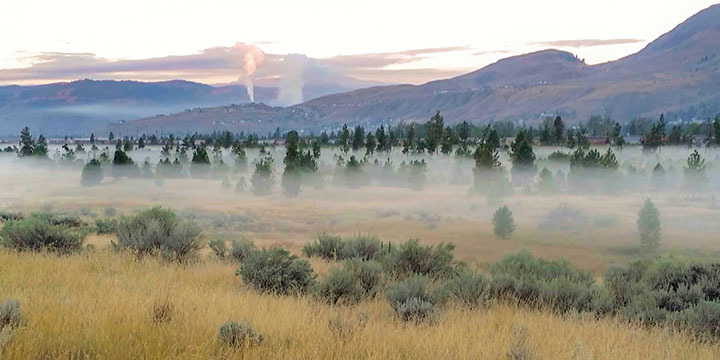
Rick Howie’s picture is used with permission.
So unexpected was the sight of a Northern Harrier at Kokanee Creek Park, that I misidentified it at first. I have occasionally seen harriers at either end of the Main Lake where they hunt small mammals while flying low over grasslands, but much of the West Arm is unsuitable forested habitats. Yet, here was a harrier hunting over the limited grasslands of the Park.
Harriers summer to our north, and winter to our south, so in the fall, these birds pass through our region as they head south, which makes September the best time to see them in the Park. Indeed, this harrier had been reported the day before I saw it. Maybe it will hang around for a few more days.
My first view of the Northern Harrier was of it chasing another bird. At that time, I had not figured out what it was.

It became clear some moments later when it flew close to me,

and a fraction of a second later it flew past.

The Common Loon doesn’t nest on Kootenay Lake. The spring freshet would flood the nests it must make on the edge of the shore. Rather, loons nest on little mountain lakes high above Kootenay Lake. During this nesting time, the bird is territorial and will drive off competitors.
However, when the breeding season is over and they prepare for their migration to the Pacific Coast, loons are social. They gather in (what are called) rafts on those larger lakes that have abundant fish. Kootenay Lake serves them well as they prepare for migration. We can hope to see rafts of loons here for the next month.
A raft of loons swims by as it hunts for fish.

A family of Grizzly Bears has been spotted high in the southern Selkirks. Do you want to see if we can find them? This invitation from Derek Kite did not require a second bidding.
Alongside a dirt road high in the mountains there was a sow and her three cubs.

The sow slowly grazed her way up the slope, eventually vanishing into cloud.
Her cubs followed.
