Yesterday, as I watched a flicker couple excavate yet-another cavity nest on the shore side of a piling, I speculated that there might be an interesting story to be told.
Over the years I had casually been aware that the cavity nests that the Northern Flicker constructed in pilings around Kootenay Lake seemed to follow a pattern: They all seemed to face the shore. But, would my anecdotal observations hold up to the collection of a few more observations? And if they did, what might be motivating the flickers to do this?
Elsewhere, Northern Flickers build their nests in trees, and, as Karen Wiebe noted in a 2001 paper about the flickers at Riske Creek (southwest of Williams Lake, BC), flickers tend to orientate their cavities to the south—apparently to increase the incubation temperature. Yet, that pattern, seen in the Cariboo, did not seem to hold around here.
This morning I did a casual survey of (some easily accessible) pilings around the West Arm of Kootenay Lake looking at shorelines oriented in various directions. Where the shoreline was west of the piling, the cavities faced west; when shoreline was north of the piling, the cavities faced north; when north east, they faced that way. It was the same for south and south east. There was no preferred compass direction, certainly none dictated by the Sun. The shoreline dictated orientation.
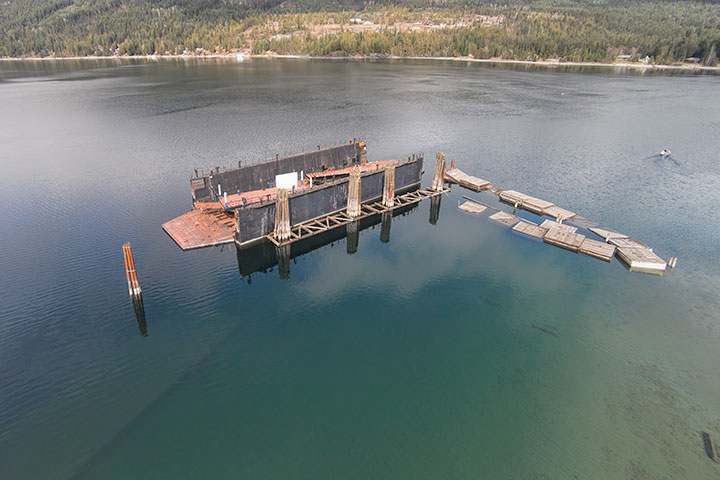
At first, there appeared to be two puzzling exceptions to this pattern: pilings on either side of a narrows (a constriction in the Lake), and those adjacent to a floating drydock. In these cases, cavities appeared on each side of the pilings. Yet, these make sense. If the objective is to face the shore, then in a narrows, there is an ambiguity as to which shoreline is relevant. Some of the cavities on the pilings holding the drydock faced the shore, while others faced the dock. However, from the bird’s point of view, the dock was probably perceived as merely another shore.
Now comes the first speculation: The flicker’s concern is for a land predator. It is better to see one coming and be able to vacate than to have one attack from behind. (An aerial predator could come from any direction, so there is no preferred defence there.)
A second speculation: When flicker chicks fledge, it is better to have them fly towards land than out over water.
But, why does the Kootenay Lake experience differ so much from that of Riske Creek. Possibly because on land, a predator can come from any side so optimization might as well be based merely upon incubation temperature, and a chick can fledge in any direction.
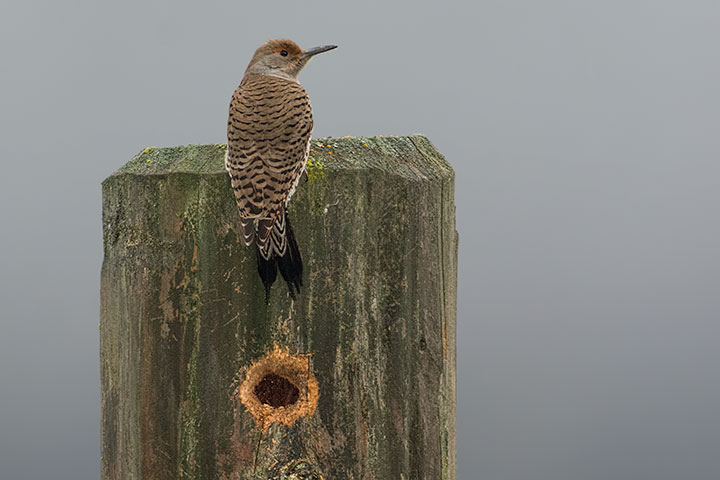
Yesterday’s (female) Northern Flicker. She was building a nest on the north side—the shore side—of a piling.
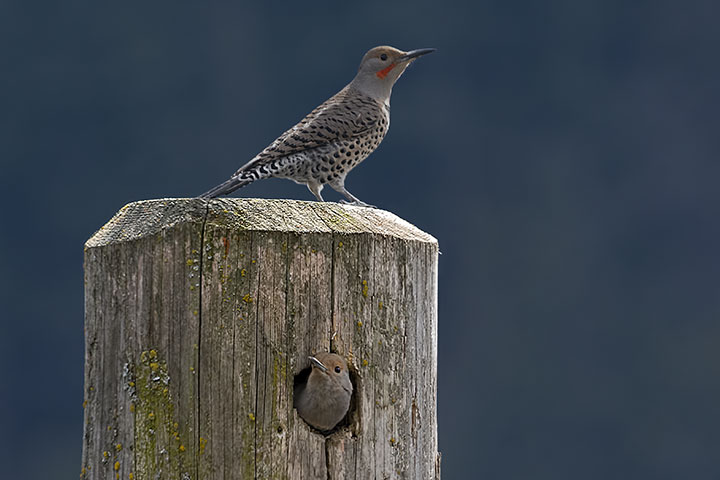
This is a view of last year’s flicker couple checking out a shore-facing nest. In it, they later produced chicks.
The wooden pilings holding this floating drydock contain flicker cavities that face both the shore (to the lower right) and the dock. From the flicker’s point of view, the dock is probably just another shore.


Anniversary bluebirds
Today marks the tenth anniversary of this website. It was launched on March 15th, 2005.
The original, and abiding, objective of the site was neither commercial nor promotional. It was merely a notebook of things learned about my surroundings. Had someone else built such a website, I would have been content to learn from it. No one else did, so I set to work.
Ten years later, the website and its blog receive about seventy-thousand page viewings a year. Most visitors are from Western Canada, but many come from other provinces and lands. Such numbers are small potatoes in the modern world of febrile social media. For me, relative obscurity is good: I am not a populist, but a backwater naturalist consulting his muse.
Yet, a decade does represent a satisfying anniversary for the project. How should it be marked? I thought about a reprise of favourite images, but decided that it would be more fun to just press on.
Fortunately, an observation this last week provided the ideal subject material, the Western Bluebird. (Thank you, Darcy Samulak for showing me where to find it.)
Locally, we encounter two species of the beauteous bluebird. I had seen the Mountain Bluebird other years (Puffed blue, Bluebird of unhappiness), but had not seen the Western Bluebird until last week. Unlike the Mountain, with its powder-blue breast, the Western has an orange breast and shoulders. The male’s colours are bright; the female’s are muted.
What a grand present: an anniversary bluebird.
The male Western Bluebird has a blue head and wings, but an orange breast and shoulders.

He is seen chasing some unsuspecting insect.

The female has muted colours.

She is seen here pouncing on and then wrestling with a larva.

Seen from the back, the male is strikingly ultramarine blue, sometimes with touches of orange.
