Recent birds


This catch up of recent birds is presented in the order they were taken. 

A Cedar Waxwing at Kokanee Creek Park

A Tree Swallow brings an insect to its chick in a nest cavity.
 

A Spotted Sandpiper chick is out foraging on its own along a beach.

A Red-tailed Hawk soars over Fish Lake. 

An Osprey nest with two chicks

One of the Osprey chicks is being fed by its mother.

At first thought to be a Yellow-bellied Sapsucker, this bird is now determined to be a Red-naped Sapsucker. It tried its luck on a utility pole but soon gave up finding sap there.

Posted in birds | 3 Comments

Three mammals


Only two of these I saw; the bear was photographed by Derek Kite.

Snowshoe hares are around, but are not all that common. The three I saw one morning are the first I have seen in nine years. Who knows? This may presage a good hare year.

The antlers of yearling buck are little more than spikes, resulting in the inappropriate name, spikehorn, for both these antlers and the animal itself. This is a mule deer. 

A bear stands on its hind legs to sniff the wind.

Derek Kite’s bear picture is used with permission.

Posted in mammals | 3 Comments

Loon’s nest


Loons do not nest on Kootenay Lake because the springtime changes in water level are so large that a shoreline nest would be flooded. Yet, they do nest nearby on small lakes higher in the mountains, which is where I saw one last year. This year, the nest on that lake was much more distant across the water. I still managed some views, first of loons in waters near me, and then of eggs in the nest.  

 While the loons usually stay far from humans, on this occasion they were close.

This allowed some detailed views.

The nest was not always occupied but, on this occasion, it was.

When the loon was not incubating, two eggs were evident.

This backside view of a loon adjusting the position of its eggs with its bill is the oddest bird picture I have taken.

Posted in birds | 3 Comments

Driven from home


Bird chicks seem to like to be looked after by their parents long after such care is needed.

Last year, I posted pictures of osprey parents coaxing their chicks to go off on their own: It’s time you went. Today, flicker parents seemed to drive off their chick. I am not sure this is what was happening, but for an hour or so, adults were not only blocking access to the nest, but gently easing a fledged chick farther and farther from it.

This picture of a flicker chick in the nest cavity was taken a week ago by my grandson, Finn. The cavity is in a piling at the end of a long ramp to a dock.

This morning, the chick was out of the nest and on the ramp to the dock. For an hour or so, an adult (female, left) blocked repeated attempts by the chick (right) to move towards the nest.

The process of driving the chick off to fend for itself took place on the surface, in the air, and any handy perch. Here, the chick (lower left) is on roof of a nearby gazebo, while a male adult on the finial blocked its ability to fly off—or that is what appeared to be happening. As is evident from the picture, these are Red-shafted Northern Flickers.

Posted in birds | 2 Comments

White rein orchid


This has been an unusually good year for finding wild orchids in Kokanee Creek Provincial Park. 

First came the fairy slipper, then the mountain lady’s slipper, then the spotted coralroot, and yesterday, the fragrant white rein orchid.

There is a shot of much of the plant to the right and a detail below. 


Posted in wildflowers | 1 Comment

Chicks abound


‘Tis the season to see chicks. Here are a few seen over this last week. Of the six pictures shown, three were taken by my visiting nine-year-old grandson, Finn. He took them all when nature watching on his own.

Even after fledging, nuthatch chicks do not know how to feed themselves and continue to be fed by a parent. That the bird on the right is a chick is evident not only by the activity, but also its yellow gape and bill.

Finn found a flicker in a nest. Again, the bill and the lack of colouring on the head show this to be a chick.

This is my shot of a mother Bald Eagle and her two chicks.

When I thought that there wasn’t much point in taking yet another picture of geese, Finn tried anyway and turned up something interesting: a leucistic goose—see the white crown of the female. Two years ago I photographed what is probably the same leucistic goose.

This is my shot of a lonely mallard chick. It was wondering along the shore apparently looking for its mother. It has just picked up a leaf off the lake and promptly ate it.

And Finn’s early morning shot of a merganser mommy and her chicks wins the cuteness award.

Finn Fraser Grathwol’s images are used with permission.

Posted in birds | 2 Comments

Inopportune moment


This the sad story of two horny Spotted Sandpipers and one thuggish Tree Swallow. 

“Hey you idiot, you are at the wrong end. And get your feet outta my face.”  

“OK, I’m ready. Now, go around to the back.”

“Crumb, if you cannot get it right, I’ll turn around. Get on with it.”

“Look swallow, this is a really inopportune moment to visit. You ruined it just when he figured out how to….”

Posted in birds | 1 Comment

Spotted Coralroot


Earlier this month, an acquaintance told me where he had found a spotted coralroot in Kokanee Creek Provincial Park. I had not yet seen this wild orchid and so followed his directions carefully. It had vanished and repeated searches turned up nothing.

Nothing, that is, until today when at a different location in the park, I was showing my nine-year-old grandson a mountain lady’s slipper and he spotted another “pretty flower.” It was the first of four spotted-coralroot plants he found.

Here are two views of the seventh local wild orchid I have managed to photograph.

Posted in wildflowers | Comments Off on Spotted Coralroot

Rainbow notes


I found yesterday’s rainbow picture to be so delicious that it had to be savoured alone: it was the nicest shot I have managed of a semicircular bow replete with its reflection in the calm waters of the Lake. 

Yet, during the half-hour I watched the rainbow, features shifted as the shower moved along the Lake and the lighting changed. There was much to see. 

The colours of the rainbow blend continuously one into another. The crayon-box claim that there are seven colours in the bow is silly: the standard mnemonic, Roy G. Biv (red, orange, yellow, green, indigo, violet) merely gives the order of colours that may or may not be seen, but which are certainly not discrete. Other striking features seen here are that red is on the outside of the curve (not on the inside as much commercial art suggests), and it is brighter inside the bow than outside.

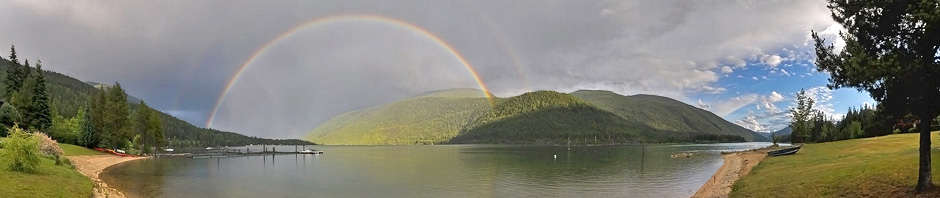
There is a much to discover in the next scene: bright central disk, anticrepuscular rays forming radii to the bow, a larger secondary bow with red on the inside, faint supernumerary bows on the inside of the primary bow, and colours improving as the bow becomes nearly vertical. A particular feature might not be evident in every rainbow, but as one watches the bow evolve, each is worth descrying. The fact that these characteristics are well understood only enhances the grandeur of the event.

Posted in weather | 6 Comments

Sunset shower


Posted in weather | 3 Comments