Birds plus


Herein are a few birds seen in the last few days, plus one mammal.

What I thought was a White-throated Sparrow is actually a Savannah Sparrow. 

Rough-winged Swallows are determined to evict a Kingfisher from its nesting cavity and have it for themselves.

A Spotted Sandpiper wanders along the lakeshore looking for things to eat.

A juvenile Bald Eagle paid me a visit.

And I found a new eagle’s nest along the shore that will be fun to watch when the chicks emerge.

The Black-chinned Hummingbird has arrived at the Lake.

And a Columbian Ground Squirrel has planted itself in the middle of a human’s trail.

Posted in birds, mammals | 3 Comments

Blue-winged Teal


The Blue-winged Teal is typically only seen around the Lake in the late spring as it migrates north to breed. Two visited this morning.

As one watches the Blue-winged Teal swim by, it is easy to wonder about its name: Where is the blue wing? Certainly, the white facial patch is striking, but otherwise it seems merely a rather small speckled duck.  

However, when these ducks fly, the powder-blue wing patches, after which they are named, become apparent. Here the ducks are lifting off from the Lake amidst a shower of splashed drops.

Posted in birds | 1 Comment

Horned Grebe


It is a remarkable transformation: a Horned Grebe goes from its plain non-breeding plumage of the wintertime to its spectacular breeding plumage of the summertime.

The Horned Grebe is common around Kootenay Lake throughout the winter, so it is often seen in its non-breeding plumage. This first image was taken a couple of years ago. Note the red eye and the white spot on the tip of its bill.

The Horned Grebe migrates northward in the summer so that its breeding plumage is only occasionally seen around here. Yet, early this morning, two of them swam by. The red eye and white spot remain, but otherwise….

While the designation, horned, seems odd during the winter, this summer view from behind makes it understandable.

Posted in birds | Comments Off on Horned Grebe

Mother’s Day


A dozen pictures of local families serve to mark Mother’s Day. They are from my personal archives and were taken at various times through the year.

A Bald Eagle watches over its chick in the nest.

Goslings are well protected by their parents.

A Raccoon mother instructs her kits on foraging techniques.
A Barn Swallow serves breakfast.

A Spotted Sandpiper father broods his chicks.

A White-tailed doe and her fawn forage together.

Mother Merganser introduces her chicks to the world.

A Northern Flicker chick begs its mother for food.

Otters pose for a midwinter family portrait.

Nuthatch chicks compete for food from a parent.

Mother osprey (second from left) poses with her three chicks before they separate during migration.

A Grizzly bear mother teaches her cubs about foraging.

Posted in birds, mammals | 2 Comments

Fairy slippers


May is the month to see fairy slippers (Calypso bulbosa). This orchid is perhaps the loveliest of our wildflowers.

Five of many fairy slippers bloom on a sun-warmed forest slope. Here are three views.

Posted in wildflowers | 6 Comments

Western toad


Yesterday, while I waited for the Harlequin Ducks to make an appearance, I sat on a rock by Kokanee Creek and watched a Western Toad. It is one of three local frogs, the others being the Columbia Spotted Frog and the Pacific Tree Frog. (A toad is actually a frog, but a particularly warty one.)

Adult western toads are characterized by a thin, cream coloured stripe down the centre of the back.

They have stocky bodies with short legs and tend to crawl rather than hop.

If you are an insect, now is not the time to wander by.

Posted in herptiles | 5 Comments

Kokanee Harlequins


Before this morning, I had not seen Harlequin Ducks on Kokanee Creek. The only local venue had been the Salmo River, where one could see them from the road joining the West and South Arms of Kootenay Lake.

I would have missed them on Kokanee Creek this morning if it hadn’t been for Joanne Siderius who alerted me and posted the first pictures to her blog. The last observation I know of these ducks in the Park was seventeen years ago. 

Duck royalty has arrived in Kokanee Park in the form of a pair of Harlequin Ducks—aptly named, Histrionicus histrionicus—apparently a name chosen to reflect their courtship display.

As is usual with water fowl, the male’s plumage is spectacular,

while the female’s plumage is muted.

This is likely a mating pair, but since this bird nests on the ground, and the trail alongside the creek is well travelled by dogs, I fear for the safety of what may be the first-ever Harlequin chicks in the Park.

In the meantime, it is clear that the local dippers have a new competitor for the creek’s resources.

Posted in birds | 5 Comments

Squirrel breakfast


Sometimes the story, the composition, and the lighting just come together.

A Red Squirrel starts its day by eating a Douglasfir cone.

Posted in mammals | 1 Comment

Rip


A rip is stretch of fast-flowing and rough water.

Much confusion arises from that simple definition:

  • In the public’s mind, the only rip is the particular one that is often called a rip current, but, given its provenance, really should really be called a beach rip. A beach rip is the strong narrow current that moves offshore as a concentrated flow. It is generated by the return flow of waves breaking on a beach. While on ocean shores, it is viewed as a danger to swimmers, it isn’t of much concern on our lake.
  • Then there is something called a rip tide which is an oceanographic term for a strong tidal flow through a constriction. There are no tides on our lake. (There is some confusion evinced by websites that assume that a rip tide is a misnomer for a rip current—it isn’t.)

While neither of these would seem to have much applicability to Kootenay Lake, we do have rips, and they behave in a similar manner to the oceanographer’s rip tide.

The residency time for water on the West Arm of Kootenay Lake is three to four days, which means that this is the average time it takes water to travel westward along the arm from Balfour to Nelson. This corresponds to an average westerly drift of a stately third of a kilometre an hour. A feature of this arm is that it is occasionally constricted by creek deltas to produce what are known as the narrows. Through these, the flow is more like that of a river than a lake. So, while not being driven by a tide, the flow can reach the magnitude of the oceanographer’s rip tide. 

However, a rip involves more than a fast current: it requires the water to be rough. For that we need the interesting aspect of wave behaviour that occurs when waves move in the opposite direction of the current.

Start with a brisk westerly wind in one of the lakelets between the narrows. The wind causes waves to propagate against the easterly current, but in the broad lakelet, the current is light and this is of little account. However, if the current moving against the waves is greater than the speed at which the waves are moving, the waves are brought to a stop. Consequently, waves may not be able to enter the narrows with its faster current.

What is particularly interesting is what happens as the waves move towards the progressively faster counter current in the narrows. As waves approach the narrows and the current increases, the wavelength shortens and the wave amplitude increases: the waters become quite rough.

When there is a west wind, the western entrance of the narrows has not only a strong current but really rough water. This is the rip. However, within the narrows where the waves generated in the lakelet haven’t been able to penetrate, it is much calmer and the current is strong.

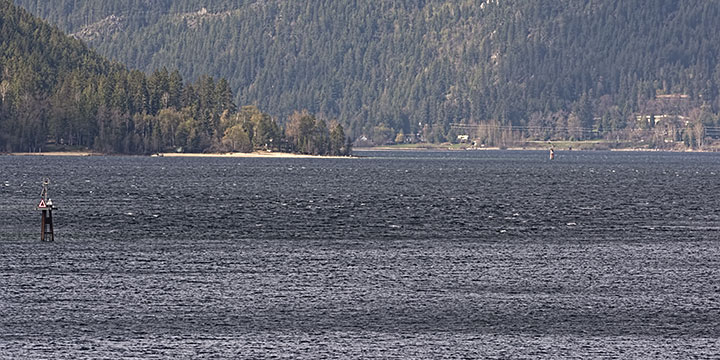
Here is a view looking west though the Nine-mile Narrows. The nine-mile dolphin is on the left and the distant seven-mile dolphin is on the right. There is a west wind (out of picture) that is building waves in the lakelet between them. But, as the waves approach the narrows, the water becomes quite rough: this is the rip. Closer, at the bottom of the picture, the water in the narrows is much calmer. (The darker water near the bottom of the picture is a cat’s paw print.)
Posted in weather | 1 Comment

First day out


This is the first day out into a scary world.  So it was that three goslings attempted to follow mummy on a walk.

“Yikes, this is scary stuff.”

“Maybe another day…. For now, I’m out of here.”

Posted in birds | 2 Comments