Rufous glow


It is an embarrassment of riches: having to choose whether May postings begin with grizzlies or hummingbirds. Grizzlies won. Even though hummingbirds had appeared on the last day of April, I did not manage acceptable pictures of them until May 2nd. Now we have the rufous.

Who can fail to admire the Rufous Hummingbird? It is an amazingly beautiful and feisty little bird.

A male Rufous Hummingbird with a glowing gorget perches on a branch.

It flies off to sip nectar.

Many pictures are taken before one is obtained that shows the whole gorget glowing.

Posted in birds | 3 Comments

Grizzly trail


Everyone appreciates a good road. Early roads often followed animal trails; now, animals often follow our roads.

Here, three Grizzly Bear cubs wander up a mountain road above Nelson. The picture is courtesy of Doug Thorburn. When he took the picture of the Dusky Grouse, he was actually hoping to spot some grizzlies. On May 1st, he saw these three lumbering ahead of his vehicle. 

Doug Thorburn’s image is used with permission.

Posted in mammals | 2 Comments

Dusky Grouse


I have never seen a Dusky Grouse. Doug Thorburn has and he sent me these pictures of a male displaying on the mountain slopes above Nelson last Sunday. It is a sight that rivals the display of the Wild Turkey

This is the male doing his song and dance to impress a female. At the moment he is showing a red eyebrow.

Moments later, his eyebrows are yellow—a fine transition.

This female is the object of his affection.

How could she ever resist such a visage?

Doug Thorburn’s images are used with permission. 

Posted in birds | 3 Comments

From wren to hair gel


These are the more interesting birds that were seen on two walks in Kokanee Creek Park. 

As the Marsh Wren nests in wetlands, it is an infrequent visitor to this well drained region. It prefers to stay hidden.

Twice, I inadvertently flushed Wood Ducks, so the best I could manage was a picture of them flying off.

Townsend’s Solitaires were hanging around the campgrounds.

While walking past a pond, I found myself within metres of a female Hooded Merganser that had her crest raised. The male was nowhere to be seen, but she obligingly posed.

Possibly it is time that she cut back on the use of hair gel.

Posted in birds | 3 Comments

Congeners


No, the Lake has not been invaded by giant eels; that is the conger. I am discussing congeners: species that share a genus. The genus of interest here is the Odocoileus, what most people refer to as deer. 

We have two species of this genus around the Lake: white-tailed deer, and mule deer. A rule of thumb is that the mule deer occupies the mountain slopes and the white-tailed, the valley floor. The one I see frequently (often in my yard) is the white-tailed. Less often do I spot a mule deer.

Early last Friday morning, I saw both species within five minutes. They are congeners: the white-tailed deer (Odocoileus virginianus) is found across most of the continent while the mule deer (Odocoileus hemionus) is a western species. That their ranges overlap in southeastern B.C. is clear from Friday morning’s pictures.

The white-tailed deer has smallish ears and large tail, the underside of which is white (for which it is named).

 The mule deer has largish ears (for which it is named) and a rope-like tail with a black end.

Posted in mammals | 2 Comments

Wood Duck visit


“The Wood Duck is one of the most stunningly pretty of all waterfowl,” is the plausible claim of Cornell’s All About Birds website. The trouble with this bonny bird is that it normally hangs out in marshes and is wary of being approached. My sightings have usually involved bushwhacking and gumboots. Yet, for the last three days, Wood Ducks have visited me. 

Although it was the third time these two couples had come by, this was the first time they didn’t flush before I could take pictures. This time, the ducks seemed unaware that I was standing nearby in the rain and low light of dawn.

They even came ashore in front of me,

and wandered about,

before heading farther along the lakeshore.

Posted in birds | 2 Comments

Sleeping heron


In the spring, I watch some tall trees overlooking a local campground because they often play host to Merlins. However, this small falcon finds the spot interesting only when the field below is filled with delicious little birds, and today, predation was on hold. The only thing I could see high in those trees was a heron, and it seemed oblivious to its surroundings.

Posted in birds | Comments Off on Sleeping heron

Lupin lustre


A lupin is a member of the pea family. When it emerges in the spring, its leaves can form a cup that can hold rain water. The collected rain can form a lens to reveal, or obscure, the intricacies of the leaves.

Lupins have collected rainwater on their leaves; some water has rolled to the centre and formed lenses.

A water lens magnifies details of the structure of the lupin’s leaves,

and reveals the intricacies of hidden patterns.

Posted in wildflowers | 3 Comments

Bombylius major


This is the season for viewing a Bombylius fly. Last year’s posting about this bee-mimic fly was also made mid-April. This year’s images are strikingly similar, same species, same dried grass, same flowers. The difference is that I now know a little bit more about this flying ball of fuzz.

This year, I am fairly confident that the fly shown here is a Bombylius major, a species found throughout North America and Eurasia. That it mimics bees is, of course, a tactic to avoid being eaten by birds (and wasps?) as it goes about sipping nectar from flowers.

It only appears in the spring because that is the time solitary bees temporarily leave their nest sites unprotected. Unlike the social bees, each solitary bee lays her own eggs and does so in a small tunnel she has provisioned with food such as nectar and pollen. She then seals the entrance. However, for the short time it takes to do this, the tunnel entrance is open and that is when the Bombylius fly comes by and deposits its own eggs inside. The Bombylius larva emerges, feeds on the provisions meant for the bee larvae; it then changes form and eats the bee larva, itself. Bombylius has only a short time in the spring to give its offspring this opportunity.

This Bombylius major may be warming itself in the sunlight. The picture shows the fly’s particularly long proboscis and legs. The usefulness of these will be seen in the last picture.
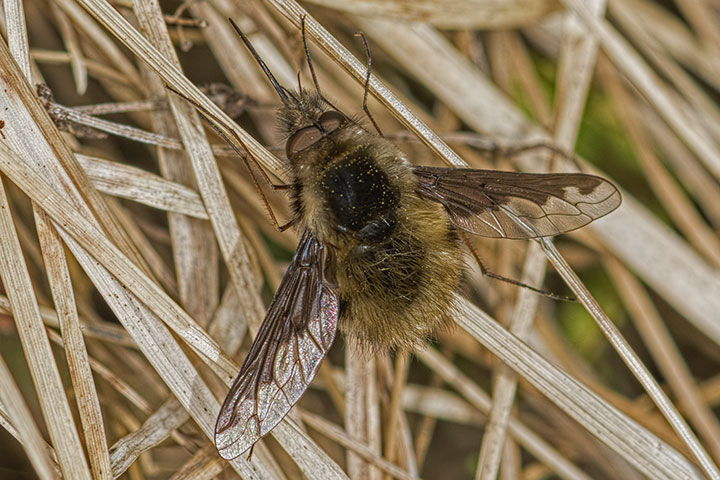
The adult fly lives off nectar.
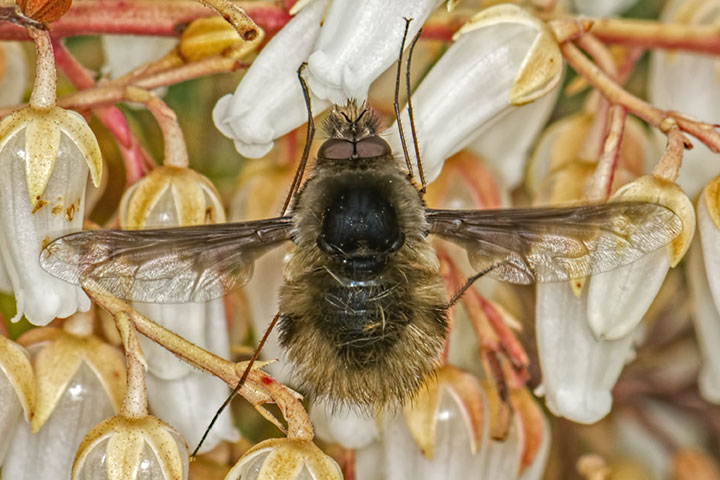
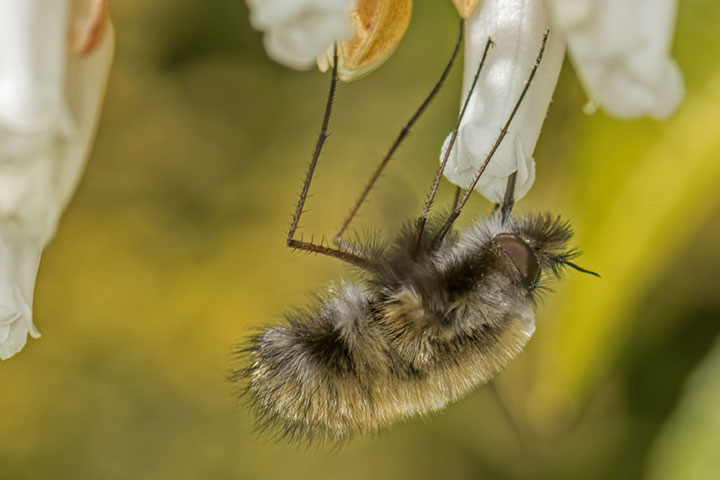
Often this fly does not land on the flower, but hovers adjacent to it (here, its wings are blurred by hovering). Its long proboscis enables it to sip nectar and it merely stabilizes itself with its long legs. Not actually landing on the flower is probably a defensive tactic against crab spiders that pounce on flies that do land.
Posted in bugs | 2 Comments

Pole dancer


Red-tailed Hawks have been plentiful this spring. This has increased the demand for voles, which in turn, has driven up the cost of living. Could this be the reason some local birds have resorted to pole dancing?

Posted in birds | 6 Comments