Coyote: A bird in the mouth is worth two in the bush.
What a playful animal is the marmot: Yesterday, I watched two of them playing tag. Apparently, the bigger (male) marmot was it, and was attempting to tag the smaller (female) marmot.
The two of them coursed back and forth over the rocky field.
They twisted and turned as he attempted to make her it.
The chase ended behind some rocks that afforded a poor view, but it seems that in the marmot version of the game, tagging involves mounting and thrusting.
We have all seen a dog climb out of a lake and vigorously shake off water. Yesterday morning, I watched a dipper seemingly do the same thing: having gotten wet, it vigorously spun back and forth rather as does a dog. Was it really doing the same thing?
Initially, the dipper would stick its head underwater while it foraged for food on the stream bottom.
When it brought its head up, it would vigorously spin it in much the same manner as would a dog. Was it trying to shake off water? There was something really odd about what was going on. 
First, even when the dipper would go underwater completely, upon surfacing it would still only spin its head. Second, unlike a dog, which has wettable fur from which the water must be removed, the dipper has non-wettable feathers upon which water merely beads and rolls off. The dipper has no need to shake off water.
The explanation for why the dipper was shaking is far more interesting. The bird had been hunting one of its favourite foods: caddisfly larvae. A caddisfly larva attempts to avoid such predation by covering itself with an intricate protective case made of found materials (each casing is slightly different). Once a larva is captured, the first thing the dipper does is to squeeze the casing until the larva starts to emerge.
The dipper now grabs the larva, itself, and shakes it until the casing flies off, at which point, the larva is toast. And so it goes, larva after larva. Shaking does not remove water; shaking removes larva casings.
Today, March 31st, I saw my first butterfly of the year: a comma. Can someone tell me which one it is?

Some postings tell a story or develop an theme: sound of orange; halo presages rain; goose raspberry; uncinus; frost flowers bloom….
But, sometimes I merely record a collage. This is one such: a collection of birds seen in the proceeding few days.
Bald Eagles are with us year round; this is a juvenile.
The iridescent feathers on the male Bufflehead Duck are not always so evident as here
Get your ducks in a row, in this case, three Ring-necked Ducks.
A heron hunting in the shallows is a study in nonchalance.
Western Grebes are most common on the Lake in the fall, but here are three of a dozen seen this week.
The Red-winged Blackbird is back in the marshes.
Hooded Mergansers are pairing up.
As are the Wood Ducks.
My resident Ruffed Grouse still hunts in my yard.
Other than a flicker, this downy is the first woodpecker I have seen this year.
This has been a good winter for the Varied Thrush, and now numbers are increasing through migration.
In silhouette, the Varied Thrush looks like its cousin, the American Robin (also a thrush), but they differ in several ways. While the robin is red, bold, and tuneful; the Varied Thrush is orange, elusive and, well, herein lies a problem. Just what is the sound made by this orange bird?
Owing to the bird being elusive, the song of the Varied Thrush is often its only evidence. So, the sound is worth recognizing. Fortunately, there are many recordings available; An example is offered by birdsource.org.
The National Geographic describes this sound as a “series of long, eerie whistles of 1 pitch”. Alas, it is not a single pitch. Although sometimes a rapid trill, it is usually a chord. (The Varied Thrush is not the only bird capable of singing two notes at once.)
Some websites acknowledge that the Varied Thrush does indeed sing a chord. Critters360 offers the “fact” that, “its tone is an F minor”. Hugh Griffith (a BC zoologist) is not quite as specific when he says that it sings, “a disjointed series of randomly, or absent-mindedly selected minor chords.” What they agree upon is that the bird sings a minor chord.
Both sites employ the language of music. However, a minor third is composed of two notes separated by three semitones, and to a musician’s ear, the notes of the thrush’s chord are within a tone (two semitones). The thrush’s chord is certainly distinctive, but its dissonance is not that of a minor chord.
The sound is eerie: a haunting sound of the early morning forest.
Despite the bird’s elusiveness, these pictures were taken this morning.
The female Varied Thrush is a pale orange with a greyish breast band.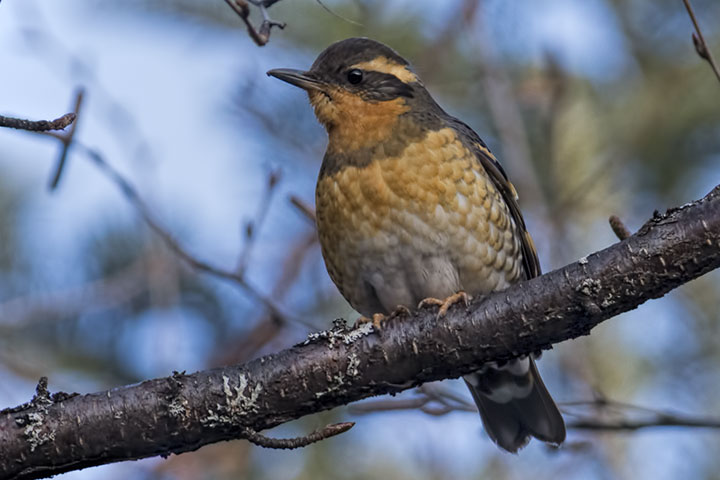
The male Varied Thrush is a brighter orange with a black breast band.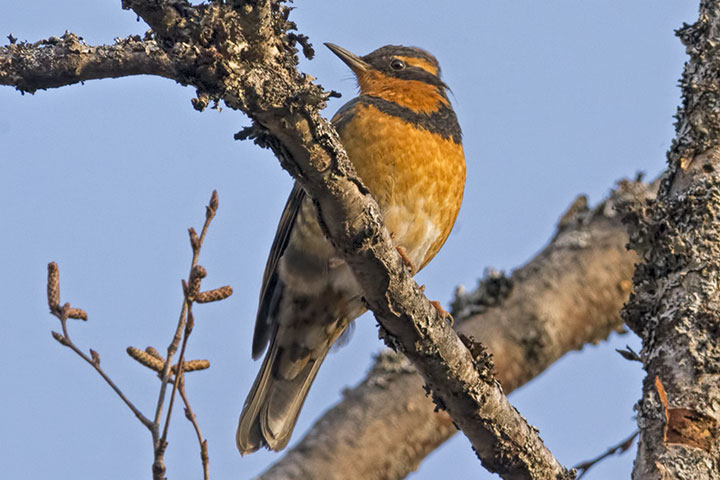
Normally, months will go by without my noticing a single Ruffed Grouse. Today, I saw two. They were three kilometres apart (as the grouse flies).
The first grouse to be seen was, to my mind, comical. It moved at the grouse’s stately pace. Normally, this allows it to move inconspicuously through brush. Alas, the tactic did it no good as it moved across a snow field.
The second grouse was the same female shown in replacement grouse and stealthy birds. Now, she appears to be sitting on a nest. This looks promising. 
Sometimes March 20th or 21st is proclaimed as the official first day of spring. This, of course, is nonsense: no officials have ever proclaimed this—and why would they? Further, the idea is silly: spring arrives slowly and at a different time in Rossland than in Creston. The dates mark the spring equinox, an astronomical event that may or may not correspond to a useful local meteorological transition.
Yet, at roughly this time of year (as distinct from on this particular date) there is a gradual transition to springtime. Here are a few birds seen over the last few days that speak to this change.
For a week or so, I have been treated to the song of the Varied Thrush, but spotting one of these skittish birds, let alone photographing one, proved difficult until this morning. This bird might well be passing through the region to breed farther north.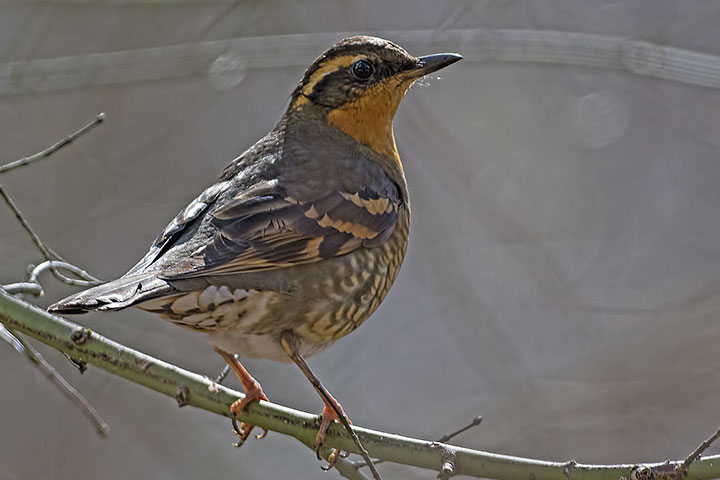
Similarly, this soaring Red-tailed Hawk might stay around here, but is more likely to head farther north to breed.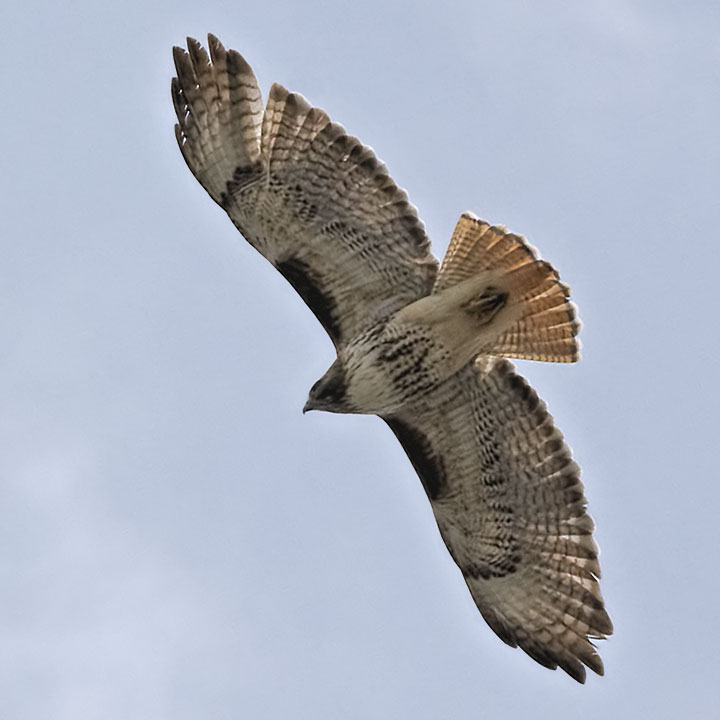
The Hooded Mergansers are likely to stay around and breed. The male is on the left.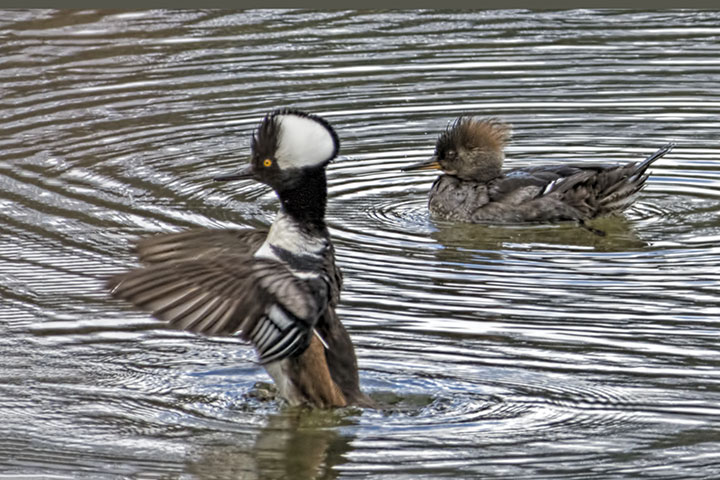
This Northern Flicker couple is clearly planning for chicks. Last year, flickers carved a cavity in this piling, but did not nest there. Maybe this year, they will. 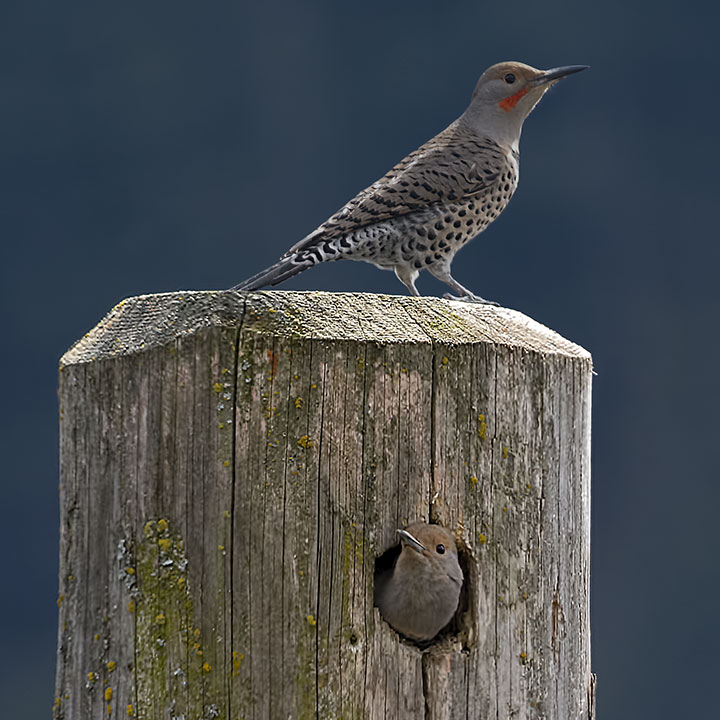
In last two days, I have watched two remarkably stealthy birds. These are not the frenetic little scaredy-cats that flit from branch to branch. These are the largish birds that move in a stately, even lethargic, manner. The two I watched were a Ruffed Grouse and a Great Blue Heron. Now, I suspect that the reasons for their measured paces differ. The grouse is probably trying to blend in so as to not attract predators; the heron is trying to blend in so as to avoid being spotted by its prey.
A Ruffed Grouse remains inconspicuous by moving slowly. However, against snow, it just cannot blend in.
When it moves into more salubrious surroundings, it can almost vanish, especially when seen from a distance. This appears to be the same female that was reported a month ago in replacement grouse.
The heron was observed to move even more slowly. It did move along the shallows, but would pause for long periods and slowly look around (presumably for fish).
On a few occasions, I obtained a view that might correspond to the last thing a fish, or a vole might see.
When Derek Kite recently posted some shots of a muskrat grooming, I was alerted to the possibility of sighting one of these large semi-aquatic voles myself (it is not a rat).
Today, from behind some shoreline rocks, small waves spread across otherwise calm water. Now, what could be causing that? I watched and waited; the waves stopped; all remained calm for nearly ten minutes. But then, success: a muskrat appeared.
