Halo presages rain


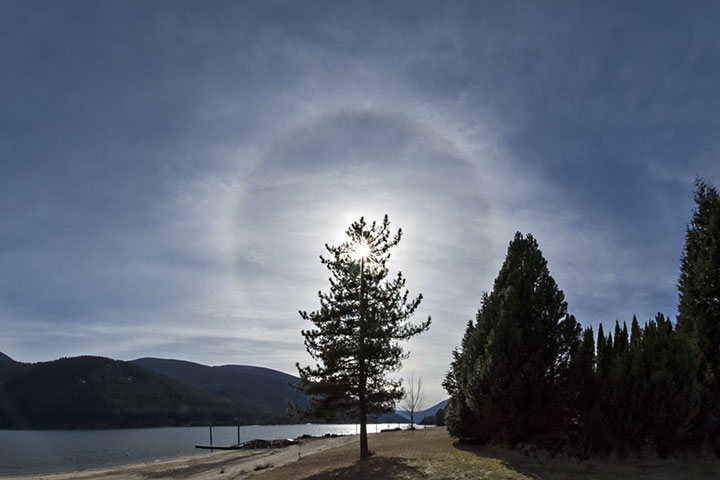
Yesterday, there was a halo around the Sun; this morning, the rain (or snow) began. These events were related.

The earliest sign of an approaching mid-latitude storm is often a canopy of cirrus—a veil of ice crystals. While simple hexagonal ice crystals will produce a 22° halo, there are many forms of ice crystals and the requisite shape for halo production might not be present. Further complicating the relationship between haloes and storms is the fact that other types of weather can also produce a halo. Alas, it is neither true that a storm is always presaged by a halo, nor that a halo is only associated with a storm.

Yet, a storm is preceded by a halo sufficiently often that the link between the two has become a part of weather lore. 

Yesterday’s 22° halo presaged today’s rain.

Posted in weather | 3 Comments

March marmot


This is the third year in a row I have used the title: march marmot. But, this is the earliest date, by nearly two weeks. Maybe it is the particularly warm mid March; maybe it is the happenstance of when I look. Yet, today I saw a Yellow-bellied Marmot sunning itself on a bank overlooking an ice-covered bay. The marmot season around the Lake has begun.

Posted in mammals | 2 Comments

Spring cleaning


Two very different species visited today, and each set about doing a bit of spring cleaning. 

First to come by were three deer: a doe and two fawns. This is the mother and a fawn who always stuck close by her. They kept an eye on me but did not seem concerned.

The second fawn couldn’t care less about my watching and set about doing a bit of washing up.

Then an eagle came by and set to preening.

At one point it stared at me and blinked (its nictitating membranes). This produced one of the oddest images I have ever taken: an eagle who turned a glass eye on me.


Posted in birds, mammals | 7 Comments

Muskrat grooming


This muskrat was eating some water milfoil fetched from the bottom of the channel. Saving some for later perhaps?
20140306_0380

Some grooming.
20140306_0433 20140306_0443

Much better.
20140306_0464

Posted in mammals | 4 Comments

Goose raspberry


Maybe it was the warmer weather; maybe it was the switch from snow to rain; maybe it was the longer daylight; but, the testosterone in local ganders was clearly soaring.

Spring is the only time of the year when ganders play king of the castle by landing on top of pilings, there to vociferously and combatively proclaim virility. 

While a female watched from the water below, a male loudly proclaimed his mating rights.

However, by not watching his back, he was quickly dislodge by a rival.

The new suitor then offered the first gander what can only be described as a raspberry.

He then flew down to the Lake and went off with the (clearly impressed) female.
 

Posted in birds | 3 Comments

Five-o’clock coyote


Some animals have rather regular habits: Birds turn up at the feeder about the same time each morning; I have seen a beaver swim by at about the same time each evening. 

For the second day in a row, a coyote has wandered along the snow-covered shore at about 5 pm. The light was failing and the coyote was distant, but this time I managed a picture. It looked back at me as if to say: I know you are watching.

 The five-o’clock coyote

Posted in mammals | 6 Comments

Uncinus


Uncinus is Latin for hooked and when applied to cirrus—itself Latin for a lock of hair—it nicely characterizes the cloud, below: formally, it is cirrus uncinus. A familiar name for these clouds is fallstreaks, for they are streaks of ice crystals falling from a cloud, one which was originally made of water drops. 

The reason ice crystals fall from a parent cloud of water drops was discussed last October in a posting called fallstreaks. In the picture shown at that time, the crystals fell, more or less, straight down because the wind through which the crystals fell did not change much with height. Under circumstances when they don’t fall straight down, they often take a parabolic path, a shape that looks like a hook, thus, the name, uncinus. Why does cirrus so often assume a parabolic shape?

Curiously, the reason for the parabolic shape of uncinus is quite easy to account for using simple calculus, but is quite difficult to explain using simple English. This is just one of many situations where natural language falls short. Natural language often presents a view through a glass, darkly, under conditions that mathematics shows things face to face. Despite language limitations, here is an inevitably flawed attempt.

The ice crystals are all falling at roughly the same terminal velocity, but they fall though a wind that changes with height at a constant rate. Such a wind variation is common. One might expect that the streaks would take the same shape as this linear wind profile and so appear as a sloping straight line. This does not happen.

The problem is that each crystal falls through a succession of different winds and so its path is the cumulative effect of an acceleration from each level above it. The result is a streak with a parabolic shape. Of course, to the mathematically inclined, this is trivial: the integral of a linear function is a quadratic. (Another example of this behaviour is the parabolic path of a ballistic projectile, where the constant acceleration is not applied by a wind changing uniformly with height, but by gravity).

Often, the wind in the atmosphere changes at a constant rate with height. When ice crystals fall through such an atmosphere, the streaks are parabolic in shape. They look like a hooked lock of hair: cirrus uncinus.

Posted in weather | 8 Comments

Swan dance


To say that these Trumpeter Swans were dancing is clearly anthropomorphizing. Yet, while I have watched individual swans stretch their wings in this way, this was the first time I have watched a group of them gyrating as if they were on the dance floor at a bar.

“Let’s party ’till we drop.”

Posted in birds | Comments Off on Swan dance

Frost flowers bloom


Frost flowers (aka, ice flowers) seen five years ago at this time of year.

I last saw frost flowers bloom along the shore of Kootenay Lake five years ago. Since then, watching for these delights has been rather like searching for a rarely blooming wild orchid.

Frost flowers bloom under a rather narrow range of conditions, live for a few hours, and are gone. Abruptly last Saturday morning, beds of frost flowers sprang up along the lakeshore.

Most types of frost result when water vapour condenses onto a cold surface and so they form a more-or-less continuous blanket (see surface hoar). Contrastingly, frost flowers result from vapour mixing just above a surface that is (relatively) warm, and they bloom as discrete blossoms.

On Saturday, the air temperature was about -6C, but near the shore, portions of the beach were wet from sun-warmed seepage. Such conditions will produce steam fog if the humidity is high enough. However, ice crystals can form at a lower humidity than that needed for water drops, and on Saturday, there were only frost flowers.

The sparse distribution of frost flowers is reminiscent of wild flowers in a meadow. While, normal frost blankets a cold surface, frost flowers are discrete blossoms on a (relatively) warm surface.
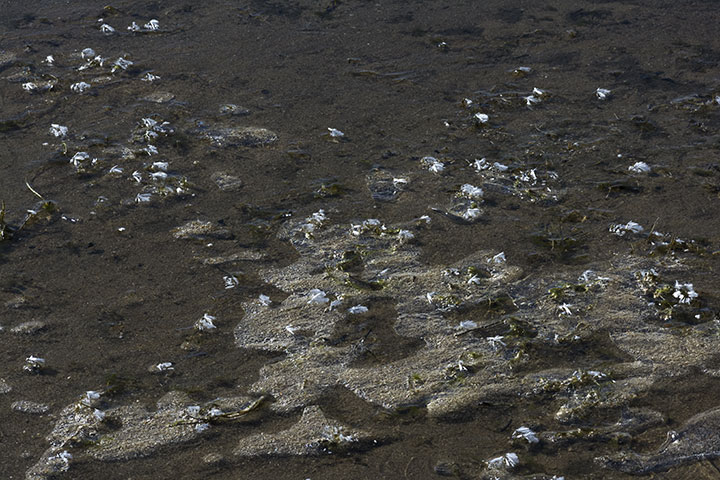
Some botanical flowers are heliotropic: they face the Sun. Frost flowers are anemotropic: they face into the flow of air—or more to the point, the flow of vapour. These frost flowers point upslope (away from the Lake) and into a barely detectible katabatic drift of air (flowing towards the Lake) bringing the vapour that feeds flower growth.
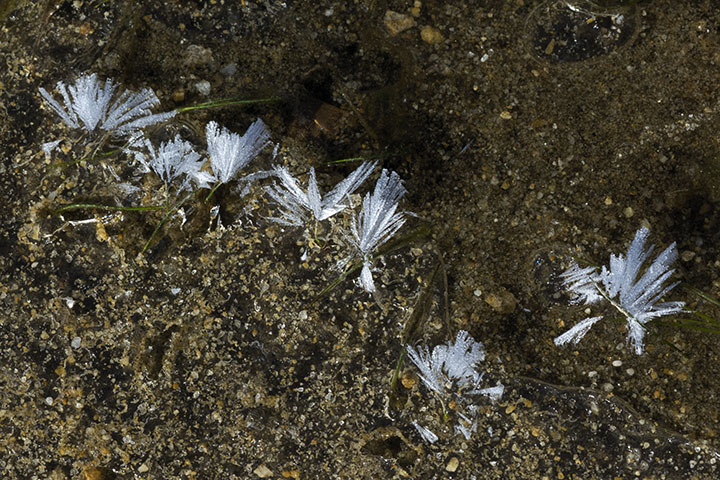
Regular frost covers the surface with a blanket of crystals because the condensation is directly onto that surface. Frost flowers form slightly above a warm moist surface in a thin layer where warm and cold vapour mix. The frost must form onto objects that stick up into that layer and in this picture, those objects seem to be tiny twigs.
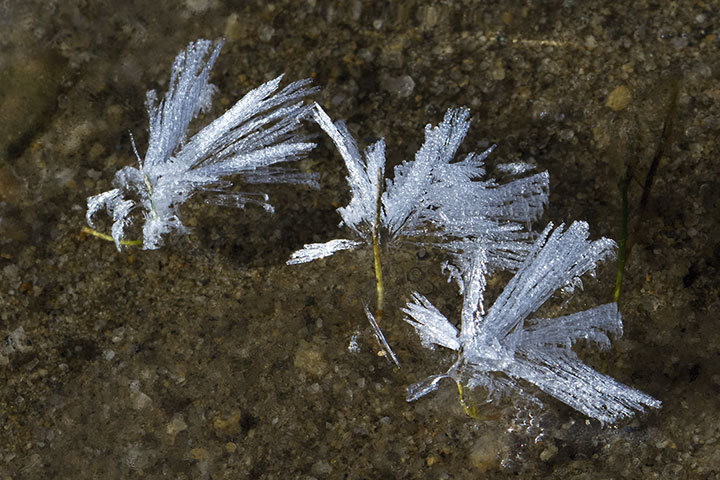
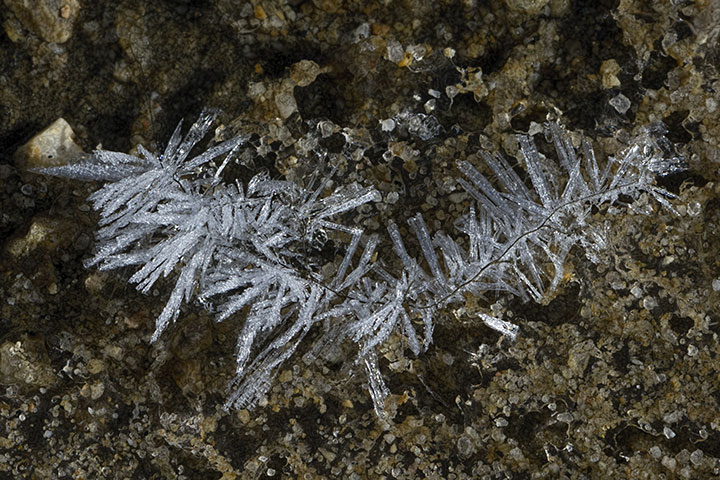
This sinuous flower formed along what seems to be a stolon. 
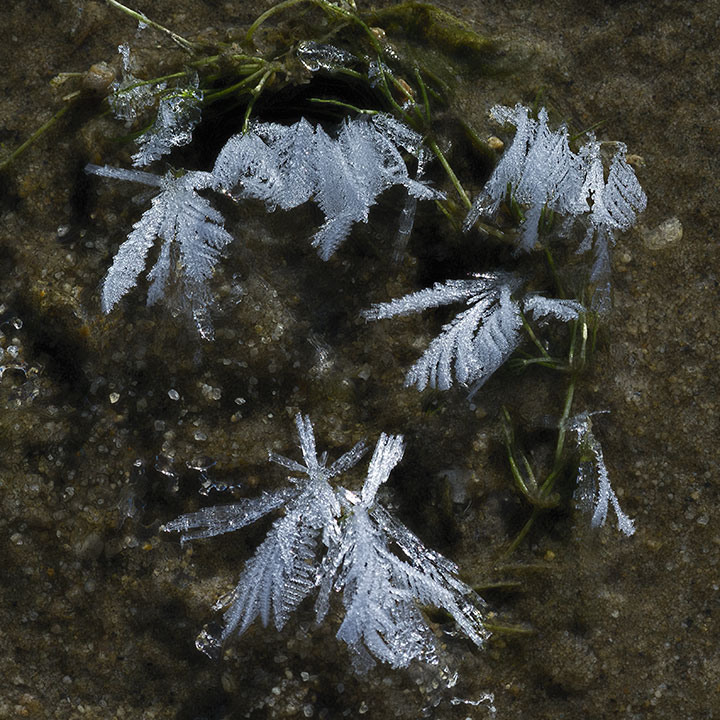
Will it take another five years before the frost flowers of Kootenay Lake bloom again?
Posted in weather | 4 Comments

Trumpeter Swans


As the lake level drops in the spring the Swans are attracted to underwater vegetation that they can reach with their long necks. So we see them at various locations on the West Arm and the Kootenay River.

A group of 8 swans, 7 adults with one cygnet were near the old Taghum bridge.

The cygnet needed to spread it’s wings to get up onto the ice

Posted in birds | 1 Comment