Cat’s paw prints


An ancient mariner’s term for a breath of air that lightly brushes the water is a cat’s paw. The name implies the gentleness of the touch; it is a zephyr, a gentle gust of wind. 

This would probably be unremarkable, except that cat’s paws are strikingly visible: you don’t just feel them; you see them. They usually take the form of a dark (occasionally lighter) patch moving across the surface of the water. This has caused some people to assign the name, cat’s paw, to the disturbed water, itself—and indeed to fabricate explanations of it based upon the character of the disturbance. I prefer the older terminology: a cat’s paw is a wind that gently disturbed the water’s surface, leaving a cat’s paw print

Yet, all who discuss it agree that the disturbance appears to result from ripples—that is, capillary waves—that have been excited by the gust of air. Indeed, this seems correct. The problem I faced was: Why do the ripples make the water’s surface appear dark?

Waves on water fall into two overlapping groups: gravity is the restoring force (think of a swing); surface tension is the restoring force (think of a spring). When the wavelength is greater than 1.7 centimetres, gravity dominates; when it is less, surface tension dominates. Now there are a few differences in behaviour across this divide (one was discussed at hoodie ripples), but the interesting one for cat’s paws is that while the slopes of gravity waves (λ > 1.7 cm.) never get large, the slopes of ripples (capillary waves, λ < 1.7 cm.) become quite steep.

To understand why the steepness of the waves makes a difference in the appearance, one can imagine a calm surface of water. The light coming from it is a mixture of light refracted from the depths and light reflected from above the surface. If the view is nearly horizontal, most of that light is reflected from a bright horizon; if the view is straight in, most of that light is refracted from dark depths. 

When the surface is irregular, what is seen depends upon the statistics of the surface tipping: gentle tipping, it still looks close to the brightness of a horizontal surface; steep tipping, it takes on some of the darkness of looking straight in. So, regular waves favour viewing light from the bright horizon, while ripples favour peering into stygian depths. 

Ok, the ripples created by the cat’s paw make the surface appear dark. Yet, another problem remains: Why does the print follow the paw (the gust)? Look at the issue this way: someone who is ski touring on virgin snow leaves a trail from the start to the finish. The cat’s paw only leaves a mark immediately below the paw—it leaves no trail. While a gravity wave can travel across oceans, a ripple (surface-tension restoration) decays rapidly. Remove the driving force of the wind gust and viscosity kills them within metres. 

There it is: cat’s paws are gentle gusts of wind that generate ripples on the water’s surface; the steepness of the ripples emphasizes stygian depths over horizon brilliance; the transience of ripples emphasizes tracks over trails.  

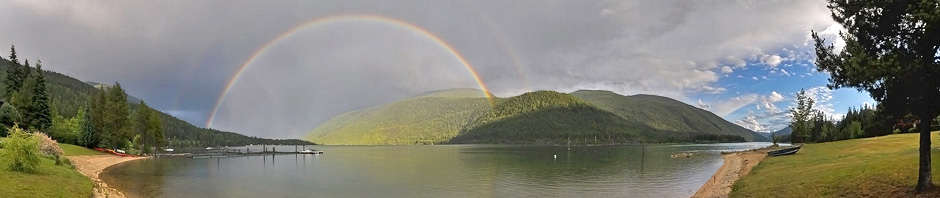
Dark patches move across the surface of the Lake. They are the prints from a wind called a cat’s paw.

Posted in weather | Comments Off on Cat’s paw prints

Northern Hawk Owl


Irruption of a natural population: to undergo a sudden upsurge in numbers especially when natural ecological balances and checks are disturbed

You may have heard the word irruption recently in connection with the Great Snowy Owl appearances in eastern Canada.

The appearance of Northern Hawk Owls in our area is described either as an irruption or a rare and irregular visitor. It’s nesting range is the boreal forests of Northern Canada, in forest fire clearings where there are rodents, open areas and perches. They are not uncommon here; recently they have been seen in the high country and in the Creston Valley. They hunt during the day primarily for voles. Their eyesight is exceptional, said to be able to detect prey at 800 meters. In flight they look remarkably like a hawk.

This owl was surveying a field adjacent to the highway near Salmo.

Posted in birds | 1 Comment

January catch-up


January draws to a close and I find unused images of miscellaneous birds on my computer. Many of them I shall ignore, but here are four I liked.

European Collared Dove

Belted Kingfisher

Black-billed Magpie

Wild Turkey

Posted in birds | 2 Comments

Ruffed Grouse


Derek Derek Kite has often permitted me to include some of his local images within a posting I made. I have finally persuaded him to make his own posting. I hope this will be the first of many. Alistair

If you find yourself in the woods in the next few months you may hear a very low thumping sound that increases in speed. (Recordings are widely available, one is mentioned, below.) You have to stop and listen; it isn’t very loud but if you are like me you will feel a shiver of pleasure. It is a ruffed grouse drumming, or beating its wings. The females seem to like it as much as we do, and if suitable, ends in romance and a clutch of chicks.


This grouse has blue feathers on the neck and a grey tail. It is a grey phase, distinguishable from the recently posted grouse crosses road, a rufous phase. It is the same species with different colouring.
The grey and rufous can come from the same clutch of eggs; the grey phase tends to be more common in the north. We have both in our area. When the male ruffs it’s neck feathers this specimen will show blue feathers. This shot shows one ruffing it’s feathers showing dark feathers on it’s neck. It appears to be the gray phase but without the striking blue.

Here is one site offering recordings of a Ruffed Grouse drumming.

Posted in birds | Comments Off on Ruffed Grouse

Vole runways


Voles do not hibernate. Rather, they spend the winter underground in burrows and forage above ground using a labyrinth of runways built under the snow. When the snow melts, the runways become exposed.  

Some vole runways are revealed by receding snow. A colony of voles lives among the roots of a willow bush in the upper right. In a bit of visual irony, their runways look like a classic airport terminal: a semicircular causeway links vole parking with concourses leading to distant lands.


Posted in mammals | 2 Comments

Heron liftoff


Flight is the sine qua non of birds. (A few non-local birds had, but lost, the capability.) So, why doesn’t this blog show more airborne birds? Unfortunately, they are more difficult to photograph.

Every so often, it is fun to explore flight—in this case the liftoff of a Great Blue Heron. During an upstroke, the wings are bent to displace the least amount of air; during a downstroke, they are spread to displace the greatest amount of air.

A juvenile heron hunting in a field caught my attention.

When a bird takes off from a high perch it first descends using gravity to pick up speed. A take off from the surface necessitates that the wings do most of the work. The first step is to bend the wings so that as they are raised, they will not displace much air.

The wings are then extended and thrust down. The heron lifts off.

On the next upstroke, the wings are again bent at the wrist and twisted so that raising them displaces as little air as possible. The heron has already tucked its neck back into an S curve. 

The airborne heron has again spread its wings on a downstroke. This juvenile’s feathers are moulting. 


Posted in birds | 2 Comments

Buteo ID


How difficult can it be to identify a couple of local buteos?

Buteos are the broad-winged hawks that hunt in open spaces. There are only two likely to be seen locally at this time of year: Red-tailed Hawk, Rough-legged Hawk. (Well, there may be other accidental visitors, but don’t count on them.) The Red-tailed Hawk is named (not surprisingly) for its red tail. The Rough-legged Hawk for the fact that its legs are feathered down to its toes.

The problem arises because each of these hawks has a range of plumages, i.e., morphs. Further, the Red-tailed Hawk has a sub-species, Harlan’s Hawk, that some think should qualify as an entirely different species. Well, that is my excuse for not being able to sort out some casual observations. 

In the numbered pictures, below, I offer guesses, not assurances. Suggestions are welcome. 

1) First, an easy one: a Red-tailed Hawk on a fence post.

2) Then, a Red-tailed Hawk hunting in a field.

3) Here are two views of the same Rough-legged Hawk.

4) And a Rough-legged Hawk in flight.

5) This bird is unclear, but it might be a juvenile Red-tailed Hawk. Suggestions?

6) Finally, the ultimate problem hawk. I speculate that it is a juvenile light-morph Harlan’s Hawk.

Posted in birds | 3 Comments

Grouse crosses road


Well actually, the Ruffed Grouse did not manage to cross the road.

The grouse tried repeatedly, but it walked so slowly that during each attempt another vehicle would come along, and the grouse was forced to retreat. Finally, a big truck came by. With this, the grouse gave up and flew back over the snow bank from which it had started.

The odd thing about this is that as vehicles were infrequent, there had always been ample time for the grouse to have merely flown across the road.

Why try to walk? Who can fathom the mind of a grouse?

A Ruffed Grouse repeatedly tried to walk across the highway. It finally gave up and flew back over the snow bank.

Posted in birds | 8 Comments

Prairie Falcon


We have falcons around Kootenay Lake, but only two species are normally encountered: Merlin, Kestrel. Merlins have appeared in this blog, but my nicest shots of them are on the main website. Two postings about Kestrels have been: Kestrel bonanza and Kestrel versus vole.

This is the first Prairie Falcon I have seen around here, or indeed, anywhere. This one has been seen by others off and on for the last month on the Creston Flats. At very least, it is a rare visitor.

Posted in birds | 2 Comments

Kestrel versus vole


Last July, I took a picture of a heron about to consume a vole. Yesterday, it was of a Kestrel.

Voles are rather low on the food chain.

Posted in birds, mammals | 1 Comment