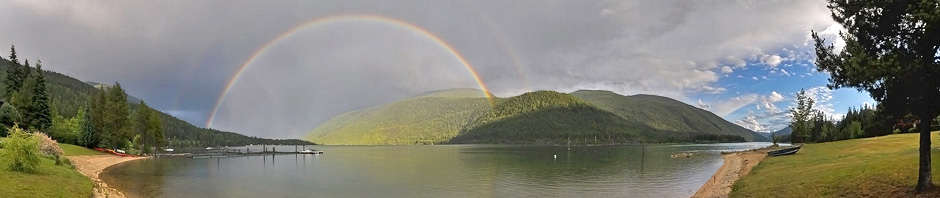
Fallstreaks


You can stick your finger into a glass of water, but not through a block of ice.

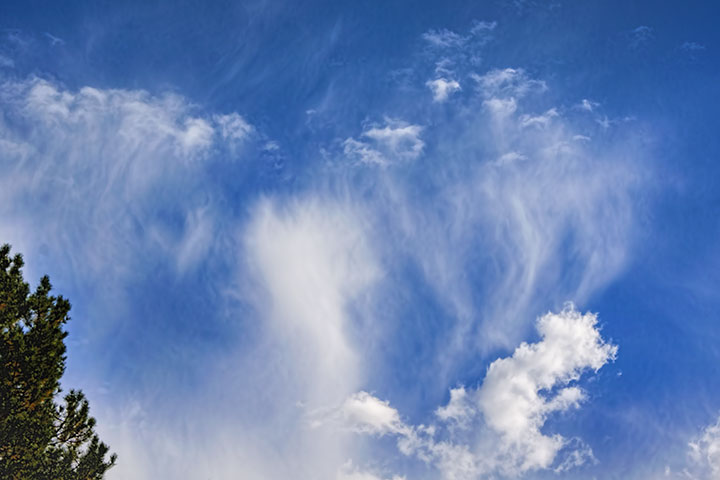
That pretty well explains what is going on in this morning’s picture of fallstreaks.

Water molecules are not as tightly bound together in the liquid as they are in the solid. This means that, at the same temperature, fewer water molecules will escape (evaporate) from an ice crystal than from a water drop.

Wry comment Over two centuries after it was shown to be nonsense, there are still teachers who ignorantly tell their students that clouds form because “cold air cannot hold as much water vapour as warm air.” This sad misrepresentation of reality is rejected by all modern physics. The issue is discussed on this site in an article called condensation. Alas, the air lacks such a holding power and air is actually irrelevant to the issue.

Imagine a small volume in which water drops and ice crystals are together surrounded by water vapour (It is humid). Yes, all three phases—vapour, liquid, solid—frequently coexist at temperatures below 0C.  The vapour molecules will condense on drops and crystals at the same rate. But, it is much easier for the loosely bound molecules in the liquid to evaporate than it is for the tightly bound molecules in the solid. The result is that often there are more molecules arriving than leaving the ice, while there are more molecules leaving than arriving on the liquid: the crystals are growing; the droplets are shrinking.

In the picture, below, the tufts of whiter cloud in the upper portion of the picture are composed of water drops; the greyer streaks that hang below them are of ice crystals. The original water cloud was larger, but when some of the drops froze, they (now being ice) grew rapidly while the remaining water drops shrunk. The increasingly large crystals had a larger terminal velocity and fell below the original water cloud to produce these fallstreaks.

And all this happened for the same reason that it is harder to stick your finger into a block of ice than a bucket of water.
Posted in weather | 3 Comments

Two ungulates


An ungulate is a hoofed mammal (ungulate is from the Latin, ungula, meaning hoof). This region has an unusually diverse population: seven species. Some are in the cattle (bovine) family and have horns: Big-horned Sheep, Mountain Goat. Some are in the deer (cervid) family and have antlers: Moose, Elk, Caribou, Mule Deer, White-tailed Deer.

On Friday, I saw ungulates from each group: White-tailed Deer, Mountain Goat. Now, the first is fairly easy to find; the second is not.

The White-tailed Deer are the conspicuous cervids of the valley bottoms. These two females are browsing beside a river alongside some driftwood.

A mother and her fawn are grazing (unbeknownst) within a hundred metres of some grizzlies.

One of five Mountain Goats is grazing on a steep cliff.

While another glances over the edge.


Posted in mammals | Comments Off on Two ungulates

Black grizzlies


I have seen (and photographed) Grizzly Bears a number of times before, but never one with an obviously black coat. Everything about these bears said grizzly—body shape, face shape, ear shape—but, the colour was wrong.

Or so I thought. A quick check of various sources reveals that Grizzly Bears can range in shade from black to brown to cream. But, a black coat had been outside my experience.

Bears have made their seasonal return to the valley bottoms: my first Black Bear was seen two days ago; my first Grizzly Bear was yesterday. The latter sighting was particularly grand: a sow with two cubs.

Two distinctly black grizzly cubs were seen on a back road. I spotted them before they spotted me.

When they realized that they were not alone, one cub stood to sniff the air for the intruder.

Quickly, mother emerged from the brush and probably told her children that they were looking at a human—something best to avoid. At this, the family wandered back into the brush.

Posted in mammals | 3 Comments

First black bear


A black bear standing in the shadows of trees is not a promising subject for photography. However I had to try, as only fifteen minutes earlier I had expressed disappointment at not having seen any black bears this year. Last year, bears descended to the valley bottom in August. This year, a good crop of wild berries seems to have kept them happily munching away on the mountainside.

This morning’s black bear was my first sighting of the year, so I asked if I might take its picture. It posed for a moment, but then wandered off into the forest.

Posted in mammals | 4 Comments

Pileated eats berries


It is fall and the Pileated Woodpecker has decided to feed on elderberries.

Posted in birds | 4 Comments

47 eagles


Forty seven, that is the number of Bald Eagles seen on the roughly forty kilometre drive along the Lardeau River from Meadow Creek to Trout Lake. On earlier autumnal drives there, the count has ranged from as few as 6 to as many as 68.

Of course, it isn’t that I have any need to see so many eagles (although they can be fun), but a high eagle count hints at the likelihood of seeing Grizzly Bears. The links between them are the spawning Kokanee. If Kokanee are plentiful, birds and bears come to feed. Alas, no grizzlies were seen on this jaunt (although the Mountain Goats were nice)—another trip is in order.

Although eagle count numbered 47, only a few were photographed, and fewer still were worth showing. This adult in a cedar tree offered the most colourful scene.

Most, like this juvenile, merely sat on tree limbs and watched the river below.

Now and then one would fly from one vantage point to another, as did this juvenile.

Here and there, one could see an eagle chowing down on a Kokanee.

Adults were better at catching the fish than were juveniles. The adult (right) perched on driftwood while eating. A hungry juvenile (left) joined it, but waited until the adult left before daring to eat the scraps.

Posted in birds | 5 Comments

Mountain goats


I had headed for the Lardeau River in the hope of seeing Grizzly Bears feasting on the spawning Kokanee (Sockeye Salmon). Alas, the jaunt produced no grizzlies. Yet, Mountain Goats high on a cliff overlooking Kootenay Lake provided satisfactory compensation.

The first Mountain Goat was seen lounging on a ledge. It remained for hours regally surveying the Lake below.

More interesting was another goat roaming the ledges about 300 metres along the cliff.

It wandered around feeding on sparse grass.

And provided me with the best views I have had of a Mountain Goat.

Posted in mammals | 3 Comments

Moulting loon


At this time of the year, the loon moults from its striking breeding plumage into its inconspicuous wintertime look. The first two pictures were posted earlier and are reproduced here to illustrate the two states; the last picture was taken two days ago and shows a loon in transition.

This picture of a nesting loon was posted in early June of this year. In addition to the strongly patterned back, the breeding Loon has a dark head and bill.

This loon from early May of last year shows the grey back, and crown along with a white throat and bill.
loon120512as

So, the loon’s moult into breeding plumage takes place in May. The reverse transition is now underway. The bill and throat of this week’s loon are already becoming lighter.

Posted in birds | 1 Comment

Coming and going


For bird watchers, September is a month to see interesting transitions: some local nesters head south for the winter; some northerly nesters arrive. The overlap presents some rich viewing of those coming and those going.

The most striking departure will be made by the Osprey. This one will likely be gone in a week.

Less conspicuous, but here through the summer and soon to leave, is the Gray Catbird.

Absent through the summer, the Western Grebe will hang out around the Lake until the end of the year, at which time it will likely leave for the Coast.

The Hooded Merganser has arrived. This picture shows two males (left, bright eyes) and two females (right, dark eyes). The two males are at different stages in their moult towards their breeding plumage.

Then there are the birds that leave one uncertain as to whether they are from here or passing through. Here are two Bald Eagles: an adult on the left and a juvenile on the right. Eagles are present year round, yet at this time, their numbers increase as more northerly nesters flow south across our region.

Posted in birds | 1 Comment

Desecration


Kootenay Lake is home to a impressively large number of pictographs. As I noted in a posting a year and a half ago: pictographs are at once art and narrative.

Our pictographs are certainly the cultural heritage of First Nations, but beyond that, they are a signpost for us all. They speak to our collective deep ancestry.

I am distraught. In June I took a picture of one of my favourite pictographs. Three months later (yesterday), I happened by and took another picture. Sometime between, the pictograph suffered major damage. The comparison is below.

I temporarily imagined that the blue blotches splattered across the ancient images might have been cause by birds. Bird experts assure me: This damage lies outside the capabilities (and poop colour) of birds. The damage was made by humans.

Alas, this archaeological artifact has been damaged to the point of obscuring the storyline. Not only does the blue (paint splatter?) disfigure, the dark seeping stain from it further obscures. Someone appears to have cavalierly disfigured thousands of years of history.

This has been reported to the RCMP and the Provincial RAPP (report a violation).

Will the police and Province act? Who knows? But, for the moment, it seems likely that some thoughtless person has chosen to muddy thousands of years of our (and their own) heritage. Sigh…

The same portion of a pictograph before and after desecration.

Posted in commentary, history | 23 Comments