Alternative reality


Nelson City Council now requires the head of every household to own a gun and ammo to “provide for the emergency management of the city” and “provide for and protect the safety, security and general welfare of the city and its inhabitants.” The new law does have exemptions for felons and the mentally ill.

Bizarre? Jarring? Yes, but that is the story out of Nelson, Georgia, a community of 1300 in the southern U.S.

This is truly a Nelson in an alternative reality.

Nelson in our reality: gun ownership is not required.

I am indebted to my daughter, Cynthia, for pointing out this odd story.

Posted in commentary | 6 Comments

KAB walk


Yesterday, I was fortunate to have joined the Kaslo Area Birders for a walk at the north end of the Lake. While others looked for birds, I looked for bird pictures. Here are four shots I liked.

A Mountain Bluebird was hunting from its perch atop a sign that read: No Hunting!

Bald Eagles and Turkey Vultures were soaring along a ridge. This is a juvenile Bald.

A highlight of the day was the freshly arrived Tree Swallows. This couple is having a conversation. Could they be saying: “John has found a really nice nesting cavity for Muriel.”  Or maybe: “I really don’t like all those birders spying on us.”

Finally, a portrait of a Tree Swallow.

Posted in birds | 7 Comments

March marmot


The Yellow-bellied Marmot emerges from hibernation here in late March. Indeed, I saw my first one yesterday as it was feeding on dried grass. Here are four pictures of this March marmot presented in the order taken.

Posted in mammals | 4 Comments

Guttation


There is nothing that says spring like the first guttation—not the arrival of swans, swallows, or robins, but guttation. It tells me that local plant metabolism is underway.

Guttation is often confused with dew. Although superficially similar in appearance, dew and guttation come about in different ways and are easily distinguishable. There are examples of each below.

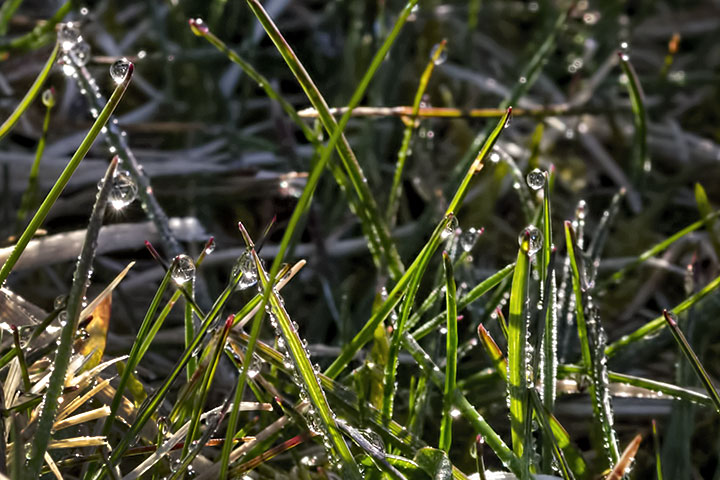
Guttation on grass appears as rather large drops of water hanging from the tip of the blade (although sometimes a drop may slide downwards). It is formed from soil moisture that the roots have pumped upwards. During the day, this moisture would have passed out through the stomates, but with the lower nighttime temperatures, the stomates have closed. Frankly, grass is not very smart and so the roots keep pumping despite the blade having closed down for the night. The water is thus extruded from the tip of the blade to produce the guttation (from Latin, gutta meaning drop + ation).

The source of the moisture for dew is not the ground, but the atmosphere. Water vapour condenses on the cold blade. The grass (or any plant) need not be metabolizing for dew to form. Indeed, dew will form on all manner of cold surfaces. Guttation, on the other hand requires the plant to be metabolizing, making it a good sign that spring is here.

(Incidentally, one sometimes sees a picture of a spider’s web covered with droplets which the photographer has labeled as dew. Alas, those drops are formed neither as dew nor guttation, but something else.)

Nearly spherical guttation drops are hanging from the tips of the metabolizing grass.
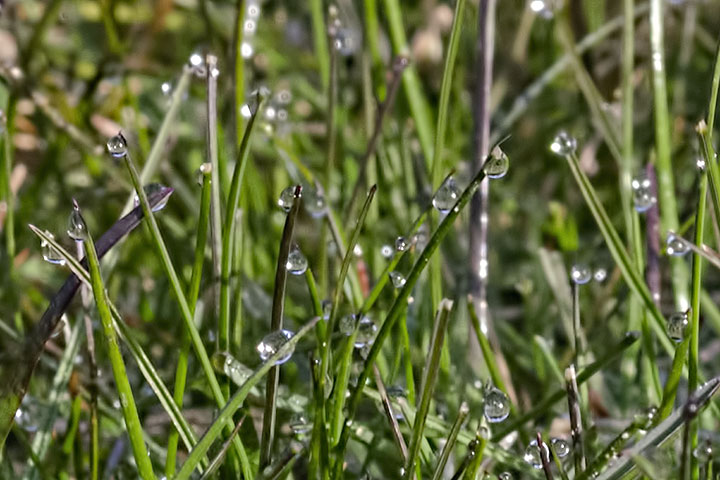
Guttation and dew can form separately or together. The large pendulous drops near the tips of these blades are guttation; the smaller ones along the blades are dew.
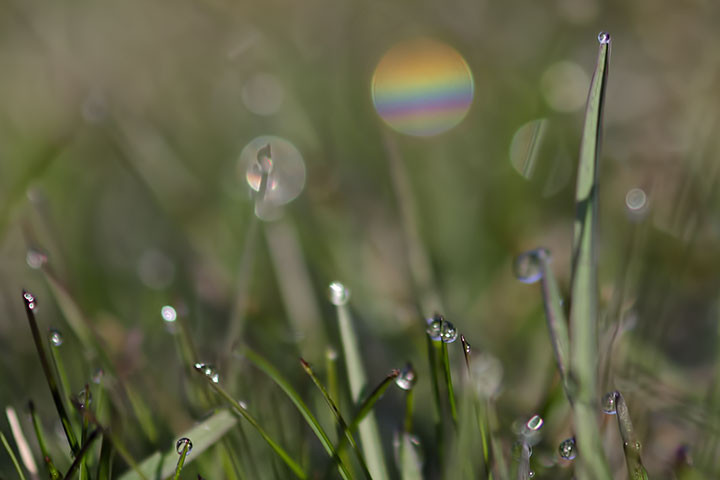
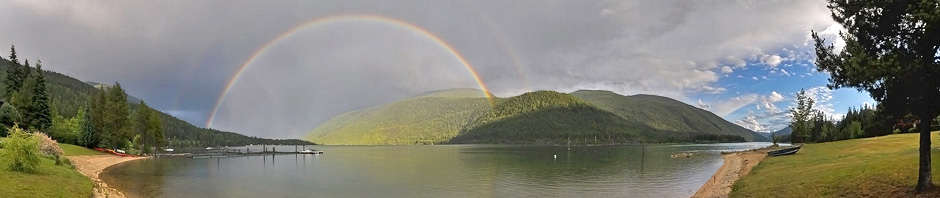
The previous pictures were taken in the general direction of the Sun to attain a high contrast. There are delights to be seen in the other direction: rainbows. Typically only formed by the more nearly spherical guttation drops, the tiny portions of a rainbow are easiest to see when the drop is out of focus.
Posted in weather | 3 Comments

Sun dog


A sun dog (a parhelion) is so named because the colourful spot of light follows its master, the Sun, around the sky. Well, it follows the Sun if the cloud, in which the sun dog forms, persists. In this case, the drifting cirrus was in the proper position for maybe five minutes and then the show was over. These brightly coloured spots of light are explained by the minimum angle of deviation of sunlight refracted through the 60° prism faces of hexagonal ice crystals.

Posted in weather | 1 Comment

An idiot


This morning, I was repeatedly told I was an idiot.

The backstory is familiar to the handful of people who read this blog. I am a nature photographer. To take pictures of birds, bears, or bugs, I use a telephoto lens stabilized with a monopod. It is my standard equipment on walks along woods, meadows, or beach. I am not alone in applying this rather successful recipe to wildlife images—it is the practice of most wildlife photographers (although some carry an even more bulky tripod).

The majority of the pictures that have appeared in this blog over the years have been taken in this way. Indeed, readers have ofttimes commented upon the sharpness or clarity of the resulting images.

Dogs find the bulk of my camera and its monopod to be a threat. Or at least that is the reason this morning’s dog walker gave when justifying the behaviour of his three off-leash dogs which had barked, bared their teeth, and charged me: “you are an idiot for carrying a big stick [the monopod].” This insult was repeated a number of times, just in case I initially had not grasped his own blamelessness for his dogs’ behaviours.

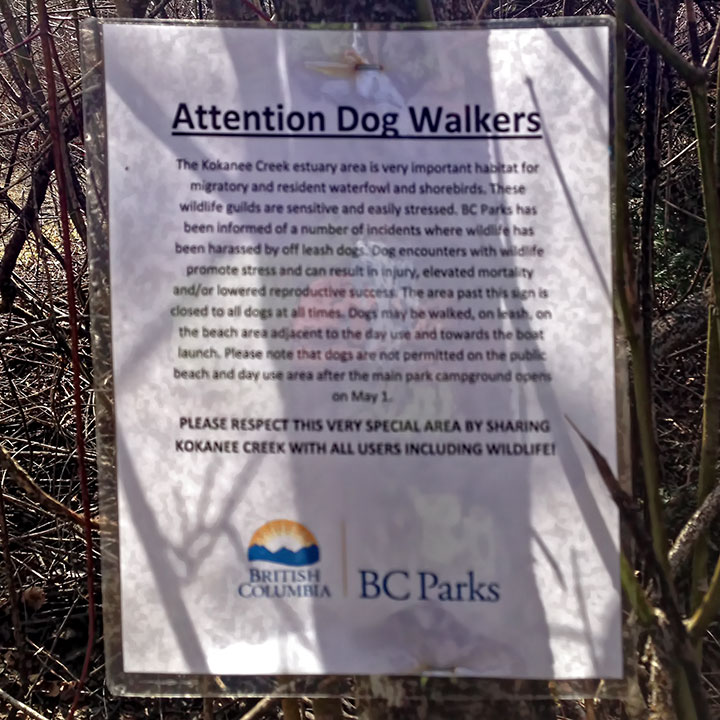
I responded that I am allowed to carry my “stick” but that he is not allowed to walk his dogs here. For curiously, the standoff took place past, but within sight of, one of the many signs BC Parks has posted around the Park. That sign (below) says:

The area past this sign is closed to all dogs at all times.

This is the second time this week that off-leash dogs have accosted me in this no-dog area. It seems that while I am allowed to carry a camera and others are not allowed to walk dogs, it is I who am the idiot. At least I am sufficiently literate to read signs.

Posted in commentary | 14 Comments

Paid: six peanuts


For some time, I have had a resident squirrel—probably not always the same animal.

We have a social contract: clicks for comestibles. Today’s picture cost me six peanuts.

squirrel130326s

Posted in mammals | 3 Comments

Crocus spring


The crocus is in the yard; can spring be far behind?


Posted in wildflowers | Comments Off on Crocus spring

Sun Pillars


Life in mountain valleys is usually life without sun pillars.

The problem is that pillars are really striking only when the Sun is low in the sky. Around here, the Sun generally appears from (or disappears) behind a mountain and so is already too high in the sky to produce a good pillar. Yet, there are times of the year when the rising or setting Sun aligns with a valley. That is the time to watch for sun pillars.

A pillar results from the reflection of sunlight off gently tipped surfaces. Most people are familiar with seeing a sun pillar on water. If the water were calm (perfectly horizontal), only a circular image of the Sun would appear. It takes the slight tipping from small waves to drag the Sun’s image out in the vertical. A resulting pillar is seen in the lower half of the picture.

Ice crystals provide the reflecting surfaces for the formation of the pillar above the Sun. Although the majority of the clouds seen here are composed of water drops, there is an all-but-invisible veil of hexagonal-plate ice crystals falling from them. These crystals settle with their broad plate-like surfaces nearly horizontal, rather like dinner plates spread on a table. Gentle oscillations of the falling crystals provide the slight tipping needed to spread the reflected image of the Sun into the pillar seen in the upper half of the picture.

For the next short while, the Sun will be rising (for me) in this gap between the higher mountains. With luck, I may get to see more sun pillars.

Posted in weather | 4 Comments

Hard-luck woodpecker


This is a tale of a Pileated Woodpecker and two Merlins.

A woodpecker was calling, so I wandered around until I found it in a tree beside a field.

As I watched, the woodpecker flew across the field and made an unfortunate choice for a new tree.

Alas, the unpropitious tree was already occupied by a Merlin.

Although the Merlin is about half the weight of the Pileated Woodpecker, it is a falcon which specializes in capturing and eating other birds. The Merlin dove.
It was only later that my pictures showed that the woodpecker had had two Merlins to contend with—not good.

Wisely, the Pileated Woodpecker beat a hasty retreat.

One of the Merlins then raised a claw as if to say: “Bear this in mind if you ever decide to return.”

Unconcerned by the petty squabbling of these smaller birds was a Red-tailed Hawk, a raptor that outweighs the Merlin by a factor of six.


Posted in birds | 4 Comments