It is a delight to spend time in the company of owls. Yet it is striking that very often of late, the one with which I spend the most time is the Northern Pygmy Owl. The explanation is simple: each of us hunts during the day.

It is a delight to spend time in the company of owls. Yet it is striking that very often of late, the one with which I spend the most time is the Northern Pygmy Owl. The explanation is simple: each of us hunts during the day.
My favourite Ruffed Grouse is featured on these pages a few times a year for it is an occasional visitor to my yard.
For three seasons, my friend is difficult to espy so well does it blend into its surroundings. It is well camouflaged both when it stands still, and during its languid travels though the brush when it appears to be little more than a bit of foliage shifting in the wind.
Alas, the cryptic plumage and stealthy movement that provide beautiful concealment during other seasons, just seem comical in the winter. Now the grouse is stridently conspicuous as it makes its stately passage across a field of snow.

Last Sunday’s (January 20th) jaunt around the Creston Flats produced a possible (now confirmed) Harlan’s Hawk near Wynndel. But, there were other interesting things to see. Some of the pictures below were taken by Derek Kite, some by me.
The first half-dozen images show predators; the rest show vegetarians.
Derek managed the best action shots. Here is another of his Red-tailed Hawks in flight.

and one I took of the Red-tailed Hawk on its favourite local perch: the crossbar of a utility pole.

Derek caught a kestrel in flight,

and a coyote hunting (for voles) in a field.

This is my sub-adult Bald Eagle hunting beside a river,

and a Northern Shrike hunting from a power wire.

A Eurasian Collared Dove seems to have just been resting on a wire as it normally eats seeds.

Finally, a pair of Horned Larks were scouring by the side of the road. First the female,

then the male.

Derek Kite’s images are used with permission.
In the winter, colours are often muted.
A Ruffed Grouse wanders through the snow, seemingly unaware of its ineffective camouflage.

Barrow’s Goldeneye Ducks are surrounded by light-flecked waves.

This is a posting that only an ardent birder could enjoy: the apparent sighting of a Harlan’s Hawk near Wynndel. (That this bird was a Harlan’s has now been confirmed by Brian Wheeler who examined six of the pictures taken of it.)
The day was sunny, so Derek Kite and I took our cameras for a Sunday drive around the Creston flats. This is the region at the south end of Kootenay Lake that, prior to the dykes, would seasonally become part of the Lake. It is now largely open agricultural land. The crops attract rodents, and these in turn, attract coyotes and raptors, so it is a good place to see hawks. Quite a few Red-tailed Hawks were seen on the drive and I attach the best shot of one in flight (taken by Derek).
Rick Howie assesses the pictures: We can rule out Rough-legged hawk quickly due to the lack of a prominent belly band. It would be much darker and more extensive on all but perhaps light male adult Roughies. I think we can all agree that this is a juvenile bird based upon the white patches on the folded wing and showing on the back of the flying bird, the strongly-banded tail with no rufous showing, the heavily-barred underwings and pale iris. I think the white throat rules out various morphs of the typical western B.j. calurus form. The darker black-brown tints and white throat suggest B.j. harlani to me. The broad white supercilium also fits the intermediate morph of harlani. So my thinking at the moment is juvenile Harlan’s Hawk in some sort of intermediate morph plumage.
Among the various red-tails, there was one seen just south of the community of Wynndel that had the right body plan, but a somewhat odd plumage. Yet, it was beyond my skills to know what it was. A knowledgeable birder, Rick Howie, suggested that the pictures show a Harlan’s Hawk.
The Harlan’s is (by most accounts) a subspecies of the Red-tailed Hawk, but it breeds far north of here and generally winters far south. The only time one would usually expect to see a Harlan’s in this area is during migration. While there have been scattered reports of Harlan’s wintering elsewhere in the BC interior, none had been known to winter around here.
First, Derek’s spectacular picture of a characteristic local Red-tailed Hawk with its buff colouring.

Then, the two pictures of the Harlan’s Hawk, first in a tree,

and then in flight.

Feel free to weigh in on the identification.
Collisions are an unfortunate codicil of being able to enjoy the frequent company of deer. Local drivers are sensitive to the fact that when evening comes, the White-tailed Deer is often out foraging and will frequently cross a road. Drivers are wary, so nothing bad happened this time. The deer was spotted; drivers slowed; the deer crossed; life went on.

“Just ignore this snag; there is nothing but snow and bark up here.”

Winter in the valley of Kootenay Lake often offers a low ceiling of stratus—the claustrophobic overcast that prompts some people to suffer cabin fever.
Yet, it is not always thus. On clear days, the view of the surrounding mountains can more than make up for the overcast on other days. Here is Sphinx Mountain in the Purcells illuminated by the departing Sun.

About a week ago, I posted some images of reddish birds feasting on rowan berries: Pine Grosbeaks and a Red-shafted Northern Flicker. Today, I add two more reddish birds to the list of birds that seem to appreciate these berries: American Robins and Varied Thrushes.
I watched robins feeding, but when the picture was taken, each was merely sitting amidst a world of berries.

Although also a thrush, as is a robin, the Varied Thrush is a remarkably skittish bird.

It reaches out and takes a rowan berry.

Thunk!
prime bird killer
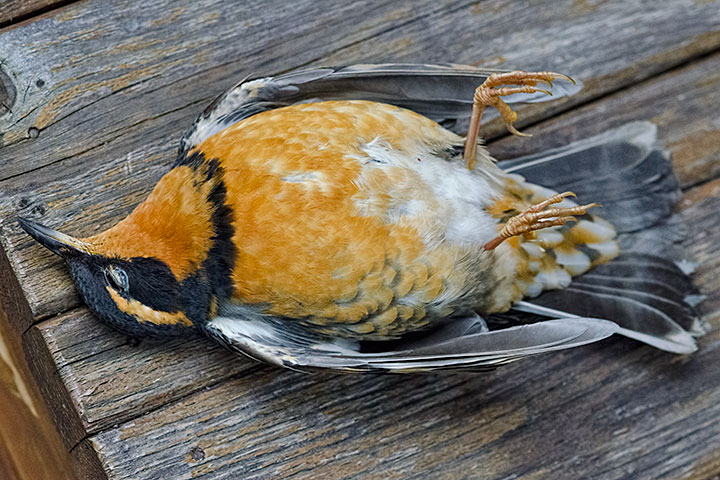
A Varied Thrush just died on impact with a window in my home—not a happy event. It is embarrassing to realize that a couple of birds are killed by my home in this way each year. Multiplied by many buildings, this adds up to a substantial toll. It is estimated at about 22 million in Canada each year—likely mainly in urban areas.
Yet, windows are passive killers, they don’t actively roam the countryside searching out birds to kill. For that anthropomorphic source of avian death, one must turn to an invasive species: the domestic cat.
For a long time it was thought that windows were a greater threat to birds than cats, but a new study by the Smithsonian’s Conservation Biology Institute now places the annual number of bird kills by cats in the U.S. in the billions. Indeed, an earlier National Geographic study that attached tiny video cameras to household cats to monitor their activities, found that a substantial part of a cat’s outdoor time was spent hunting, with an average success rate of over two kills a week per cat. Yikes.
I don’t own a pet cat—a coyote made sure of that. Granted that best estimates now place windows as a far smaller threat to birds than are cats, that realization is thin gruel when one hears that disconcerting THUNK.
Moments earlier, this Varied Thrush flew free.