Toad amplexus


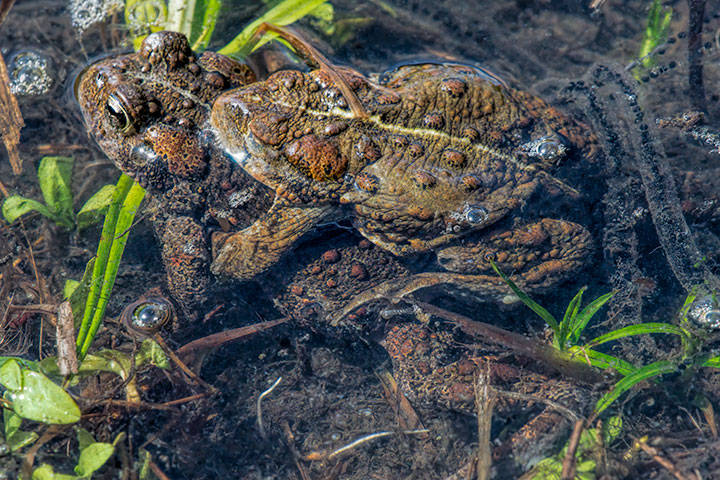
May is amplexus time for the western toad. 

The male toad (the smaller of the two) climbs on the female’s back and grabs her under the armpits. This stimulates her to release eggs, which he then fertilizes.

A male western toad grasps the female during amplexus.

Another couple is accompanied by strings of eggs in the water. Soon there will be tadpoles.


Posted in herptiles | 3 Comments

Loon’s whatsit


Loons are not the only predator that has a rather low capture rate. Certainly, when I watch loons fish, I marvel at how often they dive to no apparent effect. Yet, sometimes….

A Common Loon swam by this morning and repeatedly dived after fish, but came up with nothing. Yet, for all that, it certainly is looking good.

On one occasion, the loon surfaced with a comestible and then swallowed it. I have no idea what it found. Any ideas?


Posted in birds | 5 Comments

Beavers’ lodge in bank


Everyone is familiar with beavers damming creeks so as to get an adequate water depth around their lodges. However if the water is already deep (or fast flowing), beavers will build their lodges by burrowing into the bank. Any pile of branches against the bank of a stream or a lake might signal the location of a beaver lodge.

This pile of branches marks the location of where beavers have burrowed into the bank.

A beaver sits adjacent to its lodge and nibbles on a branch.

With morning’s light, it swims off in search of more foliage.


Posted in mammals | 5 Comments

Pileated two


I see a Pileated Woodpecker only a few times a year, and only saw two together once before. So, it was a treat to watch a pair of them on a tree trunk in the fading light of yesterday.

Two Pileated Woodpeckers work their way up the trunk of a badly scarred Douglas-fir tree in their search for grubs under the bark. The female is on the left; the male is on the right.


Posted in birds | 2 Comments

Osprey ruckus


A year ago, I watched two ospreys soaring over the land well away from the water. This struck me as odd. It is normal for an osprey to soar over the lake where it hunts for fish. But, why were they behaving this way over a forest?

Two days ago, I watched the same behaviour. Even though the water was hundreds of metres away, two ospreys circled each other in a threatening manner. Again, it was unusual. 

Then yesterday at the same location, I watched it again, but this time six ospreys took part in the fray, the focus of which seemed to be a nest occupied by a female. Were the males vying for access to her? When I subsequently looked at the pictures I took, it turned out that she was an active participant in the ruckus.

Was she the object of all the attention, or was this a competition for the nest itself? Who knows?

Two ospreys have just had a mutually threatening flyby. That they were combative is evident by the extended legs and poised claws. The female is on the left and one of the males is on the right. 

These are the original stakeholders. It seems to be the same female as in the previous picture.


Posted in birds | 2 Comments

April goulash


This is a collection of April’s images that were not featured in a posting of their own. As spring rolls in, many new species appear, or change their behaviours.

Early in the month, Trumpeter Swans were seen floating and sleeping on the Lake. The next day, they were gone.

The Columbian ground squirrel re-emerged mid-month.

With spring, the Northern Flicker seems to have a compulsion to carve cavities, whether a new one is needed or not.

Ospreys have returned.

Loons are back on the Lake. Within weeks they will head to the smaller mountain lakes to breed.

A female Brewer’s Blackbird turned up and vanished again.

Sensitivity demands that I not explain what is going on here.

The glacier lily apparently gains its name because it favours the moist ground next to snow melt. This one was in the moist soil near a cataract.


Posted in birds, mammals, wildflowers | 2 Comments

Mountain Bluebirds


After a week or so’s absence, Mountain Bluebirds reappeared at Kokanee Creek Park. While they do breed around here, I suspect that the departures have to do with those birds that were stopping by on their way to breed farther north. Mountain Bluebirds are the more common of our two bluebird species. The other one is the Western Bluebird.

A female Mountain Bluebird eyes the grasslands as it hunts from a red-osier shrub.

A male Mountain Bluebird similarly eyes the ground for comestibles. He proves successful.

The male descends to the ground and returns with a grub (my first recording of such a capture).


Posted in birds | 4 Comments

Cute fly


To suggest that a fly is cute certainly has to be a matter of taste. However, the Bombylius major does look like a child’s cuddly toy. Not only that, it is an effective pollinator as it goes around from flower to flower sipping nectar. Indeed, this little fly is one of the first pollinators of springtime.

However, this tiny bee fly has a dark side: Its offspring are parasites of solitary-bee larvae. For a short time before a solitary bee seals the entrance to the nest containing its eggs, the Bombylius major flips its own eggs in there. When the bombylius larvae emerge, they first feed on provisions meant for the bee larvae and then they eat the bee larvae themselves. Bombylius has only a short time in the spring to give its offspring this opportunity.

A Bombylius major sips nectar from a Pieris japonica. Its long legs and proboscis enable it to stay well back from the flower, probably as a way to avoid the attack of a crab spider.


Posted in bugs | 2 Comments

Crossbill feeding chick


There are many species that pass through our region. Some breed and raise their young here; many are tourists that only pause for a while, feed, and move on. Sometimes it is difficult to tell who was hatched and raised young locally and who was not.

Today, I observed (what others undoubtedly already knew) that the Red Crossbill raises its chicks beside the Lake.

A female Red Crossbill eyes one of its chicks.

The parent prepares to feed. Note: this freshly fledged chick has yet to develop its crossed bill.

It then feeds its chick.


Posted in birds | 1 Comment

Turkey Vultures


Turkey Vultures return in mid-March, but these seen yesterday were the first I had noticed.

Three of five Turkey Vulture were captured in one shot as they soared on high. They are recognizable, even from a distance, by the way they hold their wings in a shallow V.

One then descended for a closer look, but soon left. Apparently, it decided that I was in an insufficiently advanced state of decay.


Posted in birds | Comments Off on Turkey Vultures