Eagles don’t cooperate


At sunrise this morning, four eagles (three adults, one juvenile) harassed one another over a catch. Consequently, none of them made the kill and the prize escaped.

It all started when one adult flew low over what was probably a duck. The eagle’s legs were lowered and its claws were extended in preparation for a dive onto the prize when another adult, wanting it for itself, interfered. Then a third adult and juvenile joined the harassment. 

OK, Bald Eagles don’t flock, but this sort of behaviour — if I cannot have it, no one can — proved rather unproductive. However, the duck probably thought that it all worked out rather well.

This is one of the adult eagles flying back and forth preventing others from making a kill.

And here is the juvenile also contesting the prize.

Countdown: 3

Posted in birds | 2 Comments

Lake ullage


Kootenay Lake is at the lowest level I have seen it in the last couple of decades. The low water of March and April is, of course, an annual spring feature, which occurs when there is a reduced inflow because mountain moisture is still locked up as snow. This will reverse during the spring freshet of May and June when those snows melt and cause the Lake to rise to flood levels.

Yet, sometimes the learning of a new word changes the focus of one’s perspective. That word is ullage: the amount by which a container is NOT filled. This is a term used in the beverage industry — although it is more broadly applicable — to indicate the unfilled headspace in a container. 

By the ullage measure, if the typical summer lake level is 531.3 metres above sea level, and the present level is 529.9 metres, then the ullage level might be said to be about 1.4 metres. Of course, if one judged what is full by the highest water level and chose the 2012 level at 534.5 metres, the present ullage would be over triple that at about 4.6 metres. 

Curiously, this rather high ullage is the reason that loons don’t nest on this lake. Certainly they visit, but since they build their nests along the shoreline, the high ullage range of this lake gives them problems. So, they nest on smaller mountain lakes which have a much smaller ullage.

An illustration of the present rather high ullage is the Kokanee Creek boat launch. Consider the unlikelihood of being able to launch a boat from it today.

Countdown: 4


Posted in birds, commentary, weather | 1 Comment

Magpie packing


The Black-billed Magpie is a fairly common bird of western North America. However, as it prefers open habitats with only clumps of trees, it is somewhat of a rarity in our heavily forested region. As a result, it is a delight to encounter.

A magpie flew past carrying a lumpy something in its bill — but what is it? The magpie is an omnivore, so it is just unclear whether its prize is animal or vegetable. 

While the magpie’s comestible is indeterminate, one feature is obvious from this side view: the magpie’s unusual tail makes up more than half its body length.

Countdown: 5

Posted in birds | 4 Comments

Flying with fish


This morning, a Bald Eagle flew past packing a fish athwart its body. It is odd that an eagle regularly carries a fish in this non-aerodynamic orientation. Granted, the eagle is a strong flier, so the extra drag of a fish being carried across the airstream may not matter much to it. Still, why does it go to all that extra work?

An Osprey always carries a fish aerodynamically with its head facing forward. Granted, an osprey is a smaller bird, and as it takes less effort to fly with the fish in this orientation, the bird does so.

But, how is it that the eagle has never learned this trick?

An eagle carries a sucker in a non-aerodynamic orientation, so has to work harder to fly with it.

Ospreys have yet to arrive this year, so here is a picture taken last August. The osprey flies with its fish in an aerodynamic orientation and so does less work when flying with it.

Countdown: 6


Posted in birds | 1 Comment

Muskrat of spring


Early in the spring, young muskrats start wandering in search of mates and new nesting sites. So, for the next couple of months, muskrats may be seen straying beyond their characteristic waterways.

The muskrat sometimes gets a bad rap: It is not a rat, but a large aquatic vole. Besides, it is primarily a vegetarian. 

It is spring and a young muskrat’s fancy turns to searching for a mate.

Countdown: 7


Posted in mammals | Comments Off on Muskrat of spring

Geese, synchronized flapping


The synchronized wing flapping of a Canada-Goose couple was spectacular. I assume that theirs was a pre-copulatory, courting behaviour, but I did not see them complete the act.

The geese, one in front of the other, rose out of the water and together spread their wings back.

Together, they swung their wings to the side.

And then to the front. 

Countdown: 8


Posted in birds | 2 Comments

Eagle’s nest


Following recent postings about bluebirds choosing a nest box, and killdeer seeking a nesting site, here is one about Bald Eagles having chosen their nest for this spring.

A Bald Eagle couple have chosen a nest in which to raise a family.

Countdown: 9


Posted in birds | Comments Off on Eagle’s nest

Killdeer


Killdeer have arrived. They typically turn up in March, about two months before other shorebirds, such as the Spotted Sandpiper, do.

This morning a killdeer couple was seen exploring a rocky island near a creek mouth. Killdeer make their nests on open ground, so if they plan to nest on this island, they had better get on with it as the spring freshet will put the nest underwater in another few months.

The just arrived killdeer couple was probably looking for a nesting site.

countdown: 10

Posted in birds | 3 Comments

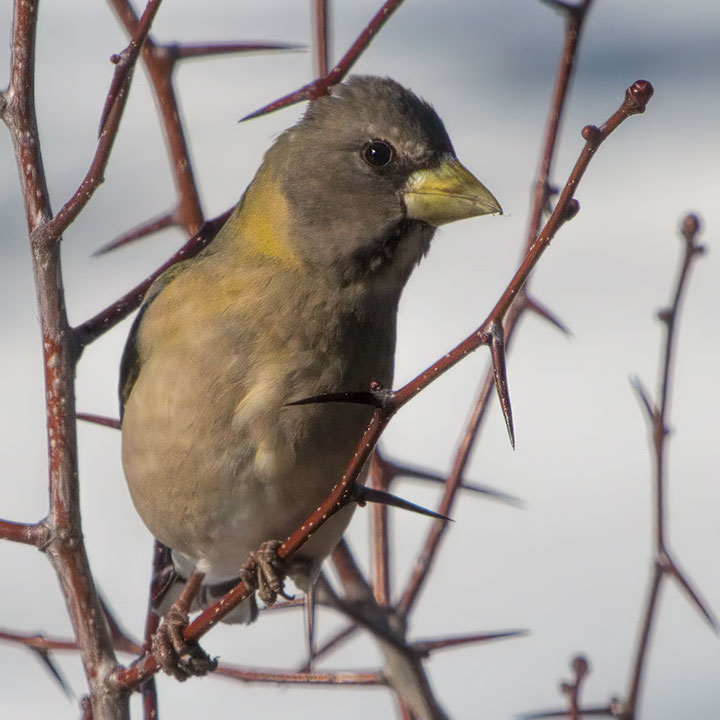
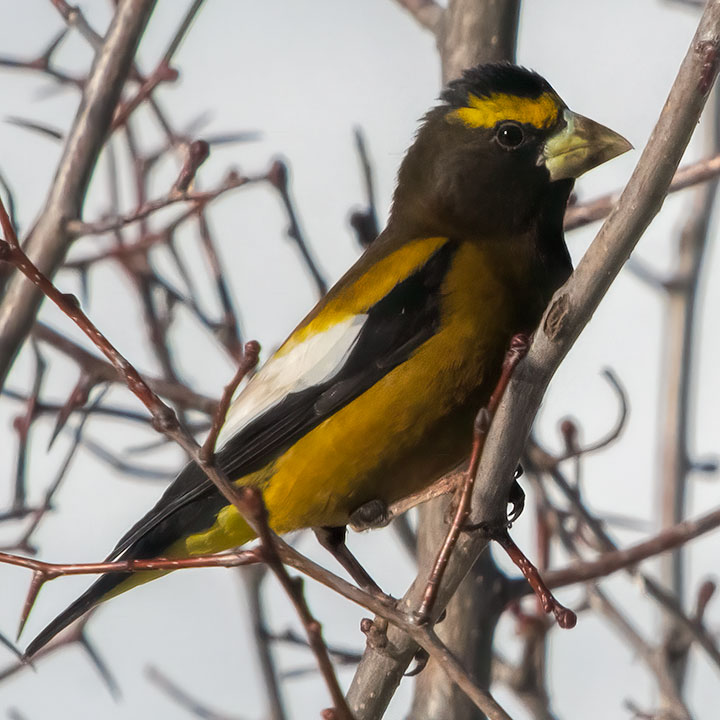
Wandering Grosbeak


The name given this bird by nineteenth-century settlers, Evening Grosbeak, comes from the mistaken belief that it only came out to sing after sundown. Much better is its name in French, le gros-bec errant, for it truly is the wandering grosbeak. Both languages agree on its prodigious beak.

It might be seen around here at any time of the year, but only occasionally, for it wanders widely in its search for food. Although seen by others over recent decades, I last saw one eight years ago.

Last weekend, I watched a small group of them in some black hawthorn bushes — a plant that in some seasons provides them with berries.

A female Evening Grosbeak has a subdued colouration of smoky grey with touches of yellow.

The male Evening Grosbeak is much more stridently coloured.


Posted in birds | 3 Comments

Attacked deer


Now and then, I am reminded that I am only able to glimpse at the lives of the wildlife around me. I see feeding, and furtive attempts to cross a road, but that is about it. However, occasional clues as to the tumultuous lives of deer can be seen. A couple of them were seen a few days ago, but I start with two older observations.

Here is a 2006 shot of a lesion on the leg of a white-tailed deer. I suspect that it records a recent coyote attack — but, who knows? The deer clearly escaped.

Then there is a partial skeleton in the snow seen in 2009. The deer was probably feasted on by a coyote and finished off by ravens.

These early observations were widely spaced. So, it was unexpected to see two more in one day. All that remains in the snow is blood and fur. 

Finally, there was another survivor, a male white-tailed deer (note the pedicle scars), which was crossing the highway in the pre-dawn light. It bore evidence of two prominent lacerations on its side, the size and placement of which suggest the claws of a cougar.


Posted in mammals | 2 Comments