Kestrel upbringing


Life in the nest is good.

Or at least it is, if judged by the reluctance of the young of some bird species to leave it. And why would they ever want to leave? They are comfortable, fed, cleaned, and protected. Yet, there comes a time when offspring must leave and fend for themselves.

How do avian parents get their youngsters to move out? Answer: Stop feeding them.

Four years ago, I wrote about how Ospreys deal with the problem: It’s time you went. This time, the birds are kestrels.

Two weeks ago, this Kestrel nestling lived (apparently) contentedly in its cavity nest in a snag. Juveniles look almost identical to the adult female, but a male chick, such as this one, can be distinguished by the heavier streakiness on the breast.

A week ago, its parents decided it should get out and fly, and apparently stopped feeding it. Hungry and complaining bitterly over this outrageous treatment, the juvenile made it to a nearby branch. There it staged a hissy fit: whining, flapping its wings and even trying to eat the branch.
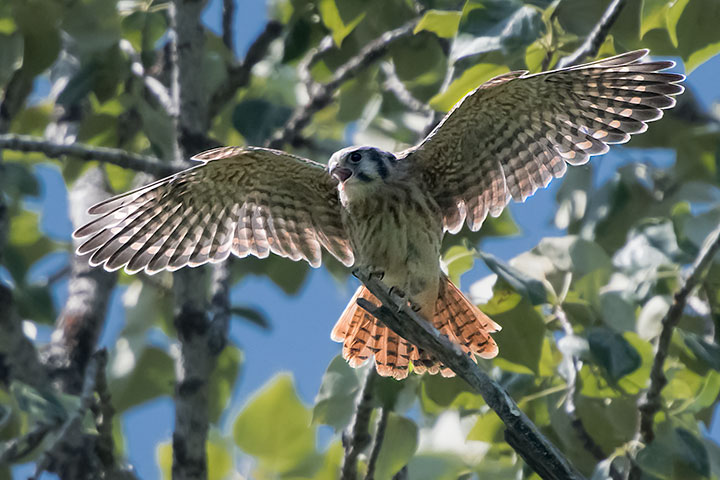
Repeatedly, each parent would fly past, but did not bring food. This is the father. The apparent message was: You must fly before you get further help from us. 
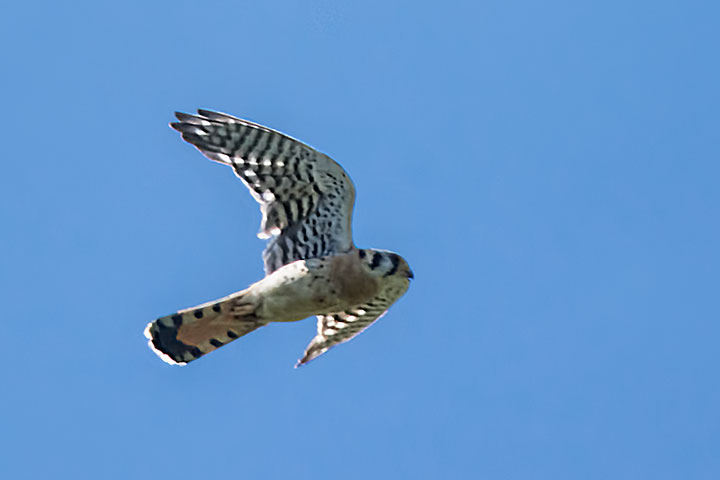
Finally the juvenile Kestrel took to the air, if only to chase his mother. Mother is on the left. The juvenile (stronger breast banding) is on the right bitterly complaining about its dreadful treatment. The poor thing must now learn to live on its own. (Derek Kite photo)
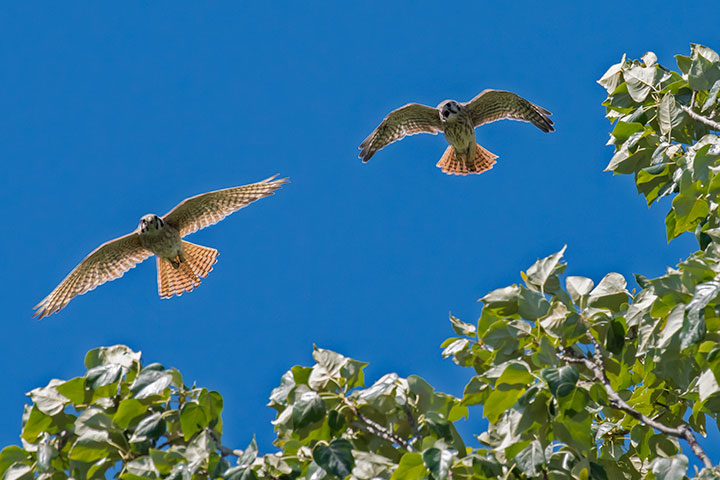
Derek Kite’s photo is used with permission.
Posted in birds, commentary | 3 Comments

Vulture


Various behaviours have been seen with most local birds: flying, perching or swimming. However, I have only ever seen vultures in the air — never roosting or feeding. This is odd.

This is one of five Turkey Vultures circling over farmers’ fields. What were they eyeing?

Posted in birds | 6 Comments

Two-deer day


Today was a two-deer day — in the sense that I saw two species of deer within one day.

This is a buck of the Mule Deer. Its antlers are in velvet.

And this is the fawn of a White-tailed Deer standing by the flank of its mother.

Posted in mammals | 1 Comment

And the cutest is…


The sight of freshly hatched chicks often evokes the word, cute.

For me, the cutest is the fuzzy-feathered, gangly-legged, chick of the Spotted Sandpiper.

Posted in birds, commentary | 3 Comments

Harepin


This Snowshoe Hare has a red pin through its ear — clearly, it is a harepin.

Subscribers will be aware that I delight in having a hare in residence. When I saw yesterday’s lad, I initially assumed that it was my hare in residence. Apparently, not. That this particular hare is not actually my regular visitor is evident from the red pin in its ear — something not seen around the yard before.

Yet, this does raise an interesting question: Who is tagging local snowshoe hares? And why are they doing so?

A Snowshoe Hare in my yard bears a red pin through its ear. Why?

Posted in mammals | 3 Comments

Inflight capture


When a Song Sparrow chases a Mayfly, the match is uneven — the bird will win.

A tenth of a second later, the bug had been captured and swallowed. 

Posted in birds, bugs | 2 Comments

Two-lagamorph day


Yesterday was a two-lagomorph day. 

Lagomorphs are an order that includes hares, rabbits and the pikas. The rabbit is not found here, but we do have the snowshoe hare and the American pika. Neither is seen often, so how likely is it to see both the same day?

The pika is usually found in subalpine talus — which is where this one appeared.

A snowshoe hare was feeding on forbs when it bolted, thus showing its signature hind legs.

Posted in mammals | 2 Comments

Like a bird on a wire


There is something unsettling about seeing a bird on a wire — possibly this arises from the juxtaposition of wild and processed.

The memorable line, like a bird on a wire, came from Lenard Cohen. In the 1960s, he was living on the Greek island of Hydra when the beginning of electrical distribution resulted in a disturbing sight: Birds began to perch on the newly installed wires. This shift in the landscape prompted his iconic song about the freedom to choose. From the bird’s point of view, a wire was just another available perch, which was maybe what Cohen was getting at when he wrote:

Like a bird on the wire … I have tried in my way to be free.

In his song, Cohen used like as a comparative. However, I use it as a verb when I say: On balance, I don’t “like a bird on a wire”.

All of which makes the line ambiguous. Four birds on wires follow.

Mountain Bluebird

Tree Swallow

Rough-winged Swallow

Common Yellowthroat

Posted in birds, commentary | 2 Comments

Portraits of loons


It is difficult to take any good picture of a loon on this lake, let alone a frontal portrait:

• Loons need clear water to spot prey, so they avoid humans, who typically befoul waterways.

• Loons seem to prefer the larger fish found in deep water, so don’t often approach the shore, from which vantage, pictures are easily taken. 

• The high contrast of the loon’s plumage presents exposure problems.

• The common practice of waterbirds is to view potential predators sideways rather than head on. This limits the opportunities for frontal portraiture.

• To top this off, the striking red eye of the summer loon is not apparent from every angle. 

• All of these problems are exacerbated on Kootenay Lake, because loons do not choose to breed along its shores owing to the variation in water level.

• Strikingly, I have been much closer to grizzly bears than I have been to loons.

I was reminded of these issues while searching for a portrait of a loon to include in the posting, Canadian life, and only found a somewhat acceptable one. The odd thing is that one day after that posting, I managed better portraits when two loons did swim close to the shore.

Two loons offer simultaneous frontal and profile views, even including red eyes. To view the full width of the picture, the cursor must be moved to various places across the frame. (A mobile device uses a tap.)
[photonav url=’https://blog.kootenay-lake.ca/wp-content/uploads/2017/07/loon170702as4.jpg’ container_height=720 container_width=694 mode=move position=center]

Posted in birds, commentary | 4 Comments

Hare’s here


A Snowshoe Hare has occasionally visited over the last few months. When first seen, it had already started its transition from the white of winter to the brown of summer. The transition progressed slowly. Three days ago, I saw it in its summer pillage.

The resident Snowshoe Hare stopped by to feed on forbs.

Posted in mammals | Comments Off on Hare’s here


