Grand flyby of swans


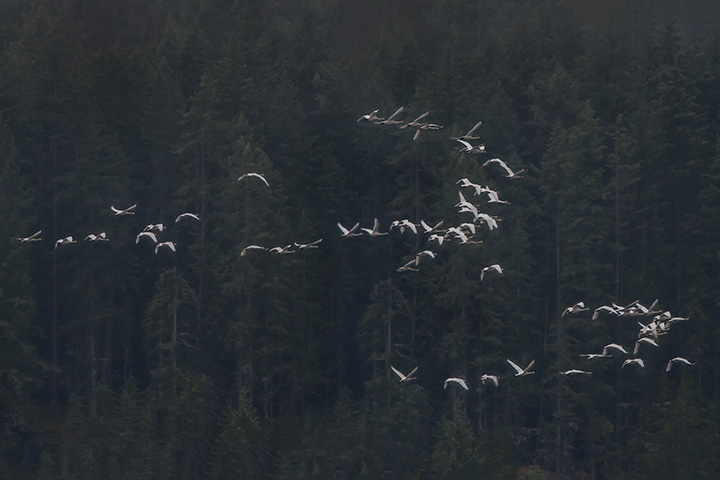
What had been planned for today’s posting was upstaged when about 80 swans (probably Trumpeters) flew down the Lake heading west. It was the best flyby I have seen.

The picture, below, shows the first seventy or so of them. Another dozen or so swans following behind were out of the picture. They will all head to the High Arctic to breed.


Posted in birds | 6 Comments

Otter twist


When climbing out of the Lake, many animals disperse water by twisting and shaking. Dogs do it, eagles do it, and otters do it. 

While I had seen otters spin their heads to shake off water, I had not photographed it — that is, until two days ago.

Two River Otters frolicked on a dock. In turn, each twisted to shake off water from immersion.

Posted in mammals | 1 Comment

March goulash


This is a month’s end collection of images, none of which has had a posting of its own. They are all local birds as other topics were treated earlier in the month.

Birds, yes, but what are these distant ones flying over a ridge of Mount Loki? Geese?

Northern Flickers (female, left; male, right) are setting up spring housekeeping.

A Merlin watching for prey from a treetop voices its objection to anyone watching it.

A Red-breasted Nuthatch flies by.

A crow starts eating a vole, but soon the meal was stolen from it by another crow.

A Common Goldeneye courts his inamorata with a head-pumping display.

A Rough-legged Hawk flies by. Soon it will leave for the High Arctic to breed.

This goulash comprises images that had not rated their own postings. However, it might be that this shot of Trumpeter Swans deserved to have made the cut.

Posted in birds | 3 Comments

Robin attack


Now begins the season of the attack robins.

Robins are territorial nesters and will attempt to drive off all rivals, including those that are merely reflections of themselves as seen in a window. Further, as the mirrored robin is equally aggressive, the contest can proceed almost interminably with no clear winner. 

To get a head-on image of a robin attacking a window’s reflection, this picture was taken from inside the house and so shows all the blotches and strangely coloured reflections of such a view.

Posted in birds | 2 Comments

Cryptic muskrat


Sometimes camouflage allows wildlife to pass almost unnoticed.

Posted in mammals | Comments Off on Cryptic muskrat

March marmot again


Over the preceding five years, the first marmot I noticed appeared progressively earlier in the season. Five years ago, it was late March, last year it had shifted to late February. Was this a trend? With the persistent snows of this year, the first marmot spotted is again in late March. 

Yesterday’s yellow-bellied marmot looks almost pensive as it contemplates spring.

Posted in mammals | 5 Comments

Killdeer skating


Killdeers are the first shorebirds to arrive each year. They have been reported from around the region for a week now. This year, some encountered ice.

A frozen pond did not prove as inviting to an arriving killdeer as would a watery shoreline. 

It decided to go elsewhere, but taking off from ice proved to be a dignity-destroying affair.

It regained its footing only to look like a beginning skater. 

Finally airborne, it chirped its displeasure with ice in late March. 

Posted in birds | 4 Comments

Icicle ripples


With the (inept) proclamation in the media that yesterday was the first day of spring, icicles would seem to be an inopportune topic. Yet, sometimes a natural phenomenon festers for years before treatment. Such is the case with icicles.

Icicles were a winter staple of my childhood home (elevation ~1060 m) in Rossland. That was in an era that preceded modern home insulation, so heat leaking through the roof in sub-zero weather resulted in abundant icicles. Indeed, my father broke his back in a fall from a ladder while trying to clear icicles from our home.

The origin, growth, tapered shape, and many features of icicles provide a rich cabinet of curiosities. These are worthy of many postings, so more may appear in subsequent years. The topic for the moment is the ripples that may grace the sides of icicles.

The odd thing is that sometimes icicles have remarkably smooth sides; yet, sometimes they display ripples which, strangely, all have a wavelength of about a centimetre. Now, I cannot explain why these ripples arise. However, as a result of a study by Chen and Morris of the University of Toronto (On the origin and evolution of icicle ripples), I can say what causes them: salt. Salt is an ionic solute: It separates into ions upon dissolution. I can only guess why this might produce ripples in icicles. 

These icicles have smooth sides indicating that the water flowing to them from the roof is pure. 

These icicles show prominent ripples suggesting the presence of an ionic solute, such as salt. They formed in the wilderness from the natural drainage off the face of a cliff.

Posted in weather | Comments Off on Icicle ripples

Road rock


A temporary break in the rains has left mountain slopes sodden. This has resulted in mudslides blocking highways. 

When late in the day, one lane of this highway was opened to alternating traffic, it was clear that in addition to a few mudslides a substantial rock blocked the passage.

Posted in weather | Comments Off on Road rock

I watch, you shouldn’t


Red-tailed Hawks are rather like governmental spy agencies: They like to watch, but they do not appreciate it when they are, themselves, monitored.

The hawks frequently watch from utility poles or trees alongside a roadway, apparently waiting for road-kill. They remain unconcerned if the traffic speeds by below, but if they notice that someone is watching them, even from afar with a scope, they often retreat.

While I am sympathetic to these hawks and do avoid stressing them, it is ironic that they want us to ignore them while simultaneously perching on man-made structures so as to watch our roads. By way of contrast, an eagle or owl would just ignore a passing human. 

A minor perquisite of this hawk skittishness is that as a hawk leaves, flight shots are possible. Below are three different flying hawks taken over a period of a three weeks.

A Red-tailed Hawk flew off as I watched from the roadside. The reddish tail is obvious.

Another Red-tailed Hawk lifted off from a distant utility pole and then proceeded to hunt from aloft. This was the first time I had seen a hawk deploy its alulae while trying to hover over prey.

This Red-tailed Hawk flew from a roadside lamp standard. That its tail has yet to turn red reveals it to be a juvenile. 

Posted in birds | 3 Comments