Sodden grouse


Birds do not have expressive faces, so normally one has to judge their thoughts by their actions. However, there is an occasion when a bird gives the appearance of being downright miserable. (Two pictures, below.)

A Roughed Grouse was spotted perched in a tree as it waited out an interminable downpour.

With sodden and matted feathers, the grouse looked as if it were miserable.

Posted in birds | 3 Comments

Kingfisher


The kingfisher is restless when fishing and skittish when approached. So on the rare occasion when one is close, a picture is in order.

The kingfisher has been described as cute, probably because its oversized head and disheveled hair remind us of children.

Posted in birds | 7 Comments

Carbon antlers


The title, carbon antlers, is easy to misread as caribou antlers. Yet, they are not real antlers, but a fungus, Xylaria hypoxylon, that grows on decaying wood. The common names, carbon antlers, stag’s antlers and candlestick fungus, come from the fruiting portion, which extends above the ground often in branched columns redolent of antlers or candlesticks.

Carbon antlers grow amongst moss. Although they don’t look carbon black now, they will turn so at a later stage.

Posted in wildflowers | 3 Comments

Icebreakers


Kootenay Lake has three (semi?) aquatic mammals. By medium weight they are: the beaver (~ 23 kg), otter (~ 8 kg), and muskrat (~1.2 kg). 

It is difficult enough to obtain decent pictures of any of the three, but obtaining shots of each interacting with ice is distinctly less likely. So, when I realized that with last week’s picture of a muskrat, I had an example of each, I felt that it was worth a posting. 

How each mammal interacts with ice probably depends upon its weight and ice thickness, but my sample of pictures is too small to allow anything but anecdotal comments. 

The heaviest of our aquatic mammals, the beaver just plowed through the grease ice. (Jan. 16, 2015)

This otter is dealing with much thicker ice, but keeps the dive hole open by stirring the water even while apparently napping. (Dec. 27, 2013)
 

Weighing little more than a kilogram, this muskrat tried to break the freshly formed ice with its claw. Failing to do so, it then dived and swam underwater to the shore. (Nov. 4, 2015)

Posted in mammals, weather | Comments Off on Icebreakers

Seasonal raptors


One of the interesting features of birds is how many of them change with the season.

Merely consider two raptors: the Osprey and the Rough-legged Hawk. These two species might well never meet. The osprey spends the summer here, but winters in Central America. The Rough-legged Hawk spends the winter here, but summers in the arctic tundra. Even if they were to overlap briefly, they occupy different local niches: the Osprey captures fish in the Lake and the Rough-legged Hawk captures rodents in fields.

In honour of the seasonal return of the Rough-legged, I show composite images of each bird as it flew past me.

This is a composite image of a single osprey flying past at the end of July.

And this is one of a Rough-legged Hawk seen earlier this week.

Posted in birds | Comments Off on Seasonal raptors

Coyote’s delight


“Grasslands are vast; voles are abundant; sunlight is warm — life is good.”

Posted in mammals | 3 Comments

Frost patterns


This is the time of year to watch for patterns in frost. Viewing is best around sunrise following a clear night.

The patterns of frost, dew, and snow melt have been discussed other years (e.g., IR snow melt) and so explanations will not be repeated.

These are footprints on a sandy beach. The frost-covered ridges are colder than the valley floors.

The frost-covered lawn surrounding a small tree is colder than that under the tree.

Posted in weather | Comments Off on Frost patterns

Morph, not moult


For some time, I fancied that I had a residential Ruffed Grouse — or at least my yard lay within its limited range. Maybe it stuck around because it viewed my yard as a sanctuary.

Alas, reality has undercut both conceits. First to go was the matter of a safe haven when a neighbourhood dog executed the bird. Second, was the fact that the grouse continued to appear. Apparently, I was not observing a single bird, but a few of them. 

Certainly, I had noticed that the colour of the grouse did not remain constant, but then the lighting varied, and besides all birds moult and sometimes can change their plumage in spectacular ways. The problem was that while the Ruffed Grouse moults, it retains the same look. Further, its breeding plumage is available at any time of the year merely by erecting its ruff and fanning its tail. The variations I was seeing were not a result of moulting.

It turned out that the Ruffed Grouse has two colour morphs (or phases), rufous and grey, where the frequency of each depends upon climate and habitat. We have both morphs here, and this simple fact made it clear that I was seeing more than one grouse in my yard. 

The Ruffed Grouse has his display plumage available whenever he wishes to threaten another male or attract a female. He does not have to moult into it. (Oct. 10, 2014)

This is a rufous morph wandering through my yard. (Feb. 2, 2014)

And here is a grey morph seen yesterday. Ah well, I watch; I learn.
 

Posted in birds | 2 Comments

October goulash


This is an end-of-the-month collection of nine images, none of which rated a posting on its own. 

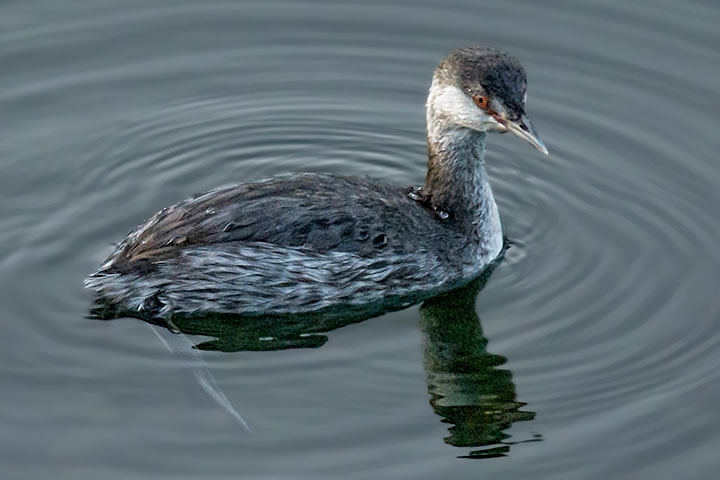
In its winter plumage, a Horned Grebe does not look as grand as when it’s in its breeding plumage.

I enjoyed the contrast between the youth of the juvenile heron and the decrepitude of the ancient dock.

When spooked, many animals face the choice of whether to flee, fight or freeze. This chipmunk froze in the hope that it wouldn’t be noticed. It stayed this way for a while before bolting.

A Kingfisher dived, entered the water on the left, but emerged without a fish.

A juvenile gull is not high on the list of exciting wildlife observations, yet I liked the view of a black-and-white bird seen against the wine-coloured leaves of October’s Red Osier Dogwood.

We think of colourful fall leaves on trees and on the ground, But what about the leaves under water? Here a dipper is probing the creek’s bounty amidst a scene of submerged autumnal leaves.

That a male Shadow Darner was still hunting in mid-October was unexpected.

A Ring-billed Gull coming in for a landing tips back, spreads its tail, and deploys is alulae.

Carmine dominates as the Varied Thrush visits rowan berries.

Posted in birds, mammals | 5 Comments

Swans


We receive welcome visits from swans twice a year when they stop by on their migrations, usually centred on March and November. So, this morning’s visit of some swans was timely. 

But, which of our two species appeared, Tundra or Trumpeter? Although they differ in a number of ways, it is difficult to tell them apart from a distance. That this family of four were Trumpeters was decided by:

  • the heavy bills that lacked yellow lores;
  • the calls they made to one another;
  • the way the neck was kinked when they were in the water.

Four Trumpeter Swans flew westward to Kokanee Creek Park from the Main Lake.

I have seen swans many times, but this was the first time I listened to them calling to one another.

Posted in birds | 3 Comments