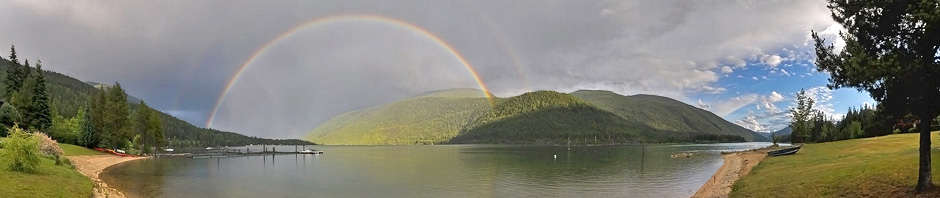
While I could offer an explanation for this morning’s cloud iridescence, instead I am going to give all the credit to its ancient eponym, Iris, the Greek goddess of sky, rainbow, and the messenger of the gods. (Two pictures, below.)


While I could offer an explanation for this morning’s cloud iridescence, instead I am going to give all the credit to its ancient eponym, Iris, the Greek goddess of sky, rainbow, and the messenger of the gods. (Two pictures, below.)
When one thinks of the migration of a species, the first thing that comes to mind is one that moves horizontally across the globe. An osprey moves from the Kootenays to Central America for the winter and back here to breed in the summer. Caribou in the Arctic make migrations of thousands of kilometres. Birds and mammals cover vast distances during their seasonal migrations.
However, in mountainous regions, there is another option: altitudinal migration. Indeed, the local Mountain Caribou don’t travel vast distances horizontally, but do move upslope in the winter (to escape predators) and downslope in the summer. Pygmy Owls spend the winter in the valleys, but the summer at high altitudes. The list of altitudinal migrants is fairly long and includes the Varied Thrush, hummingbirds, various insects, Dark-eyed Juncos, both species of local bears, and coyotes. They can accomplish quickly that which latitudinal migrants take far longer to do.
The attitudinal migrant du jour is the Pacific Wren. In the summer and fall, I have only seen it above a thousand metres or so. In the winter, it is down along the lakeside at under 600 metres.
The Pacific Wren is a secretive bird of the forest. It creeps about near the ground almost unseen beneath dense tangles, but betrays its presence by being delightfully boisterous about it.

This morning’s haloes, forming over the Lake, might have been expected. After all, a storm is moving towards us and is expected to bring rain overnight and tomorrow. Often such events are presaged by a canopy of cirrus, which is just the thing to give haloes. Yet the sequence of a halo preceding a storm, while common on the Coast, is not all that common around here.
The appearance of these circles, arcs and spots in the sky requires the ice crystals to have simple shapes. The stellar crystals, beloved of shop decorators around Christmas, just don’t do it. Rather, what is needed is either a hexagonal column (somewhat like a wooden pencil with a hexagonal cross section), or a thin slice through that (somewhat like a hexagonal dinner plate). The growth of these shapes results from the small supersaturations that are characteristic of the slowly ascending air found as a storm approaches from the ocean. The more chaotic air motion over the mountains seems to favour higher supersaturations and the more complex crystal forms.
Sometimes we do see the simple crystal forms in the sky. What was interesting about this morning’s haloes was that they only resulted from columnar crystals, not plates. Which form appears depends not only on the humidity, but also the temperature in the cloud.
In the scene, below, the 22° halo is the smaller one centred on the Sun. It is formed by quite small crystals that assume a wide range of orientations as a result of the Brownian motion in the air. Sunlight passing through the 60° prisms presented by alternative crystal sides is deviated by a minimum angle of about 22° to give the halo. As the columnar crystals grow larger they become horizontally oriented by aerodynamic forces during their descent. These crystals give the upper tangential arc that appears as the bird wings touching the top of the 22° halo.
At about twice the distance from the Sun as the 22° halo is another one. This is explained by sunlight refracting through the 90° prism ends of columnar crystals. If these crystals were small and assumed a wide range of orientations, they would produce the 46° halo. It is more likely that what we are seeing is the result of larger columnar crystals producing the supralateral tangential arc.
Be that as it may, the features that would be caused by hexagonal plate crystals — sundogs, circumzenithal arc — are missing. To see a posting with some of these other features, visit celestial splendour.

One does not set out to see a quail around here — the likelihood of success is just too low.
The California Quail is not indigenous to the Province. There are some in southern Vancouver Island, where they were seeded in the 1860s, and southern Okanagan, where they probably snuck across the border from the US. An expedition to find quails might have the possibility of success at those places, but not here. The number of observations here are too few to justify the effort.
Yet, here were a half-dozen of them by the side of a secondary road. It is unclear why, but they were fun to see.
A male California Quail hopes that its inactivity makes it invisible.

Each of my handful of sightings of the Red Crossbill has, unexpectedly, been incidental to watching grizzly bears. While the most recent shots of crossbills are not as detailed as those of an earlier occasion, the pattern of seeing them while scouting for grizzlies remains. I cannot imagine that this pattern will be sustained, but it has produced an odd coincidence.
These are a few of the many Red Crossbills seen filling a tree adjacent to grizzlies.

They enabled me to alternately photograph crossbill and grizzly.

This was the first time I had seen a grizzly sow react protectively when encountering a grizzly boar.
The Grizzly Bear is a top predator: Even a cougar will back away from its kill when a grizzly approaches. No other local wildlife matches the strength of a boar (male grizzly). The boar leads a solitary life. He is aggressive towards other males in his territory, towards females that refuse to mate with him, and even towards cubs, although the boar will usually accept a female in his territory if she doesn’t have cubs.
Why doesn’t the boar like cubs and will even try to kill them? There seem to be two reasons: He sees the cubs as potential competition; Females with cubs won’t mate. Even though smaller, a female will fight vigorously to save her cubs.
The first grizzlies seen were a sow and her three cubs. They were foraging along the side of a backcountry road. At one point, instead of continuing along the road, she turned and moved her charges into the brush.

When deep in the brush, the sow arranged the cubs tightly around her, almost as if they were assembled for a family portrait. Although she was agitated, the cubs seemed relaxed, one even licked its mother. I have seen a sow with her cubs a number of times, but never before assembled as here (photo: CCF).

The reason for the sow’s behaviour became clear: a boar appeared from the side of the road (photo: FFG).

The immediate response of the sow was to minutely monitor the movement of the boar. When the boar wandered off in the other direction, the sow took her cubs farther into the woods (photo: FFG).

In fairness to the skittish sow, I, too, was cautious around this fellow.

The second picture was taken by Cynthia C. Fraser. The third and fourth pictures were taken by Finn F. Grathwol. Each is used with permission.
“Thank you for your gracious offer to have us all for dinner this evening. May we ask what you are serving?”

A sighting of Grizzly Bears in the South Selkirks revealed a more healthy looking family than the lone bear seen elsewhere. These grizzlies appeared to be feeding on tubers, rather than the grass the gaunt grizzly relied upon.
Displaying the confidence of the callow, a cub surveys its world in the dim light before sunrise.

Nearby a sow stands over her other two cubs (lower left and right) as they feed.

Here the whole family is seen feeding together in the yellowish light of sunrise.

At one point the adventuresome cub dug deep in the earth and ate something. As it climbed out, it shook off the dirt just as a dog or otter would shake off water. 
Buddies.

 This blog does not usually concern itself with the activities of people. That is the domain of news organizations and social media. This posting is an exception: I laud KICS.
The web is so much a part of our lives now that it is hard to imagine a time before it came to be. Yet, only twenty years ago, virtually no one in the public had heard of it and the combination of words, dot com or dot ca, was not on our radar. However, the power of this new communications medium was evident to a few prescient locals. The Kootenay Internet Communications Society (KICS) was launched as a volunteer service in 1997 to provide individuals with email service and organizations, particularly local nonprofits, with website support.
Now, eighteen years later there are a great many commercial options available and KICS feels it has fulfilled its mandate. As of November 1st, KICS will have completed its mission. Our community looks different now than it did in the mid 1990s: Everyone is connected and communicating. A good deal of the local transition was eased as a result of the efforts of the volunteers who established and ran KICS.
This posting is the first to be made on this blog that hasn’t been delivered from a KICS server. I remain in its debt for supporting my efforts; many in the community remain in its debt.
The web was new in the 1990s. The prescient volunteers of KICS recognized the potential advantages to our community. They arrived with sustenance when we didn’t even understand we wanted it.

Snowberry eaters
What eats snowberries?
Most types of berries are colourful, sweet and juicy, a persuasive combination that prompts birds to eat them and consequently to spread the seeds. In stark contrast, snowberries (waxberries) are white, tasteless and dry. As snowberries are both widespread and common, they have clearly evolved an effective strategy for propagation, but what is it? What eats snowberries and disperses their seeds?
A web search for snowberry eaters produces a list of frugivorous (fruit-eating) birds. There were also suggestions, such as that of Wayne Weber, that snowberries aren’t the preferred food of birds and that most of them probably fall to the ground before they get eaten.
Terry Taylor takes this idea further and argues that: by not being juicy, they avoid the competition of the fall berry season; by not being sweet, they resist mould and so extend seed dispersal into the hungry time of winter; by being white, they are more readily visible on the ground at night where they can be eaten by mammals. He suspects that the seeds are spread primarily by rodents.
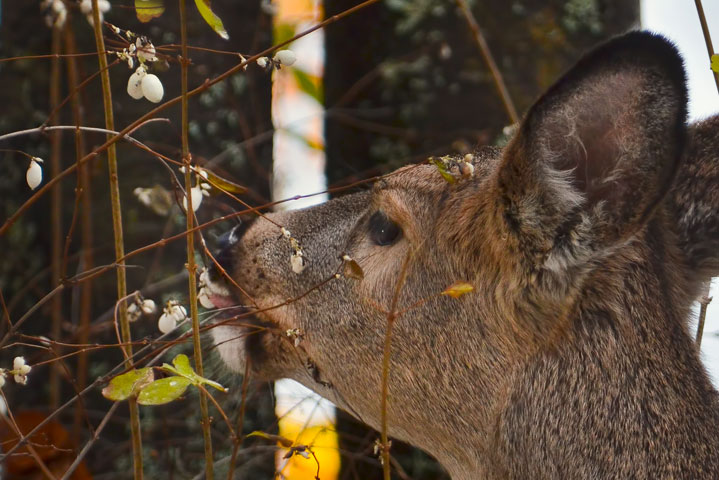
Taken together, these nice bits of biological detection suggest that, while birds occasionally eat them, snowberries evolved to appeal primarily to mammals.
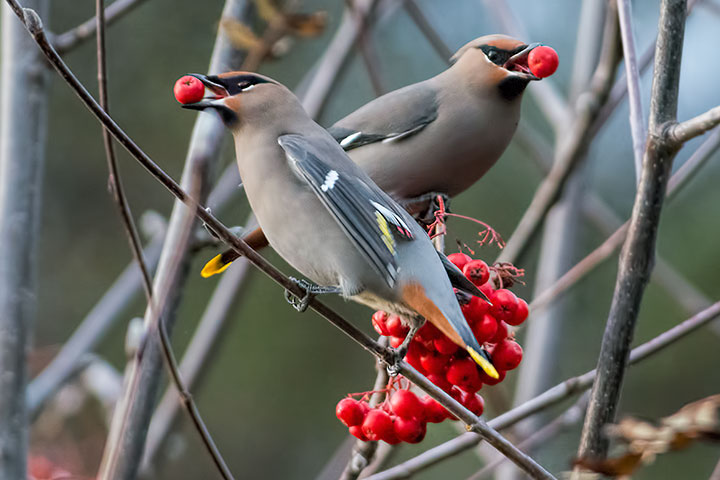
In the fall, most berries compete for the attention of birds by being colourful, sweet and juicy. These rowan berries (mountain ash) have attracted Bohemian Waxwings (November 18, 2014).
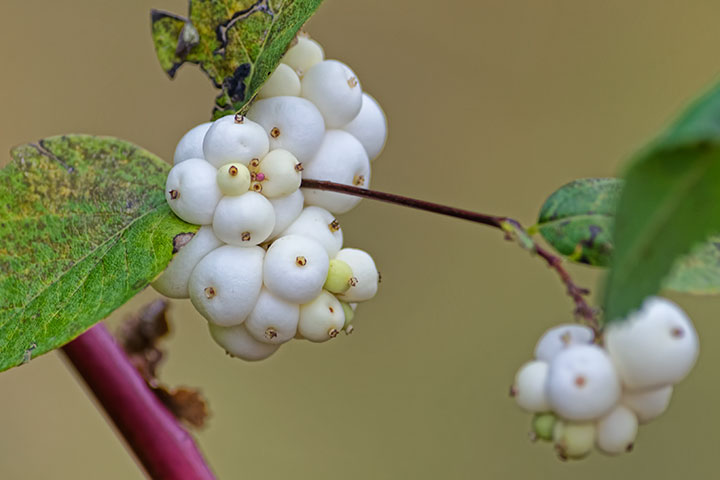
Snowberries avoid the fall competition by being white, tasteless and dry, but they last into the hungry season when they have the stage to themselves (October 18, 2012). Although occasionally birds eat them, I have yet to see this.
However, I have seen mammals eat them. This is a White-tailed Deer (November 11, 2011).
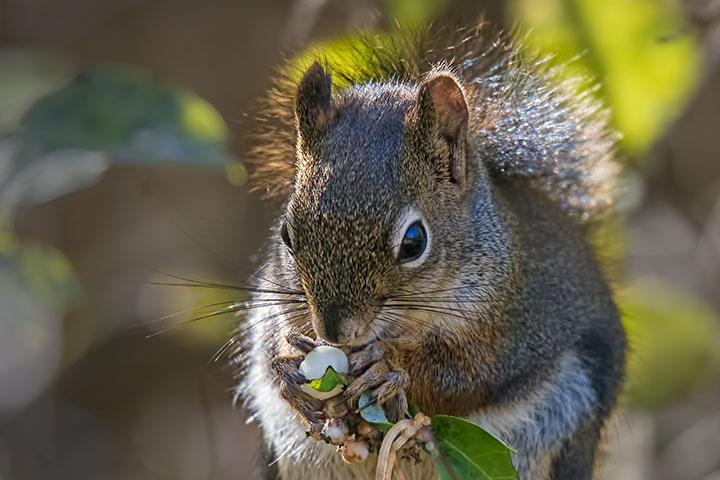
And, here is yestermorn’s observation of a Red Squirrel.