Kingbirds


Kingbirds are flycatchers. We are near the northwestern end of the range of two species. The Eastern Kingbird is black and white. More colourful, the Western Kingbird is grey, and yellow.

An Eastern Kingbird is watching for insects from a perch.

A Western Kingbird was seen preparing to feed a longhorn beetle to its enthusiastic chick.

“Eat up.”

Posted in birds | 1 Comment

Vultures redux


It seems that a PR representative of the Union of Carrion Workers (Vulture Division) must read my blog. A week ago, I commented that I had only ever seen Turkey Vultures flying, but never perched. Apparently, the Vulture Local was concerned by this lack of representation, and three days later, I was shown seven of them perched in trees.  However, they were all distant and I posted nothing about it. So, the vultures upped the ante and yesterday I was given a close view of two. It pays to complain.

Two of seven Turkey vultures seen Tuesday when perched on distant snags.

This is one of two nearby Turkey Vultures seen on Friday.

The other vulture devoted its time to preening.

Posted in birds | 1 Comment

Butterfly roving


There are worse ways to spend a few hours than to wander amongst butterflies.

Painted Lady (topside of wings)

Painted Lady (underside of wing)

Common Wood-Nymph

Great Spangled Fritillary (in flight)

Purplish Copper (feeding)

Purplish Coppers in flight with the male (upper left) approaching the female.

Woodland Skipper

Hedgerow Hairstreak

Northern Crescent 

Northern Checkerspot (portrait)

Posted in bugs | 1 Comment

Ducks of that ilk


Sometimes a picture is taken merely so as to delight in a whimsical, but obscure, title. It may be that only a canny Scots botanist will get this one.

Posted in birds, commentary, wildflowers | Comments Off on Ducks of that ilk

Hello mommy


Posted in birds | 2 Comments

Kestrel upbringing


Life in the nest is good.

Or at least it is, if judged by the reluctance of the young of some bird species to leave it. And why would they ever want to leave? They are comfortable, fed, cleaned, and protected. Yet, there comes a time when offspring must leave and fend for themselves.

How do avian parents get their youngsters to move out? Answer: Stop feeding them.

Four years ago, I wrote about how Ospreys deal with the problem: It’s time you went. This time, the birds are kestrels.

Two weeks ago, this Kestrel nestling lived (apparently) contentedly in its cavity nest in a snag. Juveniles look almost identical to the adult female, but a male chick, such as this one, can be distinguished by the heavier streakiness on the breast.

A week ago, its parents decided it should get out and fly, and apparently stopped feeding it. Hungry and complaining bitterly over this outrageous treatment, the juvenile made it to a nearby branch. There it staged a hissy fit: whining, flapping its wings and even trying to eat the branch.
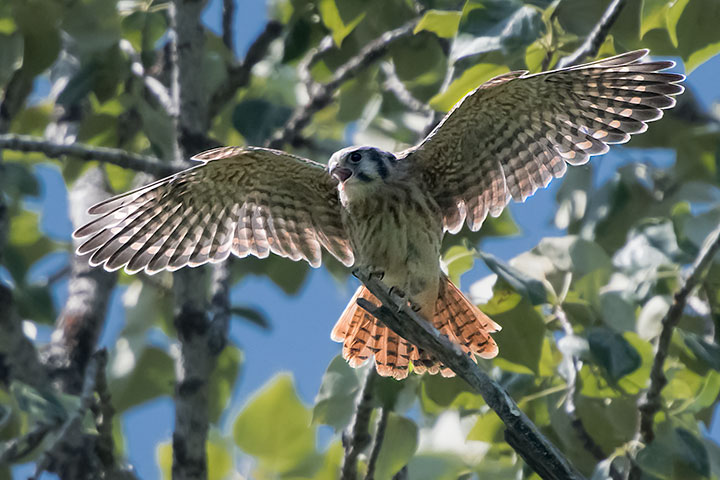
Repeatedly, each parent would fly past, but did not bring food. This is the father. The apparent message was: You must fly before you get further help from us. 
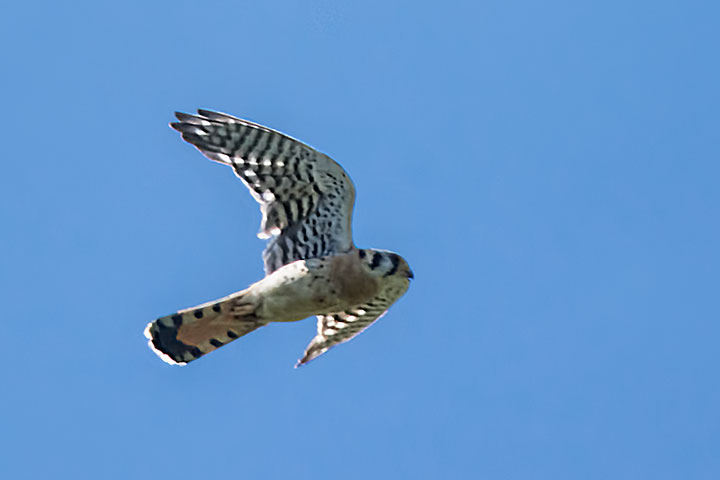
Finally the juvenile Kestrel took to the air, if only to chase his mother. Mother is on the left. The juvenile (stronger breast banding) is on the right bitterly complaining about its dreadful treatment. The poor thing must now learn to live on its own. (Derek Kite photo)
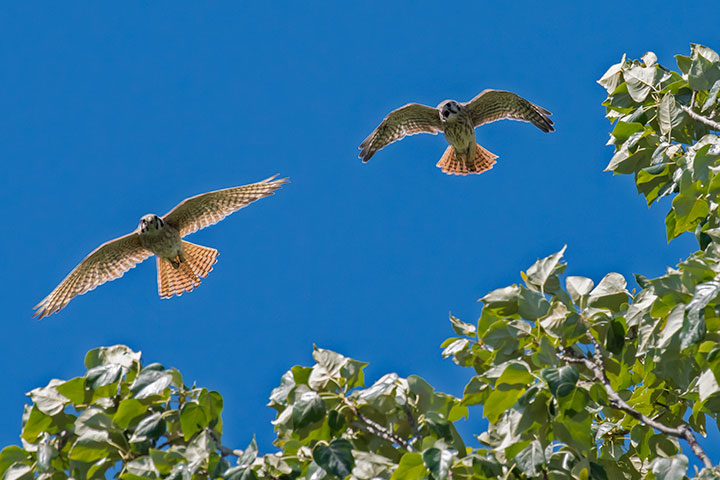
Derek Kite’s photo is used with permission.
Posted in birds, commentary | 3 Comments

Vulture


Various behaviours have been seen with most local birds: flying, perching or swimming. However, I have only ever seen vultures in the air — never roosting or feeding. This is odd.

This is one of five Turkey Vultures circling over farmers’ fields. What were they eyeing?

Posted in birds | 6 Comments

Two-deer day


Today was a two-deer day — in the sense that I saw two species of deer within one day.

This is a buck of the Mule Deer. Its antlers are in velvet.

And this is the fawn of a White-tailed Deer standing by the flank of its mother.

Posted in mammals | 1 Comment

And the cutest is…


The sight of freshly hatched chicks often evokes the word, cute.

For me, the cutest is the fuzzy-feathered, gangly-legged, chick of the Spotted Sandpiper.

Posted in birds, commentary | 3 Comments

Harepin


This Snowshoe Hare has a red pin through its ear — clearly, it is a harepin.

Subscribers will be aware that I delight in having a hare in residence. When I saw yesterday’s lad, I initially assumed that it was my hare in residence. Apparently, not. That this particular hare is not actually my regular visitor is evident from the red pin in its ear — something not seen around the yard before.

Yet, this does raise an interesting question: Who is tagging local snowshoe hares? And why are they doing so?

A Snowshoe Hare in my yard bears a red pin through its ear. Why?

Posted in mammals | 3 Comments