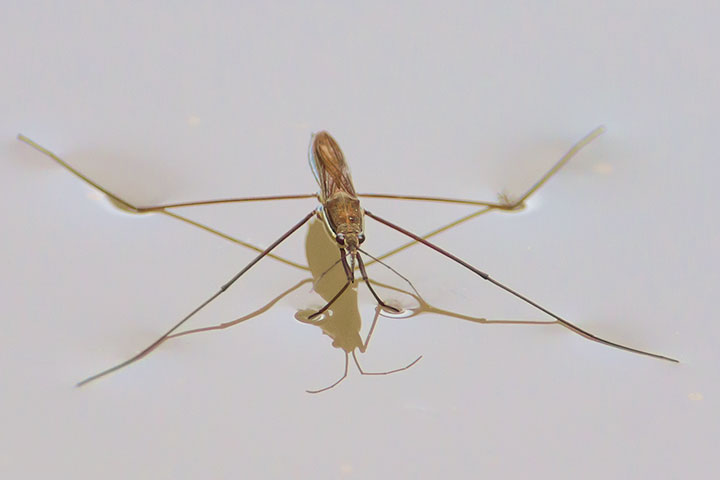
A pond skater goes by an amazingly large number of common names. Wikipedia lists some—water strider, water bug, magic bug, pond skater, skater, skimmer, water scooter, water skater, water skeeter, water skimmer, water skipper, water spider, Jesus bug—but, there are even more that those. Such a proliferation implies that the bug, itself, must be remarkable. And it is: it walks on water.
The skater makes use of the surface tension of water for support by distributing its weight across long hydrophobic legs. From its maneuverable position on the surface of the water, it can detect, hunt down, and consume less fortunate invertebrates that have fallen onto the water and have become trapped by that same surface tension.
I watched a pond skater (Limnoporus notabilis) that initially seemed to be aimlessly standing on the water’s surface. Yet, it was busy. Its two front legs were feeling the water for ripples produced by anything trapped by, and struggling against, the surface tension. The ripples carry information about the bug’s direction, distance and size. The skater sensed something and abruptly headed straight towards another bug about four meters away and undoubtedly beyond its visual acuity.
The skater quickly closed in on a female robber fly (Nicocles sp.). After all, the skater is highly mobile on the water’s surface and the fly is not.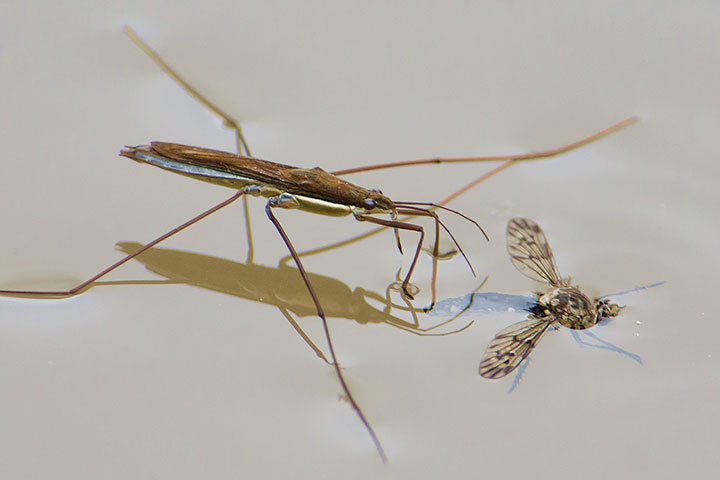
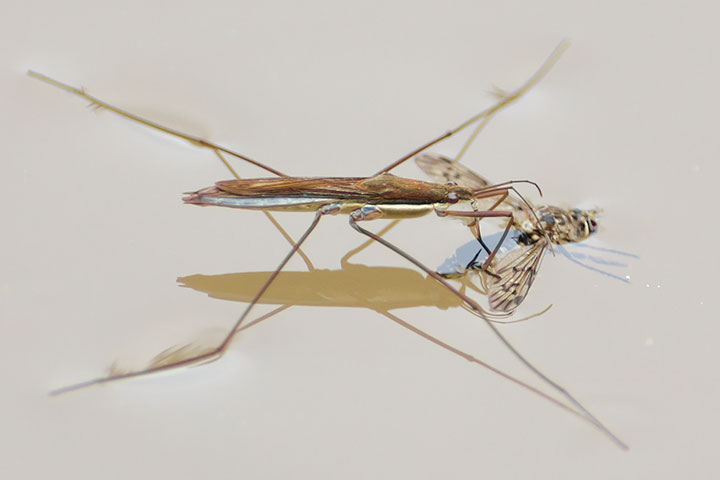
The skater punctured the robber fly’s abdomen and began to suck its juices. The fly now struggled against both the water’s surface tension and the actions of the skater. It thrashed about vigorously, but the outcome was foregone. There was no escape; this is how the skater makes its living and it is good at it.
Alistair, I get such enjoyment out of the daily or weekly nature lessons and I am in awe of your photography. I have often marvelled at the dexterity of the water bug.
Lois
You never fail to amaze me Alistair. I’ve watched these critters on the pond for many years and wondered how they did that (with some envy) I see now thanks to your photos.
I aver with the above two comments. What I wonder, though, is what makes the legs hydrophobic? Is it the configuration of the cells; are the legs marbled with oil? Or is it the configuration of the legs beneath the body? I’m baffled.
Pamella, it is a combination of things: both the surface material and its structure can contribute to making a surface hydrophobic.