Otters and ice


A pair of River Otters ceaselessly patrolled the edge of border ice. Why? Were fish more plentiful there, possibly because ice forms where water is shallow, or because fish seek safe darkness under ice? Does anyone know? Whatever the reason, the otters did catch a fish (but the picture of it was poor).

A shot of nearly submerged otters is not nearly as interesting as ones where they are half out of the water,

climbing onto the shore,

perching on a snow bank,

or sitting on border ice.

Posted in mammals | 2 Comments

Grebe 1, crayfish 0


Of the four species of grebes that frequent Kootenay Lake, the Pied-billed Grebe is the smallest and least often seen. So, when one is spotted, it is worth watching: Will its underwater foraging produce anything of interest?

Thursday’s Pied-billed Grebe made, what to me was, an unexpected find: a crayfish. I did not even realize that Kootenay Lake contained crayfish, and now the grebe was feeding on one—the grebe knew what I did not.

A Pied-billed Grebe was hunting along the shore of Kootenay Lake.

It dived and surfaced with something that, at first, I thought was a fish.

But, those dangling legs didn’t quite fit the profile of a fish.

The grebe had captured a crayfish. Is it is a native Signal Crayfish, Pacifastacus leniusculus, or an invasive Rusty Crayfish, Oronectes rusticus? My pictures are probably not good enough to distinguish. However, the grebe did not care. Its main problem was to turn the crayfish from being athwart its bill to aligned with it so as to swallow it.

The grebe dropped the crayfish and picked it up again so it was aligned with its bill.

Then with one gulp, the crayfish vanished down the grebe’s gullet.

Posted in birds | 2 Comments

White-fronted Goose


These blog postings usually explore the ordinary. Ordinary doesn’t mean familiar, indeed obscurity often dominates. However, the exploration is ordinary in the sense that it treats locally encountered features.

Ordinary doesn’t apply to the solitary Greater White-fronted Goose that has been hanging out at Nelson’s waterfront for the last month. This goose breeds in the tundra far to our north and winters far to our south, but its migratory path rarely takes it anywhere near Nelson. That one is here is distinctly odd.

The bird is a juvenile: it has not yet developed its full adult plumage. Maybe it arrived after wandering off the normal path of its southern migration. This one likes to hang out with local Canada Geese.

The White-fronted Goose is named for the white on the front of its face.

Posted in birds, commentary | Comments Off on White-fronted Goose

Frost flowers


After first spotting frost flowers along the shore of Kootenay Lake in 2009, I had to wait five years for the next sighting. Now only a year later, I have seen them again.

In fairness, I did not find them; my grandson, Finn, did that. As with some wild orchids last summer, having told him about them, he went out and found some—ah, to see through the eyes of a child. 

In both appearance and process, frost flowers differ from the familiar hoar frost. The latter occurs when vapour condenses onto a cold surface in a process that involves vapour cooling. Hoar frost is characterized by a continuous covering of frost. The formation of frost flowers involves a warm surface and a distinctly different condensation mechanism known as vapour mixing. It is characterized by discrete flowers that form above a warm surface.

The background is the frozen surface of a creek through which the creek bottom is visible. The surface may be cold, but it is warmer than the air above it where the vapour mixing occurs.

Anything sticking into the region where the warmer vapour mixes with the colder vapour can serve as a nucleus for the formation of frost flowers, as these sticks and leaves illustrate.

My favourite shot of the frost flowers on the ice-covered creek was one taken by Finn. It shows three tightly grouped flowers sitting above the ice.

Finn Grathwol’s image is used with permission.

Posted in weather | 4 Comments

Pine Grosbeak


The Pine Grosbeak is an irruptive species: some years it is here in abundance; other years it is absent. This year it is here. It is easy to spot when it is feasting on rowan berries (mountain ash). 

It is easy to tell the sexes apart. The male shows almost the same red as the berries,

while the female has an orangish trim.

The Pine Grosbeak is not easily spooked by humans, so can be approached for pictures.

Maybe they are just too busy eating to be concerned with a photographer.
 

Posted in birds | 6 Comments

Bird reprise 2014


2014 brought this blog a plethora of satisfying bird images. The selected dozen appear chronologically.

A male Mountain Bluebird looks at the camera and fluffs its feathers. 

A male Wild Turkey displays his finery for the girls.

A Bald Eagle took a few days to consume a large Rainbow Trout that washed ashore during the freshet.

Harlequin Ducks were seen on Kokanee Creek for the first time in over a decade.

This odd-looking structure is the backside of a Common Loon adjusting eggs in the nest.

Wood Ducks nest around here, but it is rare to see this secretive bird with her chicks.

A Raven unsuccessfully tries to intimidate a sub-adult Bald Eagle into sharing its fish.

A Great Blue Heron swallows a Large-scale Sucker whole.

A juvenile Cooper’s Hawk scans for prey.

The hawk would have liked to have seen these Bohemian Waxwings as they enjoyed rowan berries.

A Pygmy Owl with a bloody beak shows its claw.

A Dipper tried to eat the egg of a Kokanee salmon, but fumbled it.
        

Posted in birds | 8 Comments

Mammal reprise 2014


Alas, my camera finds far fewer mammals for me than it does birds, so I must savour the few opportunities it gives me. Here are a few of the mammal shots I liked from 2014.

There are two local species of marmots. This is a Yellow-bellied Marmot parent grooming its pup.

This was the first year I managed to photograph a Pika. I had heard them before, but not seen them.

White-tailed Deer abound, but I was particularly pleased to manage this contemplative shot of a doe with its faun.

There are River Otters in our Lake; they visit occasionally. 

The Mountain Goat is skilled at avoiding predators by living on a cliff. Its ledge is even narrower than its hoofs. 

The Grizzly Bear is an icon of the wilderness. Here, a sow scarfs a berry of a black-hawthorn tree.

This is an image I have sought for some time: two Bighorn Sheep butting heads as they compete for a female. 

Posted in mammals | 2 Comments

Weather reprise 2014


This is a reprise of my favourite weather images from 2014. Tomorrow, I will treat the year’s mammals, and on new-year’s eve, birds.

Maybe once every winter or two, I get a decent shot of a steam devil. It can be thought of as a dust devil where the dust has been replaced by steam fog. The contrast in this scene is greatly improved by being able to shoot across the Lake towards a mountainside hidden from the winter sun.

Seen less often than steam devils are frost flowers. Unlike hoar frost which requires a cold surface (vapour cooling), frost flowers require a warm surface (vapour mixing—the same process involved in producing steam fog and contrails). As a result they grow above the surface as individual flowers. The petals point into a gentle katabatic flow of vapour.

Frazil is a collection of loose flakes of ice in water. Although the air temperature is well below 0C and ice is forming along the shore, waves have prevented the individual flakes from sintering.

Anchor ice forms on the base of a creek or river. We normally think that ice should form at the top of a water column, but that is only true when the water body is stratified. In a turbulent stream, it can form throughout the depth and then adhere to the bottom. Here, the (white) border ice is on the top of the more gently flowing sides of the stream, while the (green) anchor ice is on the bottom in the turbulent central flow. 

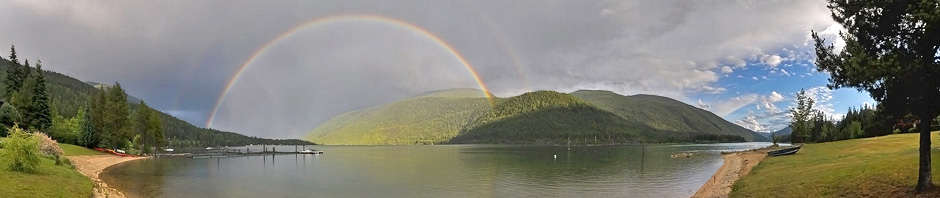
Then there is my perpetual favourite: a rainbow. This is a shot that I had sought for many years. A low-sun rainbow with the circle completed by a reflection in the calm waters of the Lake (normally a storm leaves the water too rough).

Perhaps my most unexpected weather shot of the year is of the total lunar eclipse of October 8th. Why do I claim that it is a weather shot? The Moon is in the Earth’s umbra so the red colouring is from light that passed through the Earth’s atmosphere after much of the blue had been scattered out. Even more interesting is the blueish rim. This is only seen as the Moon enters or leaves the umbra and is the result of light that passed through the Earth’s ozone layer (ozone absorbs reddish light but allows bluish light to pass through).

Posted in weather | 5 Comments

Loon of December


Most loons have left the Lake for the Coast by mid-fall. A few stragglers can sometimes be seen in the winter, but I had not seen one previously. (All my earlier loon pictures were taken from April to October.)

In its nonbreeding plumage, this Common Loon is one of four seen in late December. Its breeding plumage is seen from March to October.

A view of a coot and a loon in the same scene is an unusual local sight. Normally, the loon is here in the summer and the coot is here in the winter. Being gregarious, this lone coot had previously tried unsuccessfully to hang out with grebes; now, it approached the loon. The loon promptly dived and left a still lonely coot.

Six Horned Grebes watched from afar. They knew better than to try to hang out with a loon.

“I am loon; admire my finery. The only other species I need have fins.”

Posted in birds | 2 Comments

Rime line


Christmas dawned white, but the white on this mountainside was neither snow nor frost; it was rime. 

Yesterday’s dusting of snow was soon gone from trees. Then overnight, part of the ridge became white again, but only where a cloud had rested. The cloud was composed of supercooled droplets—liquid water, despite having a temperature below 0C. These drifting drops froze instantly when they bumped into trees. The sharp line between this rime and the lower bare trees marks what had been the bottom of the cloud. 

Posted in weather | 2 Comments