An ancient mariner’s term for a breath of air that lightly brushes the water is a cat’s paw. The name implies the gentleness of the touch; it is a zephyr, a gentle gust of wind.
This would probably be unremarkable, except that cat’s paws are strikingly visible: you don’t just feel them; you see them. They usually take the form of a dark (occasionally lighter) patch moving across the surface of the water. This has caused some people to assign the name, cat’s paw, to the disturbed water, itself—and indeed to fabricate explanations of it based upon the character of the disturbance. I prefer the older terminology: a cat’s paw is a wind that gently disturbed the water’s surface, leaving a cat’s paw print.
Yet, all who discuss it agree that the disturbance appears to result from ripples—that is, capillary waves—that have been excited by the gust of air. Indeed, this seems correct. The problem I faced was: Why do the ripples make the water’s surface appear dark?
Waves on water fall into two overlapping groups: gravity is the restoring force (think of a swing); surface tension is the restoring force (think of a spring). When the wavelength is greater than 1.7 centimetres, gravity dominates; when it is less, surface tension dominates. Now there are a few differences in behaviour across this divide (one was discussed at hoodie ripples), but the interesting one for cat’s paws is that while the slopes of gravity waves (λ > 1.7 cm.) never get large, the slopes of ripples (capillary waves, λ < 1.7 cm.) become quite steep.
To understand why the steepness of the waves makes a difference in the appearance, one can imagine a calm surface of water. The light coming from it is a mixture of light refracted from the depths and light reflected from above the surface. If the view is nearly horizontal, most of that light is reflected from a bright horizon; if the view is straight in, most of that light is refracted from dark depths.
When the surface is irregular, what is seen depends upon the statistics of the surface tipping: gentle tipping, it still looks close to the brightness of a horizontal surface; steep tipping, it takes on some of the darkness of looking straight in. So, regular waves favour viewing light from the bright horizon, while ripples favour peering into stygian depths.
Ok, the ripples created by the cat’s paw make the surface appear dark. Yet, another problem remains: Why does the print follow the paw (the gust)? Look at the issue this way: someone who is ski touring on virgin snow leaves a trail from the start to the finish. The cat’s paw only leaves a mark immediately below the paw—it leaves no trail. While a gravity wave can travel across oceans, a ripple (surface-tension restoration) decays rapidly. Remove the driving force of the wind gust and viscosity kills them within metres.
There it is: cat’s paws are gentle gusts of wind that generate ripples on the water’s surface; the steepness of the ripples emphasizes stygian depths over horizon brilliance; the transience of ripples emphasizes tracks over trails.
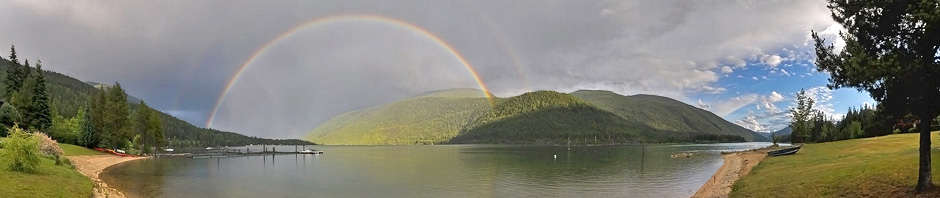
Dark patches move across the surface of the Lake. They are the prints from a wind called a cat’s paw.



Kill, pose, limn
I was perusing a digital copy of John Fannin’s Checklist of the birds of British Columbia (1891), when I ran across an illustration of a Merlin (well, it was often called a Pigeon Hawk, at that time).
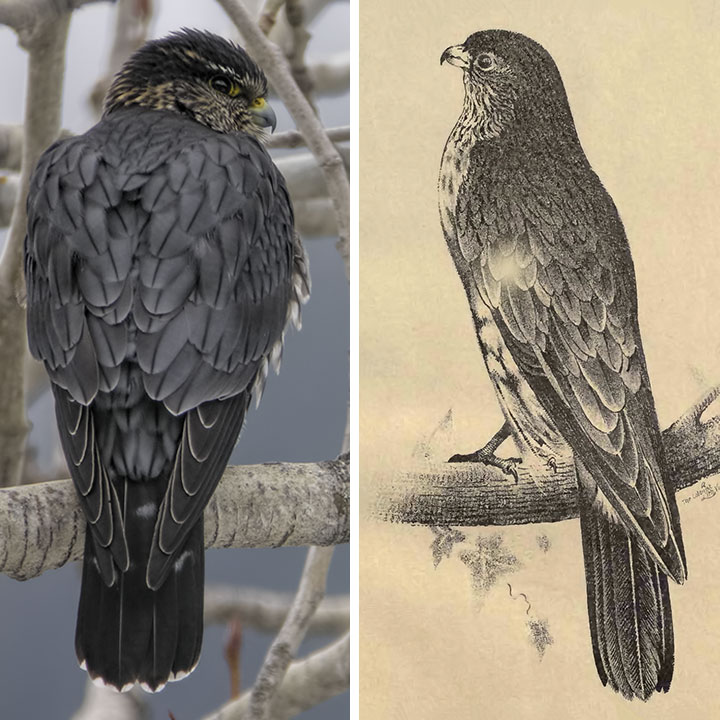
The Merlin’s pose looked familiar. I had photographed a somewhat similar view a few years ago. So, I looked more closely at the description, which read:
“Taken”? That word clearly had a different meaning for birders in the nineteenth century. Indeed, Fannin had shot the Merlin! The dead bird was then presented to an illustrator who posed it in a lifelike manner, and sketched it.
That is how it was done.
The renowned illustrator of birds in the United States, John James Audubon, would (as he said) harvest the birds he painted. His harvesting tool of choice was a rifle. In short: he shot them, then posed them, and then painted them. Curiously, he also then ate (or tried to eat) each of the birds he had harvested.
Audubon’s work predated photography and there were few other options open to him if he wished to limn birds. While Fannin’s work postdated photography, it probably wasn’t until a century later that camera technology would consistently outclass a rifle in the acquisition of good images of birds. We now have high-quality, long-focus, image-stabilized, lenses mounted on high-resolution cameras. Taking a bird in its most perfect plumage, now has a photographic meaning.
Here are two Merlins recorded in British Columbia (with only slightly different poses). On the left is a bird I photographed a few years ago. It was unaware of my presence. On the right is the one Fannin had taken. It too was unaware of Fannin’s presence, but that is because at the time of the illustration, it was dead.