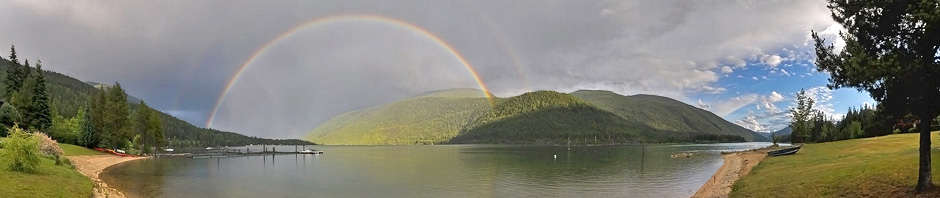
For many years I presented wildlife talks for the summer speaker’s series at the Nature Centre of Kokanee Creek Park. My last talk was on Wildlife Mating in 2024 with my daughter, Cynthia.
This week I am again sharing the stage with Cynthia. She will show Owls and I will show (the rarely seen) Black Grizzly Bears. We invite you to join us.
Title: Black Grizzly Bears & Owls
Speakers: Alistair Fraser & Cynthia Fraser
Location: Nature Centre, Kokanee Creek Park
Date: Thursday 6 Aug. 2026
Time: 7:00 p.m.
Donation: sought $5 to Nature Centre (not to us)
A black grizzly bear

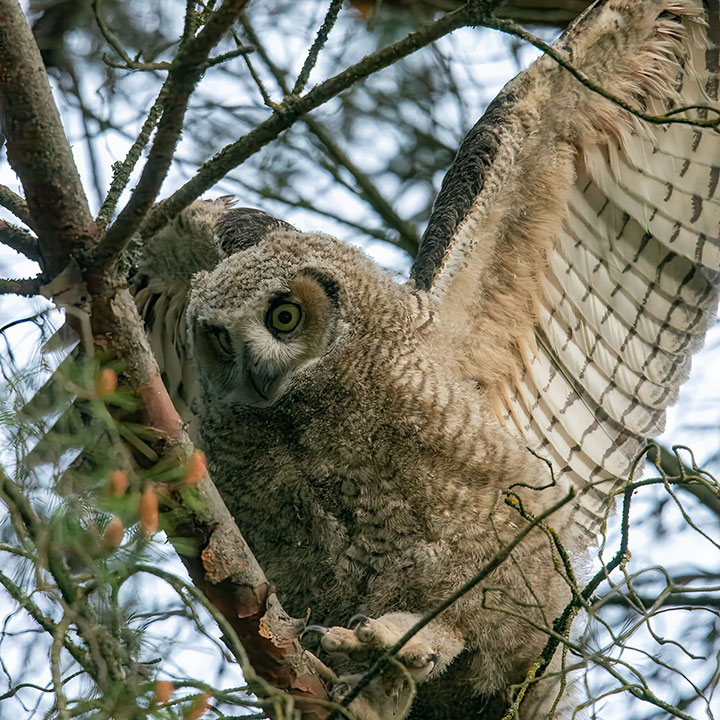
A Great Horned Owl chick learning to fly. Photo by Cynthia.
Beauties, Alistair!
Looking forward to your presentation!
Excellent! I plan to attend!
That black “bear” (not “black bear”) is most unusual and beautiful, looks like its own has a parka ruff. Is there anyone out there considering that black bears and grizzly bears are mating, locally? Like grizzly and polar bears, hybridization is well documented within most bear species, even Asian and European bears, but not with Panda bears. See wikipedia Ursid hybrid. Appearance is one things, DNA is sometimes conclusive but not always, according to the research.
Robert, apparently black bears and grizzly bears have mated but, because of behavioural differences, it is exceedingly rare except in captivity. I watched the above bear for a while. It was all grizzly in looks, behaviour and its progeny. I have now seen over a dozen black grizzlies and they are all definitely grizzlies.
Alistair, I take your word as the gospel. Although, that “black” bear’s face does not appear as dished as grizzly bears. But, it’s a frontal shot and probably deceptive. I’d love to see a profile of the face and body. I call the polar-grizzlies the “global warming” bear. Have you heard of black grizzlies anywhere else? I’m in Alaska and showed the pic of the black griz to a fish biologist friend here. He spends a lot of time in the bush and he’s very familiar with bears. He thought black bear. Maybe these “black” grizzlies are “becoming” a little different. It happens. Thanks for the conformation and for the web site. P.s. lots of talk about lots of bears, griz and black in down town Harrop-Procter this summer.
Robert, what’s in a name? I will use italics for the bear’s name to distinguish it from its actual colour. Around here, the black bear is not always of a black colour. In the talk, I showed some local pictures of black bears that were coloured black, blue, brown, and cinnamon. Plus I showed a local black bear a friend took that was white, Now, in Europe, the grizzly bear is called the brown bear, but it isn’t always coloured brown, We call it the grizzly bear, but it isn’t always grizzled (means streaked), and I showed a number of grizzlies that were not grizzled. But, the grizzly I showed above is grizzled (the whitish hairs around its face). No black bear that I have ever seen is grizzled. This shot was of a female grizzly. Its two cubs were also grizzly. All had the high foreshoulder hump (and other grizzly features) but it was black. Hair colour just does not pin down a species among bears any more than it does among humans.