The coyote is a reasonably common animal in our area, but is rarely seen. This morning’s coyote was the first I have seen for nearly three years.
This coyote looks really heathy with its thick winter fur coat.

The coyote is a reasonably common animal in our area, but is rarely seen. This morning’s coyote was the first I have seen for nearly three years.
This coyote looks really heathy with its thick winter fur coat.
A walk in Kokanee Park on New Year’s Eve revealed two less-common female birds.
A Pileated Woodpecker went from tree to tree scouring for edibles. It is almost certainly the same female that appeared earlier in the month (blog.kootenay-lake.ca/?p=34028) .

This Pygmy Owl just looks pregnant, so I guess it is female. Some winters don’t have many Pygmy Owls coming to the valley bottoms, but this year they are fairly easy to find.

I suppose that I am just partial to otters. This is the fourth time I have seen them this year, and the third time this fall, although I suspect they have been nearby more often. This time four otters came by, but I am only showing two shots: one of an otter approaching, and one of one sitting on a dock.
This otter swam around far off before deciding to approach.

And then one sat up and surveyed its surroundings.

After showing a male Pileated Woodpecker foraging on a piling a couple of weeks ago <https://blog.kootenay-lake.ca/?p=33997>, Cynthia found another foraging pileated. This new one was a female. So, I am showing both.
First, I will reproduce the male from the two-weeks old posting. It has a reddish malar strip (from bill down to neck). Its red cap also extends to its bill.

Second, here is Cynthia’s shot of the female from the latest observation. The malar strip is black (not reddish) and the red crest stops above the eye. The darker eye colour seems to be only a result of the age of the bird, not its sex.

This shot of the female shows the red crest stopping well above the bill, and the dark malar strip. But, the real reason it is included is that it is an unusual view.

Some winters, I have been able to photograph a Pygmy Owl.
This small owl spends most of its year at high elevations, but sometimes seeks the valleys in the winter. Unusually, it hunts by day and will sit quietly for hours on a tree branch waiting to fly after a small bird or maybe a vole. Then it has a quick dive to catch its prey.
However, in many winters of watching, I have never seen it fly after something. All my shots are just of the owl sitting and watching. That is, until yesterday when I watched the Pygmy Owl go after a small bird. The bird escaped, but I managed an acceptable shot of it diving after it.
A Pygmy Owl dives after a small bird, claws at the ready.

This may well be one of the first Pygmy Owls in the valley this winter. They spend their summers in the high mountains where they are rarely seen. They are sometimes with us at the valley bottoms in the winter.
This Pygmy Owl was hunting (for small birds) from a tree.

Yesterday, I was watching a Pileated Woodpecker scrounge for grubs and ants in a piling. I took many pictures hoping to capture something interesting, but in the end, I only show one image and the bird is just sitting there. Its activity was interesting enough, but a question kept arising: what sex is the bird?
Now the standard way to determine the sex of a Pileated Woodpecker is to look at its malar stripe. This is the line angling back from the bird’s bill separating the cheek from the throat — sort of a moustache. If this is red, the pileated is male; if it is black, the pileated is female. Sometimes it is as simple as that. But, sometimes the malar strip is dim and inconsistent. Now what?
Yes, there is something else.
Here is the one picture from yesterday’s shoot of the Pileated Woodpecker. What colour is the malar strip?

Here is a 2011 shot of a female pileated. The malar strip is black, but there is something else: the bird’s red crest ends above the eye. From there to the beak it is black. It turns out that this shortened appearance of the crest is another indication of a female. 
Now we return to the a blowup of the original picture. On the male, the red crest extends almost to the beak. In the blowup, the redness of the malar strip is also more evident, but it is dark. This bird is a male as revealed by both the crest and the malar strip.
I don’t often see elk. The last time was in the fall of 2022 when I actually saw an elk harem. and a harem master. But this time was much more mundane a group of four of then feeding on grass. The odd thing to me was the makeup of this group, a female with two first-year calfs and a spike elk. Spike elk are second-year males that have antlers with single, straight spikes instead of the branched antlers seen in mature bulls.
When first seen, there was a mother (centre) and two calfs of this year.

All were eating grass.

The spike elk took it upon itself to prod the calves off the bank which had the good grass. Presumably this was done for their protection because there were people watching them.

On one occasion the spike elk stuck out its tongue, but it seemed to be just licking its lips.

The spike elk, itself, didn’t seem to feel threatened: I guess because he was big.

Most of the postings I have made have been from the ground level, and those are often of animals. This is more a consequence of opportunity than narrow interest. But, now and then I can glance at our region from above the clouds. This is not just for the wider field of view, but for the things that are only possible to see by looking down, than by looking up. These are the directional things seen opposite the sun when looking down particularly on clouds.
Things seen can be are loosely grouped by whether you are looking down on water clouds, ice clouds, haze, or clear air. Yesterday, I looked down on some water clouds and briefly saw both a cloudbow and a glory. These are at their best when the cloud drops are uniform in size and this was accomplished by flying over a wave cloud. (There was also a faint shadow of the airplane.)
The cloudbow (left and right side of picture) is easiest to understand. It is about the size of a standard rainbow (about 42° in radius), but unlike the standard rainbow, the colours are faint due to the diffraction in the smallish cloud drops. Just to the inside of the cloud bow there are fainter supernumerary bows.
At the centre of the bow (and centre of the picture) is the much smaller, but brighter, glory. It can be quite colourful with multiple rings if the drops are really uniform. However, in the present view about all that is seen is a small bright circle with a slight horizontal line through it. This line is the shadow of the plane (and so this is the antisolar point).
A fish-eye view out the window of a commercial airplane leaving Castelgar. The cloudbow and supernumerary bow are seen on the left and right side. The glory and (slight) shadow are seen in the centre of the picture.

2,000th posting
This is the 2,000th posting to this blog site, Exploring Kootenay Lake.
For this occasion, I am showing some of my favourite pictures, by year, from the last 500 postings. After all, you already can see some of my favourites from the first 1,500th postings, which was made five and a half years ago on 2019 April 10. However, the present posting includes some images from later in 2019.
As before, my favourites tend to involve the interaction of two or more individuals or a less common natural phenomenon. Included are photographs from other close family members that also appeared on the blog.
2019

Great-Horned-Owl chicks are still in their natal down.
Female Spotted Sandpipers are the sexual aggressors; males are not. Here, two females are battling for territorial rights.

A father Pileated Woodpecker (left) is instructing his son (right) on how to find food.

2020

A mother yellow-bellied marmot is suckling her pup.
A feisty Rufous Hummingbird battles another (unseen) rufous for access to food.

A dipper parent brings grubs for its chicks.

An adult Osprey brings a fish to its three excited chicks. Photo by Finn Grathwol.

Two robber flies mate.

2021

Male and female clearwing moths mate on the wing.
Bald Eagle chicks sit in a nest with their parent.

As testosterone rises in the fall, a young white-tailed deer jousts with his father.

A mother elk suckles her young. Photo by Cynthia Fraser.

2022

Cynthia Fraser caught this shot of a battle between an osprey (top) and an eagle (bottom).
A very wide-angled lens captures a cloud bow and its reflection. Photo by (son) Alistair.

In one of the last meals before migration, an osprey father brings a fish for his family.

2023

A bobcat stops by to scrounge at a bird feeder, but encounters humans.
A female grizzly bear with exotropic eyes swallows a fish.

This (somewhat confusing) picture shows a white-tailed deer mother suckling her fawn.

A weasel has killed an injured robin and then jumps off a deck to eat it below.

2024

Swans mate far to the north, but courting sometimes happens here. Photo by Cynthia Fraser.
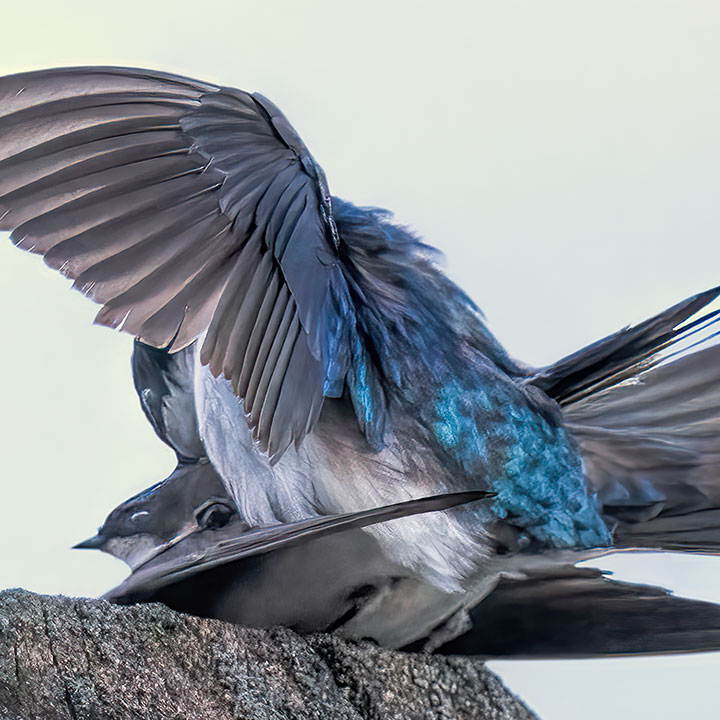
This mating of male and female Tree Swallows lasted about one second.
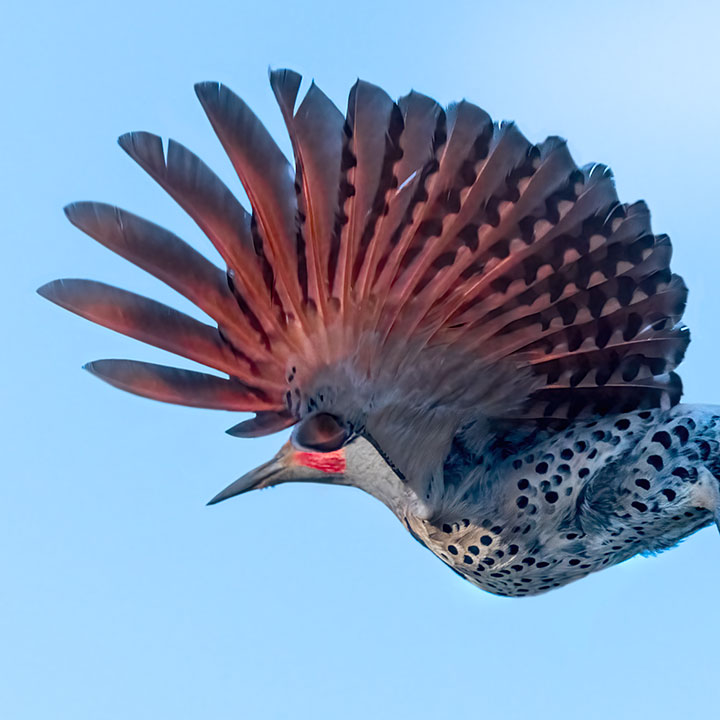
A momentary scene of a wing’s underside looks like a headdress on a flicker.
A blue heron lacks teeth so it swallowed the mallard chick whole.

A locally rarely seen ibis takes to the air.

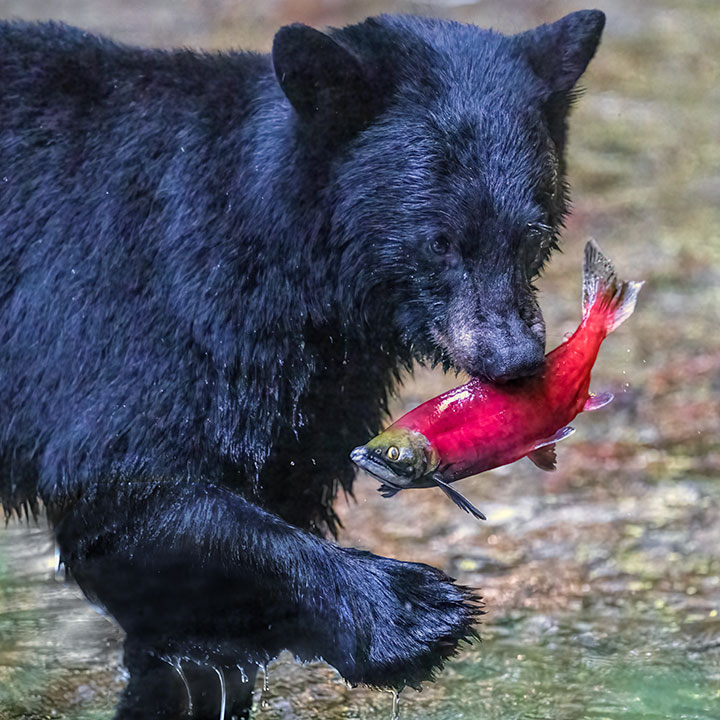
A black bear picks a Kokanee salmon from a local creek.
The Long-billed Dowitcher migrates the long distance between the Arctic Ocean and Mexico twice a year. On its way, it occasionally stops by here to feast.

This is an aurora borealis on October 10. The existence of all life on Earth is a consequence of the appearance of auroras. Photo by Cynthia Fraser.

A Ring-billed Gull manipulates a small fish before swallowing it.
