The Northern Alligator Lizard is secretive and normally found under rocks or logs. Now and then it will sun itself in the open. Maybe that is what this one was doing when I spotted it yesterday afternoon.

The Northern Alligator Lizard is secretive and normally found under rocks or logs. Now and then it will sun itself in the open. Maybe that is what this one was doing when I spotted it yesterday afternoon.
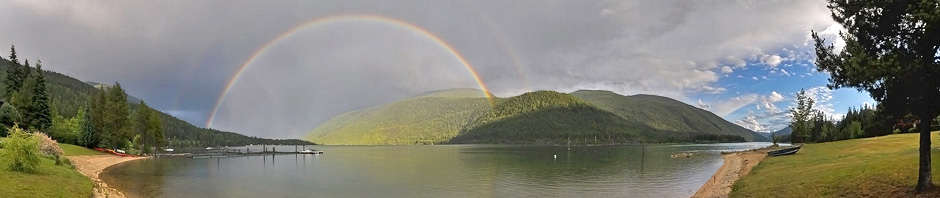
The Lake level is as high now as I have seen it in recent decades: above the beach and onto local lawns. The spring freshet has consequences for many animals and plants, but until this morning, I would not have guessed that a robin would care about it one way or another.
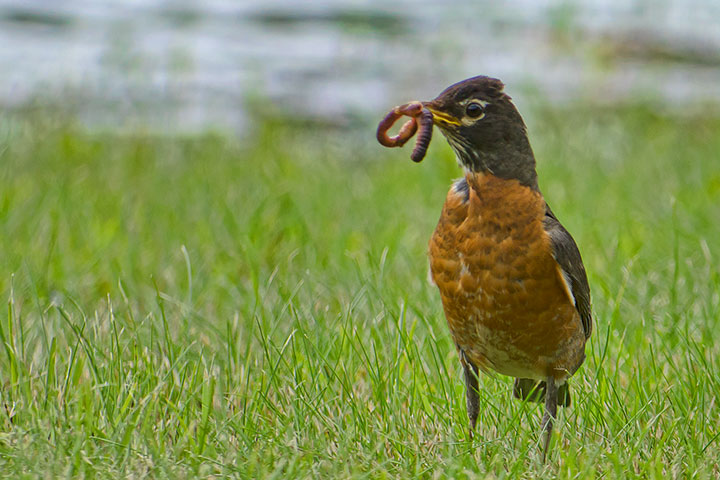
Normally, a robin seems to hunt over a wide area of grass where it is occasionally rewarded by capturing a worm or grub. Now that the Lake has risen onto the adjacent grass, robins have shifted to foraging within a meter or so of the water’s edge (almost in the manner of a sandpiper). Further, their capture rate has climbed considerably: it is one worm after another in quick succession.
The clue to this behaviour, I suppose, is the water-soaked ground. Worms respond to sodden earth by moving to the surface where robins pick them off with ease.
A robin uses sight (not sound) when patrolling soggy ground. Driftwood is seen along the edge of the high water.
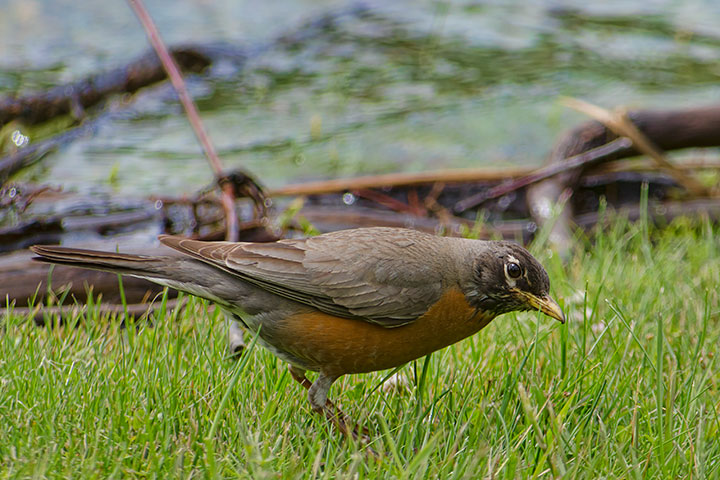
As all the worms are now near the surface, rewards are frequent.
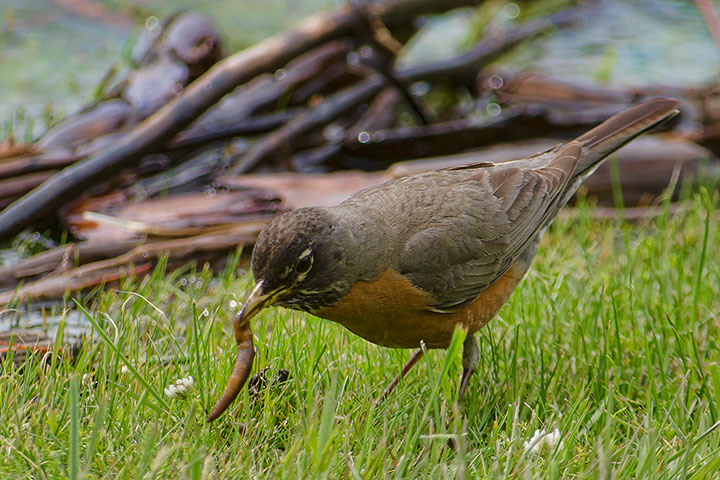
Once the Lake has risen onto the lawn, the adjacent grass becomes the robin’s favourite hunting ground.
The first thing that caught my eye was a fin sticking above the water. The fish seemed to be circling erratically in the shallows—a behaviour I had never before witnessed.

Joe Thorley of Poisson Consulting looked at this picture and said that it is either a Brook Trout or a Rainbow Trout. The white patches, he said, are fungus, which accounts for its odd behaviour—it is dying.

One should never underestimate the importance of regular ear maintenance.

I find it difficult to photograph insects in flight—birds are not easy either, but they are not as difficult as insects. Insects are small and usually too fast for my camera’s auto focus to capture. So, my occasional modest success with flying insects owes more to persistence than skill.
Here is a honey bee approaching a wild rose. You can see the ball of pollen attached to its hind legs.

A hover fly approaches a flower of the same plant.

For all its parasitic behaviour, a cuckoo bee is beautiful to look at.
A cuckoo bee looks something like a wasp—but it isn’t a wasp; it’s a bee. There are quite a few different apian species that have earned the name, cuckoo bee: a bee that has the habit of laying its eggs in the nests of other bees (and so behaves in a manner reminiscent of cuckoo birds). Cuckoo bee females are best recognized by the fact that they lack pollen-collecting structures. Further, they neither construct their own nests, nor have much body hair.
Most cuckoo bees are in the sub-family, nomandinae, but there are many different species, a number of which I have seen in my garden. I don’t know which species today’s cuckoo bee is.


The loveliest looking species of cuckoo bee I have seen in my garden is this one from three years ago.

The Black-billed Magpie certainly has been seen at a number of places around the Lake—but, it has been seen only occasionally. As efauna.bc.ca says: it is a rare year-round visitor. Truth be told, the one I present here was seen just west of this region in the Monashees, but a magpie it is. It has perched in the rain on great mullieins.
The magpie is a member of the crow family, i.e., it is a corvid. The region offers other more frequently seen corvids: crow, raven, Stellar’s Jay, Clark’s Nutcracker, and now and then, a magpie.

A few days on the road have revealed patterns among cervids that were not readily apparent from the smaller sample that could be seen around my home.
First, all that I saw were moulting from their winter coat into their summer coat.
Second, the tails provided an indelible way to distinguish species.
White-tailed Deer show off both their strikingly large tail along with some patchy moulting on the hip.

A Mule Deer shows some patchy moulting and its rope-like tail with a black tip.

An elk shows a short white tail on a white butt, and a bit of moulting on its hip.

Finally, a male Mule Deer with tiny antler buds on its crown looks at me and asks the perennial question posed by other local animals: “Why are you pointing that camera at me?”

Windows are a potential hazard for birds.
Many birds hang around my home: hunting, feeding, nesting, and squabbling. Yet, collisions with my windows are remarkably rare. When it happens, the window usually displays an indistinguishable smudge.
The smudge was not indistinguishable from the collision shown below. Fortunately, the bird, itself, survived, but I cannot say whether it had a headache.

Normally, the only moths I spot in the daytime are those that are sleeping in conspicuous places such as on a window, wall or carpet. In their natural habitat, they are a great deal more difficult to find because their cryptic patterns allow them to blend with their chosen resting spot. I just don’t see them; presumably hungry birds miss many of them also.
In the early summer, the alfalfa looper (Autographa californica) drifts into our region on the south wind. In previous years, I had occasionally wondered about the hook-shaped pattern on its wings—why might these markings have evolved? My answer might lie in the picture, below, where one is sleeping on a fallen tree branch. Could this moth’s wings mimic lichen-covered bark?
