Yesterday, I posted pictures of Great Horned Owls and their owlet. Today, there are two owlets. Might tomorrow bring three?
Two Great Horned Owlets look out from their nest.

Yesterday, I posted pictures of Great Horned Owls and their owlet. Today, there are two owlets. Might tomorrow bring three?
Two Great Horned Owlets look out from their nest.
The Great Horned Owl is widely spread across North America. It is also fairly common, yet not particularly easy to find. There is, however, a local nest site that had been used other years. It merited exploratory visits.
With the Great Horned, both parents attend the nest, and as far as I can tell, both have been seen, but on different occasions. They have two owlets, but I have only seen one.
This is one of the parents.

The markings of this owl seem different, so I assume it is the other parent.

The star of today’s visit was one of their owlets.

When I think of yard birds, I think of robins, Steller’s Jays, and Song Sparrows. I don’t think of Mallard chicks and teals.
But, there they were wandering about my front yard.
Mallard chicks explore the grass at the behest of mommy.

What the Blue-winged Teal was doing there was unclear.

The fairy slipper is perhaps the first wild orchid to bloom each spring. It seems to have evolved to fool the earliest of pollinators, queen bees, into pollinating it — yet the fairy slipper offers bees no rewards in return.
Some years I have seen dozens of fairy slippers as early as mid-April at my favourite observing spot. This year it was mid-May before I saw even one — indeed, at that time, there was only one to be seen.
There are two varieties of fairy slipper in North America: the eastern and the western. The western isn’t found east of the Rocky Mountains. However, we get both varieties.
This bloom is the eastern variety, which blooms earlier than the western.

These images were taken during the same event as the previously posted muskrat’s kiss.
Midst its feeding, the muskrat climbed out and preened — almost as if it were doing callisthenics.
The first step is to shake off the water.

Then there is the stretching.

A test of the jowls.

Some more stretches and scratches.

All exercise should involve some pain.

And back to tranquility.

I went for the beaver; I stayed for the muskrat.
Beavers and muskrats are known to share lodges carved into the bank of a stream or lake. It seems that they not only tolerate each another, but even share duties. I had gone to visit the beavers, and two of them were present, but distant. However, also emerging from the lodge was a muskrat. It proved more interesting, and not just because it came close to where I was sitting along the shore. Indeed, it will require a second posting to show some of its antics.
A muskrat came out of the (beaver) lodge in the early morning light and swam along the shore. What is only barely apparent is that it is carrying a mouthful of aquatic weed.

The muskrat climbed into a hollow stump in the water and set about eating its salad. It sallied forth for more vegetation two more times and each time returned to its hollow stump to eat. The next shot shows one of the times it headed out. However, the picture looks much more as if it is an example of the whimsical title I have given it…

The muskrat’s kiss.

Another muskrat posting will follow.
The mule deer is not seen as often at the valley bottoms as is the white-tailed deer. Among its distinguishing features are its largish ears (after which it is named), and a white black-tipped rope-like tail.
The mule deer is also the only local animal that stots.
Stotting is a travelling gait (e.g., walking, trotting, galloping) in which the animal moves forward by leaping into the air with four stiff legs. It seems to be a response to seeing a perceived predator and says: I see you, so you lack the advantage of surprise.
Two mule deer were standing on the edge of a forest when one of them started stotting.

After a brief pause, it stotted again, this time leaping higher.

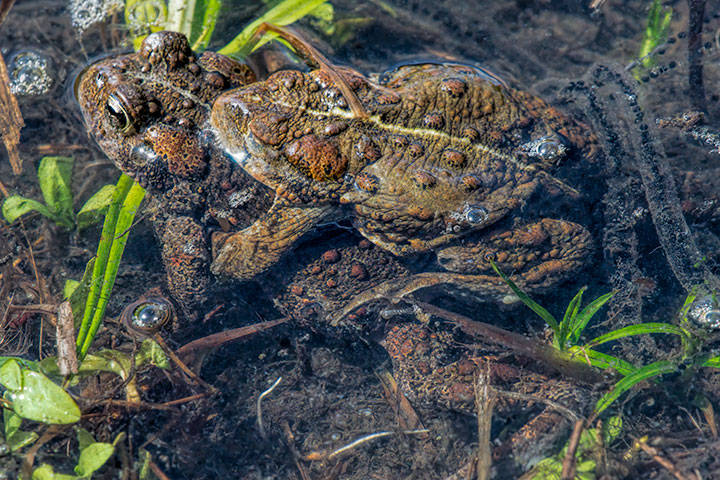
May is amplexus time for the western toad.
The male toad (the smaller of the two) climbs on the female’s back and grabs her under the armpits. This stimulates her to release eggs, which he then fertilizes.
A male western toad grasps the female during amplexus.

Another couple is accompanied by strings of eggs in the water. Soon there will be tadpoles.
Loons are not the only predator that has a rather low capture rate. Certainly, when I watch loons fish, I marvel at how often they dive to no apparent effect. Yet, sometimes….
A Common Loon swam by this morning and repeatedly dived after fish, but came up with nothing. Yet, for all that, it certainly is looking good.

On one occasion, the loon surfaced with a comestible and then swallowed it. I have no idea what it found. Any ideas?

Everyone is familiar with beavers damming creeks so as to get an adequate water depth around their lodges. However if the water is already deep (or fast flowing), beavers will build their lodges by burrowing into the bank. Any pile of branches against the bank of a stream or a lake might signal the location of a beaver lodge.
This pile of branches marks the location of where beavers have burrowed into the bank.

A beaver sits adjacent to its lodge and nibbles on a branch.

With morning’s light, it swims off in search of more foliage.
