Mommy mallard complained about the injustice of my two recent treatments of merganser families (1, 2). Why would I have featured those (clearly lesser) beings, while neglecting her own worthies? Ok, here is mommy mallard and her eight progeny.

Mommy mallard complained about the injustice of my two recent treatments of merganser families (1, 2). Why would I have featured those (clearly lesser) beings, while neglecting her own worthies? Ok, here is mommy mallard and her eight progeny.
Interactions among wildlife are plentiful and make for interesting viewing. Many of these involve predators and prey, but other forms of competition and cooperation are observed.
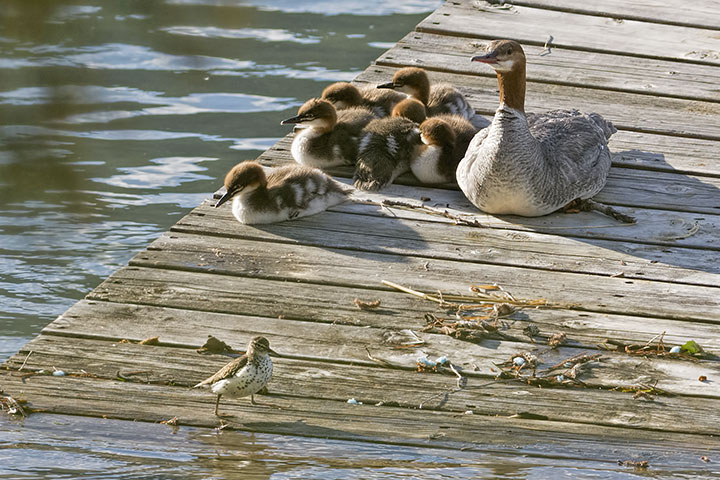
Having recently shown merganser competition, it was now fun to watch as a family of Common Mergansers ignored a passing Spotted Sandpiper. Neither species saw the other as a threat.
We spotted wee spotted frogs.
(How often does one get to write such a sentence?)
Columbia Spotted Frogs were seen basking along a shoreline. Pictures of the region’s two frogs and one toad can be seen on the Kootenay-Lake.ca website.
This is a typical view of the Columbia Spotted Frog; it is rarely seen far from water.
Its tadpoles were swimming in the vicinity.

Here’s looking at you.

You know that you are in the backwoods of Canada when, while watching a nesting loon, you spot a moose grazing along the same lakeshore. That this moose is a male is evident by its antler buds. Here are two pictures.


Loons thrive on Kootenay Lake, but you will look in vain for a nest here.
Loons are clumsy on land—they are looney—and they cannot move their nests as the water level changes, so to nest adjacent to the water, they must find a lake where the water level does not change much through the spring. This is not Kootenay Lake, where the lake level might change by three metres during the breeding season.
Yet, on some of the smaller alpine lakes in the vicinity, loons will nest. Last year, some Canada Day loons were seen with a chick on one of these little lakes. The same thing will probably be seen this year, for today, on that lake there was a loon seen sitting on her nest at the water’s edge.

While this skunk is shown foraging alone, she frequently has been seen with kits. With persistence, I soon may be able to post family scenes.

The skunk will have to wait.
Last evening I managed to take the first good picture of a foraging skunk in a long time. I was about to post it, when a circumzenithal arc appeared in the sky. Nature’s palette is rich; the skunk got skunked.
The circumzenithal arc has been featured on these pages a few times before: Feb. 27, 2011 and Dec. 25, 2012. I am a sucker for its beauty, which can outdo a rainbow. The arc appears high in the sky (circumzenithal: it circles the zenith) when the Sun is low. It has a brother: the circumhorizontal arc (it circles the horizon) appears low in the sky when the Sun is high. The occasions when one can see the circumhorizontal arc were discussed recently as blue cirrus. I will continue to watch for the circumhorizontal around midday all this month.
A fisheye picture shows the circumzenithal arc as a coloured line high in the sky. The Sun is behind the trees, but has an elevation of about 18°. The curvature of the horizon is a consequence of the fisheye lens.

As patches of cirrus drifted through the requisit position, the arc would appear and disappear. By the time this more detailed shot was taken of the arc itself, the Sun had climbed to 20°. It shows a superb spectral range.

The merganser’s warning: don’t accept a ride from a stranger.
This posting reads a bit like an animal story written for children: heavy on lessons of human behaviour; skimpy on knowledge of animal behaviour. Certainly, the captions represent my interpretation, but the event was witnessed by three people and two cameras. Further, the pictures are presented in the order they were taken.
Mommy merganser has taken her eight chicks out to expose them to the delights and dangers of the pond.

As is often the case, some chicks hitch a ride on mommy’s back.

Danger approaches from out on the pond: another female merganser. It is unclear why mommy should see this as a threat, but the approaching female has no chicks of her own and may well want to adopt some of mommy’s.

Certainly, mommy merganser is not going to even allow the possibility. She attacks with great vigour. She drives off the other female, and has to do so twice.

Returning to her own brood, one can almost hear her say: “I have just protected you from being kidnapped.

The family retires to a safe place: “Remember, you can accept a ride from me, but never from a stranger.”

Name calling This particular species appears to be Hemaris thetis. Historically it went by the names H. senta and H. diffinis. It has had the common names of Rocky Mountain Clearwing, Snowberry Clearwing, and California Clearwing. As a group (genus), such moths are called either Clearwing Moths or Hummingbird Moths.
One of the oddest sights to be found in one’s yard is that of a hummingbird moth. It looks like a baby hummingbird as it extracts nectar while hovering next to a flower. But, it is a moth, is active during the day, and has clear wings.
Last year, I saw it on dandelions. This May, I saw it on three occasions, but each time it was gone in an instant.
Two days ago, the moth appeared as a blurry apparition flying past the mating butterflies that were occupying my attention. This is a good picture of neither moth nor butterflies, but it set the stage to do better with each.

I located the moth again as it was sipping nectar on some other lilacs. It was soon gone, but I had its picture.

A second view.


Two Western Tiger Swallowtail Butterflies make love on a bed of lilacs.