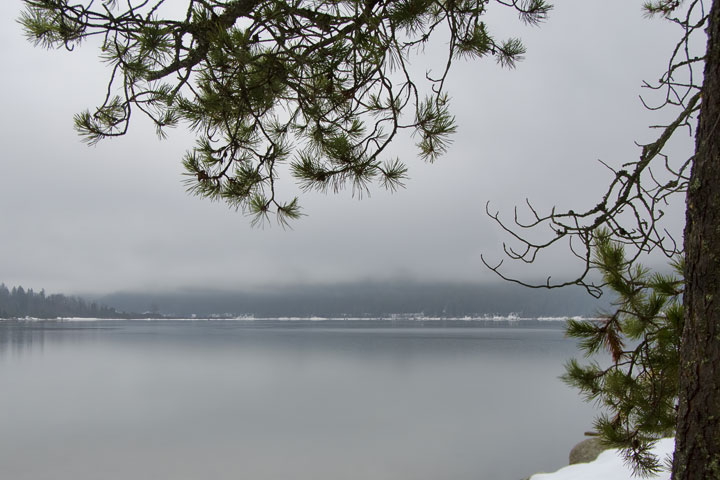
On Thursday, I gave a talk to the Kootenay History Interest Group. These folk take delight in exploring a wide range of local history: artifacts, buildings, characters. It struck me that historical language might be grist for this mill.
Language changes. There is perhaps no period in history when the curmudgeons of the world did not decry shifts in language: the way younger folks have changed the meaning of earlier words and have blurred distinctions formally recognized.
Being a curmudgeon myself, I have great sympathy with the these concerns. Why, I wonder, does no one still recognize the difference between the words: simple and simplistic, nauseated and nauseous, restless and restive, uninterested and disinterested, historical and historic, unusual and unique? Now when I hear someone use any of the second words—simplistic, nauseous, restive, disinterested, historic, unique—I just assume that that person means something other than what was said.
So, it goes. In such matters, the curmudgeon will always lose; time is not on his side. Language changes; meanings change. For those who like history, nuance, and continuity, the only thing left to do is to write the obituaries of a few dying terms.
Yet, many of these shifting usages could describe language anywhere in the English-speaking world. My immediate interest is the shift in commonly used local language.
A major shift has resulted from our changing relationship with one of our central geographic features: Kootenay Lake. There was a time when moving people and goods over this rugged land was arduous and slow. Over water was the easy way, so whether by rowboat or sternwheeler, Kootenay Lake provided the pathway. When railways were built, people and goods adopted the train. They changed again with the construction of extensive roads and bridges. Changes in transportation resulted in changes in language.
A second language shift in common local usage reflects changing local industries such as logging and agriculture. Of course, agriculture has never been big around here, but the substantial number of residual fruit trees speaks to many earlier attempts to make a living from orchards (it might be argued that the primary local crop is now the sub rosa production of Cannabis sativa indica).
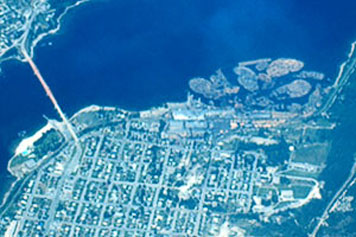
Log booms lie along Nelson's waterfront in this 1973 areal view.
Here are a few examples of words that are generally no longer recognized by the local public:
Booms: The term for a large collection of logs on water which could be pulled by tug to a mill. Log booms vanished from Kootenay Lake when Kootenay Forest Products closed in 1982. Logs are now moved by truck along the roads.
Camp: In the days before the bridge (1957) the West Arm of the Lake was maybe 90% seasonal dwellings. The term for such family summer properties was a camp. Wikipedia now claims that a camp (as a noun) refers to a group retreat. We have and have had a few of these around here: Camp Koolaree, Camp Lourdes (both religious), Camp Busk (scouting), and now Tipi Camp (yoga). But, families who repair to their rustic structures by the lakeside no longer seem to go to their camps. Now the North Shore is 90% permanent residences. I note that the upscale, year-round Yasodhara Ashram styles itself a study centre.
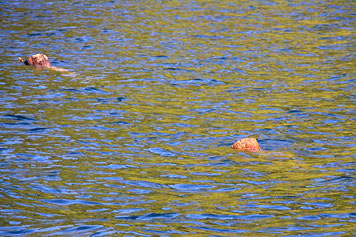
Deadheads, semi-submerged logs, were a hazard to boats.
Deadhead: My dictionary tells me that it now means a follower of the rock group, Grateful Dead. But, when I worked for the C.P.R. it was an empty trip: no paying passengers or freight. It is still used as trade jargon among those who transport things. However, in the days of log booms, it was a partially submerged log—invariably, one that had escaped from a boom. Deadheads were significant hazards to boats. They were once common; indeed, there are still a couple of places that have them along the West Arm, but generally this term from the days of log booms has vanished from local language. The loss of the deadheads themselves is not to be regretted.
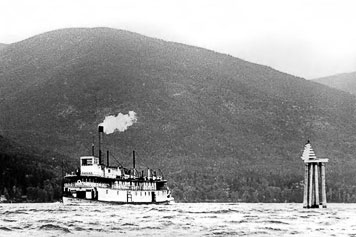
When the Lake served as the primary transportion route, dolphins were familiar markers. Picture taken in 1952 by Denis Daly.
Dolphin: To me, the symbol of the Lake is the dolphin. These are the navigational beacons that allowed the sternwheelers to avoid the sand points; they still serve local boat traffic. The term is old, and although it refers to any bound group of pilings, it is used locally to apply to one used for navigation. The terminology, dolphin, is not only officially correct (thank you, Canadian Coast Guard), but it was the universally used term of my youth. Now, I hear Nelsonites refer to these structures as buoys. They pronounce it: bOO-EE. That is the American pronunciation of a device Canadians pronounce as BOY. A buoy is called a BOY because it is BOYant. However, calling it either of these—a BOO-EE or a BOY—is idiotic because a dolphin is not buoyant: it is embedded in the lake bottom. So, what happened to the word, dolphin? Even modern pleasure boaters seem to have lost the term.
Froe: In the days before metal roofs, shakes were used. The tool used for splitting shakes is a froe.

Early lakeshore homes were built with the front facing the Lake. Now, such homes place the grand entrance facing the road.
Front of the house: Here is the rule, if you live along the lakeshore, the front of the house faces the water. That is how lakeside homes are designed—or at least that is how they used to be designed. This used to make sense: you wanted your house to face the water, and every visitor came by boat. Not only the front of the house faced the Lake, but the front door faced the Lake. Then people began to travel by road. We now have the bizarre state of affairs where the front of the house faces the Lake, but the front door faces the road. So, the front door is on the back of the house.
Highball: This is a logging term that meant: hurry up the project.

Landings linked transportation and settlers. R.T.Fraser took this of the SS Nasookin at Fraser's Landing in 1935.
Landing: When the means of getting around the region was by water, the Landings were the portals to farms, orchards and homes. Dozens of them were marked on the map. A few survive in such legacies as Macdonald’s Landing and Johnston’s Landing. These are the places that served everything from sternwheelers to rowboats. Now, the term, landing, has degenerated into realtor schlock (e.g., Kutenai Landing).
Layritz: Layritz Nurseries in Victoria supplied most of the fruit trees used locally. He also introduced rhododendrons to BC, of which a local grove still survives. At one time the name Layritz was better known locally than the name of the Prime Minister.

Only the animals now know where all the fruit trees from Layritz are to be found.
Local names: It is to be expected that many local names will be lost both as a result of shifting modes of transportation and the filling in of the gaps between named settlements. Some that have drifted out of local consciousness are: Outlet, Cedar Point, Ferguson’s Point, and of course, many landings such as Gibson’s and Fraser’s.
Milk run: When used today, this term seems to mean merely an uneventful trip. But, originally, it was a trip with frequent stops to to pick up each farm’s daily milk output. In the West, that was often done by train. Apparently, it no longer means this: the term now has lost the meaning of a trip with endless stops. It is the opposite of the one meaning of deadhead.
Narrows: Formed by creek deltas, the narrows are constrictions to the flow of water along the West Arm of Kootenay Lake. The narrows are navigation bottlenecks, they alter the waves, they produce an overturning of the water and so alter the surface temperature of the water for swimming, and they bring fish to the surface. Each of the narrows along the arm has a name: Fraser, Harrop, Kokanee, Nine-mile, and Six-mile (and all have dolphins). These were markers on any trip along the Lake. Now, even the general term, narrows, has largely vanished from everything but the navigation charts.
Peavey: This is a long handled tool used for rolling or moving a log. To the handle was attached a heavy steel point and a hinged steel hook.
Pilings: The Lake is festooned with pilings. These are the heavy beams driven vertically into the Lake’s bottom usually to secure a dock or float. More often than not, when I hear someone in Nelson refer to them now, they are at a loss for an appropriate word and merely call them a post—as if they were equivalent to a fence post. One suspects that these people would think that a pile driver was probably a device to treat hemorrhoids.
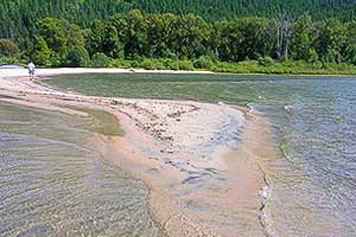
Sand points of the West Arm extend at right angles to the shore.
Points: These are an unusual feature of the western half of the West Arm—points of sand extending at right angles to the shore. They are named after the distance along the Lake from the Nelson’s Pier (at the foot of Hall Street): Five-mile Point, Seven-mile Point. I sometimes hear a person these days fish for terminology and call them sand spits. Indeed, there is a sand spit on the arm at Kokanee Park. But the sand spits (which lie parallel to the shore) are not sand points (which extend at right angles).
Punkwood: These are little pieces of driftwood that strutting children would light and smoke in imitation of their elders’ cigaretts. The repulsive taste may have done more to discourage smoking than all the ads.
Rafting dogs: This is a term from the days when logs travelled down the Lake in booms. This era ended in 1982 when Kootenay Forest Products closed its mill in Nelson. The rafting dogs comprised a metal spike topped with a ring. The spike was driven into a log and ring enabled many logs to be chained together to form the perimeter of a boom or a group of salvaged logs to be joined.
Rural Route: When I was a child on the North Shore, our postal address was: R.R. #1, Nelson. The designation, Rural Route, has now vanished, although I still think of myself as rural. The term, rural route is still used within the postoffice by the mail sorters and carriers, but it is now trade jargon, not part of the public’s language. From the point of view of Canada Post, I live in Nelson; Telus tells me that I live in the never-never land of North Nelson; the BC Government wins with the beautifully crafted term, Area F.
Shook: The bundles of parts that had to be assembled to make an apple or cherry box. These were assembled with 1 ½ inch box nails.
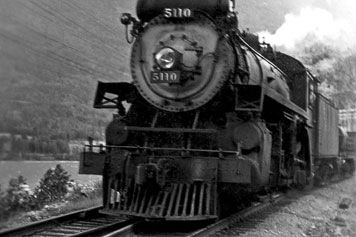
One did not turn a key and drive off; one had to get the steam up. A 1949 picture of a steam engine at Troup by Denis Daly.
Steam up: Steam once powered sternwheelers, tugs and railway engines, but no more. Before the train could pull out from the station, or the ship from the dock, the pressure in the boiler had be quite high—one needed to get the steam up.
Tin tops: The local meaning of this arose in cherry orchards. These are the baskets into which cherries were placed as they were being picked. They were made of thin wood held together by tin bent over the top. Nowadays, a tin top is used by classic car collectors to describe a coupe as opposed to a convertible.
Finally we come to the biggie and the saddest loss of all: the West Kootenay.

Gulp, who dreamed up this abomination?
West Kootenay: The West Kootenay was formed when the Kootenay district was split into East and West portions in 1888. This is a fairly simple idea: there is a West Kootenay and an East Kootenay; taken together they are often referred to as the Kootenays. So far, so good. After the division, reports and books began to refer to the two districts together as the East and West Kootenays. This practice seems to have lasted though the Second World War. But, in the 1950s, writers began to use the same cadence when referring to the western district alone. Some called the district the West Kootenays—a bit of linguistic ineptitude that implied that there were multiple West Kootenays. Now, it seems that the default option is to say: the West Kootenays. Sigh, this usage is unmitigated nonsense.
So, it goes: Words come and go; Language changes and a history interest group might well choose to watch the change in local language in the same way it watches the parade of historical characters and buildings.
I am indebted to Tom Lymbery, Ron Welwood, Kevin Underwood and Don Lyon who suggested some words to include here.
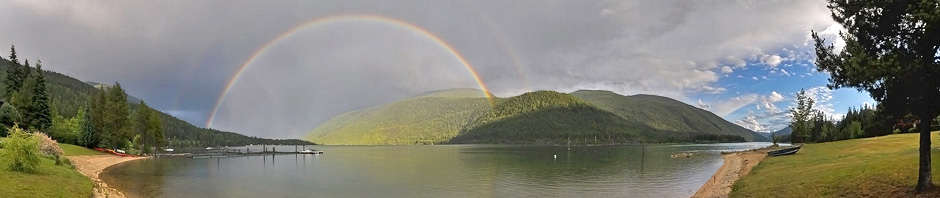


Snow eater
A weather condition that results in the particularly rapid melting of snow is often referred to as a snow eater.
I explored the term, snow eater, on the Web and was disappointed by how many sites sloppily treated as if it were synonymous with the word, chinook. A chinook is merely one type of a snow eater. Nonsensically, one site even asserted that “chinook is an Indian word that means, snow-eater.” It does not: chinook comes from the name of a people and the wind was named after them.
The warm dry wind, known as a chinook in the foothills of the Rockies, is a well-known example of a snow eater. It causes both rapid evaporation and melting. Although similar winds occur in the lee of other mountain ranges (e.g., the föhn in the Alps), such winds are regional.
There are other snow eaters with a geographically broader effectiveness: rain and fog. It has long been observed that snow vanishes rapidly in response to rain. It was once assumed that this resulted from the rain drops having a higher temperature and so warming the snow it fell upon. But, fog can be even more effective in melting the snow and there is minimal settling of fog drops.
It turns out that the primary reason rain and fog do this is that each is accompanied by a high humidity. It is the water vapour condensing on snow that does the melting rather than the water drops falling upon it. The high latent heat of condensation does the melting.
The way a patch of snow vanishes depends upon what is doing the melting. Sunshine usually melts the snow around its edges. The Sun warms bare ground which warms the adjacent snow with the result that the snow shrinks from the edges toward the centre. A warm wind or the condensation associated with rain or fog melts snow over its entire surface and this causes the snow patch to become thinner.
This morning brought drizzle (a fine rain) and the uneven snow on this beach thinned quickly to reveal little pits.
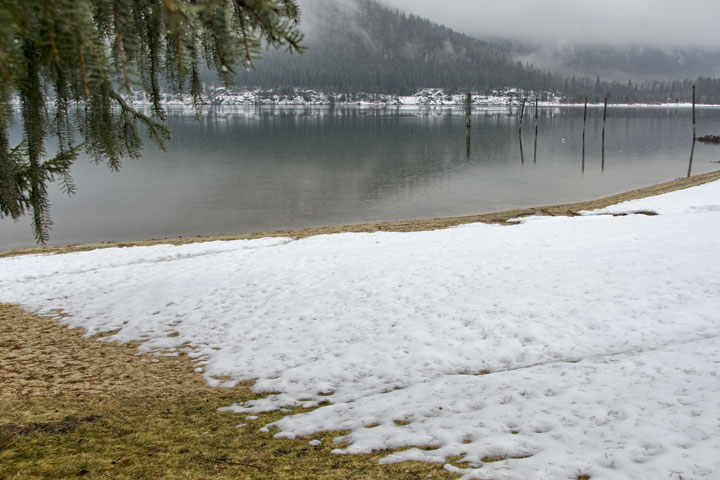
Water vapour doesn’t only condense upon the snow, but on any colder surface; the lake is such a cold surface. Water condensing on water does not lead to a change in the appearance of the Lake, itself, but it does change the appearance of the air. The downward flux of the vapour dries the lower air leaving the fog (now a cloud) hanging above the surface.