Redpolls by the gross

It has been a good winter in the south for seeing redpolls. Despite being small, redpolls are content to winter in the frigid north as long as the food holds out. When it doesn’t, they head south. Last Friday I saw a flock of a few hundred. Indeed, in one picture shot into its midst, I counted a 150 birds, and many more were outside the frame.

Birders have fun watching redpolls. There are two different species: Common Redpolls and Hoary Redpolls (accustomed to even bleaker arctic conditions). Further, both show sexual dimorphism: the males and females look somewhat different. I will guess at some of these variations, below, and have labeled pictures to make for easy commenting.

A portion of a flock of redpolls—mainly Common Redpolls with a few Hoary Redpolls mixed in.

(1) A female Common Redpoll has been eating tansy seeds.

(2) A male Common Redpoll (showing a much pinker breast)

(3) Some Hoary Redpolls (the ones with the fainter streaking on the sides and white butt)

(4) So, what is this?


Posted in birds | Comments Off on Redpolls by the gross

Car•nage

This seems to be a good year in southern British Columbia for irruptive winter finches. Siskins, grosbeaks, and redpolls have irrupted from their normal wintering grounds in search of food. These birds are mainly seed eaters, although they also need to consume some grit to serve as a digestive aid.

Finches find a ready source of grit (and salt) on our winter roads—with some obvious consequences. Indeed, in parts of BC, winter finches are referred to as grille birds owing to the large numbers that collect on the grilles of moving vehicles.

I watched such a drama while on the drive over Kootenay Pass to visit the raptors of the Creston flats. When finches gather on the road, ravens gather in the trees above. The ravens know something that the finches apparently do not: there will soon be carnage.

A mixed flock of siskins and redpolls forages on the highway. Even in this picture, there are corpses.

As expected, a vehicle drives through their midst.

There is momentary agitation, but soon the birds settle back to foraging in the same spot.

Everybirdy just ignores the corpses. Apparently none stop, ponder, and say (to lift a caption from a Farside cartoon): “And now Edgar’s gone…something’s going on around here.”


Posted in birds | Comments Off on Car•nage

Raptor rapture

A coyote prowls the Creston flats foraging for voles and mice.


The expedition began with an inquiry from Michael McMann: would I like to accompany him to the Creston flats to photograph Rough-legged Hawks? I grab any opportunity to head into the field with such a knowledgeable naturalist, so on Friday we crossed Kootenay Pass on our way to the flats.

The Creston flats occupy the broad valley bottom at the south end of Kootenay Lake. It is now the home of small lakes, marshes, farms and—as a testimony to the diversity of its wildlife—the Creston Valley Wildlife Management Area. Originally the area was the flood plain of the Kootenay River where it flowed into Kootenay Lake.

This sign shows that farmers appreciate the services of coyotes.

In 1935 dykes were built along the river and this allowed some of the land to be used for farming. Grain farming attracts rodents; rodents attract predators: coyotes and raptors. Certainly, we saw coyotes hunting in the fields—even in snow-covered fields. (In a posting last March, Coyote hunting, I showed the technique they use to hunt for voles under the snow.)

But, it was the raptors we went to see—principally the Rough-legged Hawk, a species I had not seen before. It was one of five different species of raptors seen that day, pictures of which are below. (Some other birds seen will form a second posting.)

The first raptor seen was a Red-tailed Hawk. Quite a few of them were seen during the day. This shot of one calling might be entitled: Now Hear This!

A Red-tailed Hawk flying. I see these hawks on the West Arm mainly in the springtime before leaves obscure perching banches.

The next raptor spotted was an eagle. Well, this was no big deal: I see them frequently around home (one is sitting outside my window as I write) but, it was nice to add this to the list of raptors seen on the Creston flats.

Then the first of a few kestrels was seen. This one was on a power wire. It is a female.

This one had taken flight.

Finally, we saw a Rough-legged Hawk. It was sitting on the cross-bar of a power pole when it rose to fly off. With its dark belly and feather-covered legs (the origin of its name), it looked as if it were performing some tai chi.

It was soon in the air.

An unexpected find of the day was a Northern Harrier (female). Its owl-like face is apparent.

When hunting, a harrier flies close to the ground listening for sounds made by rodents.

Five raptor species were seen in one day—two of them new to me. Thank you, Michael.


Posted in birds, history, mammals | 4 Comments

Random header

The longtime header for this blog is now merely one of many.

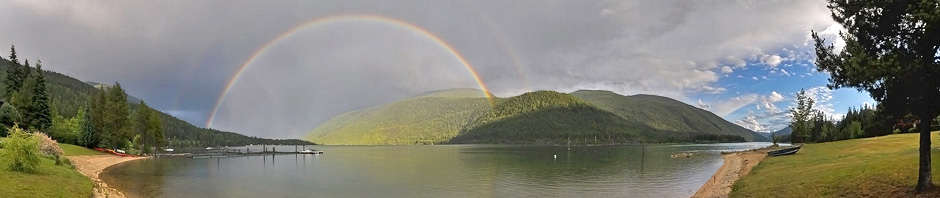
Since the establishment of this blog, Exploring Kootenay Lake, I have used the same header: a panorama of a rainbow spanning the West Arm and having one side apparently resting on Kokanee Creek Provincial Park.

I am now experimenting with choosing a random header from pictures taken around the Lake. Each time a page is loaded (or reloaded), a new selection (out of fifty) is made.

I now have to decide whether I like this design, or whether it is a tad too distracting.

Posted in commentary | 6 Comments

Pregnant spruce


Nuff said.

Posted in commentary, weather | Comments Off on Pregnant spruce

Snow and birds

How do birds deal with all the snow we have had lately? Snow piles high and limits access to their favourite foods. I am sure that birds deal with the problem in a variety of ways, but yesterday’s observations show a few approaches.

Note: the previous posting talked about the formation of the lovely snow structures I referred to as crystalline marshmallows. These structures probably do not hold the same appeal for birds as they do for me.

First, the problem: If you are a bird that eats the berries or seeds on trees, how do you get at them when the snow has piled up like Marge Simpson’s hair gone white? (These are the berries of the mountain ash).

One solution is to avoid the problem altogether by seeking food in a place sheltered from the snow. This is what some Song Sparrows did as they flew back and forth between the snowy branches and the sheltered region.

A second strategy is to not seek a sheltered region, but a much more exposed one: one high in the tree and exposed to the wind. Even a gentle breeze is sufficient to limit or prevent the pileup of snow there. Consequently, the snow marshmallows formed from gently interlocking crystals are more likely to be found on lower branches. This go-high approach is demonstrated by a female Pine Grosbeak. I also watched a Northern Flicker and a Varied Thrush using this same approach.

If the bird forages low in the tree, it must contend with the snow. Although my observations are limited, I have not seen a bird purposely clear the snow before eating. Rather, as with this female Pine Grosbeak, being unable to eat the berries at the top of the bunch, it reaches away around and eats the berries from the bottom.

A final picture of a male Pine Grosbeak demonstrating the go-high strategy is my favourite shot of the day (although Marge’s hairdo was a close second).

Posted in birds, weather | 4 Comments

Crystal marshmallows

The snows have arrived. Today, the temperature was low and the ice crystals were stellar: six pointed crystals. Such crystals form when the temperature in the cloud is in the vicinity of -15C. Skiers love these low density crystals. When the stellars pile up, they refer to the snow as powder.

I sometimes facetiously refer to the stellar crystals as department-store snow for this is the only form of snow (out of the many crystalline forms that exist) that is ever presented to the public in the form of cutout store decorations during the winter.

Leaving aside the beauty of the many variations of stellar snow, the complex structure allows them to interlock when they pile up on something. The result is another lovely structure: crystalline marshmallows that adorn trees.

In the next posting, I will explore the way some birds handle these snow marshmallows.

As the snow fall begins, stellar crystals begin to interlock.

The interlocking crystals pile up to form a tower of snow on branches. Such a delicate structure only forms when there is no wind. As the wind is always stronger near a canopy’s top than within it, these structures are generally confined to the lower parts of a tree.

Ultimately they create crystalline marshmallows on the branches.

The trees adapt to this extra weight by having flexible branches. At higher altitudes where there is often a much greater snow load, branches slope downwards to better shed this load. (This picture was taken three years ago; the others were taken today).

Posted in weather | 3 Comments

Orange on red

A few days ago, I watched Pine Grosbeaks as they sampled the berries on a mountain ash—it was red on red.

For the last few days, it has been orange on red as some Varied Thrushes visited the same tree and helped themselves to a few of the many remaining berries.

A Varied Thrush eyes the feast of berries,

while another sets to eating.

Posted in birds | 1 Comment

Two-hundred meters

Is it too much to hope for—a heron nest only two-hundred meters from my door?

It is too early to be sure, but for nearly two weeks, I have watched two herons from the same spot. Sometimes they are flying, sometimes fishing, often standing in trees. A nascent nest is beginning to look likely.

Of course, other things are seen (below) during these walks, but the possible nest is the exciting news.

This morning a heron sat on the same branch as on other occasions; meanwhile its friend flew to a nearby tree.

Two days ago, while the first heron sat on that branch, its friend fished from a nearby piling.

From the same spot, a dipper is seen as it floats on the Lake between dives.

And only slightly farther along, a Common Goldeneye couple has been seen day after day.

Posted in birds | 1 Comment

Penguin dance

It appeared to be an ancient courting ritual I was watching in the light of the dying sun.

Indeed, that is what was taking place far out on the waters of Kootenay Lake: the penguin dance of the Horned Grebes.

The penguin dance was described and named a century ago by the English biologist, Julian Huxley. He watched the manoeuvres of the Crested Grebe (not the Horned Grebes that I saw) and observed:

finally the whole bird save for a few inches was standing erect in the water, and reminded me of nothing so much as the hypnotized phantom of a rather slender Penguin.

Along with the many things Huxley described, my grebes also bumped bellies and nudged bills.

Horned Grebes are monogamous (as are other grebes), but apparently reestablish commitment in this way in the late winter or early spring. Spring? This is early January. Could this reflect the mild winter we are having?

Hi there sweetie!

Posted in birds | Comments Off on Penguin dance