A Tale of Two Cities


It was the best of signs, it was the worst of signs.

Which city manager should buy its promotional folk a dictionary and ask them to cease misleading advertising?

Posted in commentary | 5 Comments

Nelson’s Gyro Park


Yesterday, I visited Gyro Park in Nelson and took a couple of pictures. I suspect that only people who are familiar with the park will be able to make sense of them — well, maybe even these people will struggle with them.

This is a shot of the foot bridge to the overlook. 

And a view of the overlook and Nelson. 

Posted in scenes | 5 Comments

Wednesday’s roving


My typical posting features a species or a process. But, today it is merely a grab bag of things seen while roving around yesterday with Derek Kite. The odd thing is that, rather than seeing interesting birds, all the good stuff was earthbound. 

I have mentioned before that as far as I can tell marmots do little more than eat, sleep, mate, and bask. Now and then, they also try to stare down passers-by.

It seems that turtles also choose the marmot’s lifestyle. These two Painted Turtles climbed a short distance up a deadhead and then decided that was enough work for the day.

The Columbian Ground Squirrel spends about two-thirds of its year underground. This peek must have been almost its first look outside.
 

Within ten metres of the ground squirrel were many glacier lilies. I suspect that the squirrel views them not as lovely, but as tasty. 

Finally, while driving past Nelson’s Cathedral of Mary Immaculate, I thought that the portico might offer an interesting site for a full-sphere panorama. 

Posted in herptiles, mammals, scenes | 4 Comments

Blue


Blue: sky and birds arrived together.

Posted in birds | 6 Comments

Swallow vs. flicker


Each year at about this time, a contest ensues. Norther Flickers, who build the nesting cavities and have been on site for some time, are challenged for ownership by freshly arrived Tree Swallows. It usually works out that flickers get to use some cavities and swallows others. 

A female Norther Flicker examines a nesting cavity. The male was hanging around doing the same thing.

Tree Swallows (male on left, female on right) arrived on the last day of March to look for nesting sites. Inevitably they try to take over ones that flickers have built for themselves, and the swallows sometimes succeed. On this occasion, they were harassing the flickers in a failed attempt to drive them off.

“Combat is a real nuisance. Just because flickers build the cavities doesn’t mean they should own them all.”

Posted in birds | 3 Comments

Ducks in trees


Ducks in trees? Given the day, this might sound as if it is an April Fool’s gag. It isn’t. 

About a half-dozen local ducks will nest in trees, among them, the beautiful Wood Duck. It is a bit early to see the nests, but these pictures show that nesting is on the ducks’ minds.

“This is a terrible time of year to be alone on the pond.”

“Hey, big boy I am calling to you down there on the pond — yes, you.”

“OK, I came up into the tree with you — now what?”

“Look, maybe I will have to explain this nesting business to you.”

Posted in birds | 4 Comments

Not seen here


This blog is about the region around Kootenay Lake, but it is sometimes useful to recognize what cannot be seen here. This posting shows two pictures of a Greater Yellowlegs. Although occasionally this sandpiper is seen around the Lake, the particular bird shown could not have been photographed here. I wonder why this might be?

Posted in birds | 4 Comments

Knees-up eagle


The sub-adult Bald Eagle is often mistaken for a Golden Eagle for they both can have a mixture of brown and white plumage, but they differ in other ways. Yesterday’s Bald Eagle looks as if it were hatched last summer. 

An overflight reveals the mottled plumage of a nearly year-old Bald Eagle.

“I am practicing for a dance competition doing Knees Up Mother Brown.”

Posted in birds | 1 Comment

Black-tailed Deer


The mule deer and the black-tailed deer are the same species, but different subspecies. They have been separated by the Coastal Range of mountains so long that they have evolved a somewhat different appearance and behaviour. While the region around Kootenay Lake has both the white-tailed deer and the mule deer, it lacks the black-tailed deer.

First a earlier picture of a mule deer near the Lake. Its rope-like tail is largely white, but has a black tip.

This black-tailed deer was seen yesterday just west of the crest of the Coastal Mountains. The black on its tail extends the full length, and the whole deer is somewhat darker.

Posted in mammals | 1 Comment

From ice to flowers


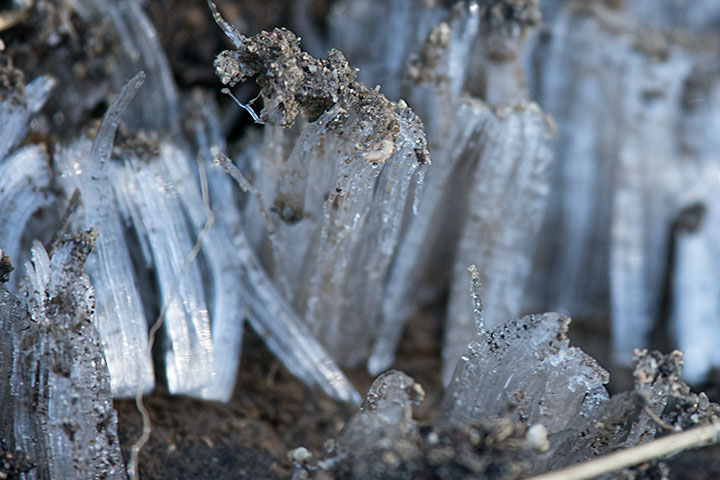
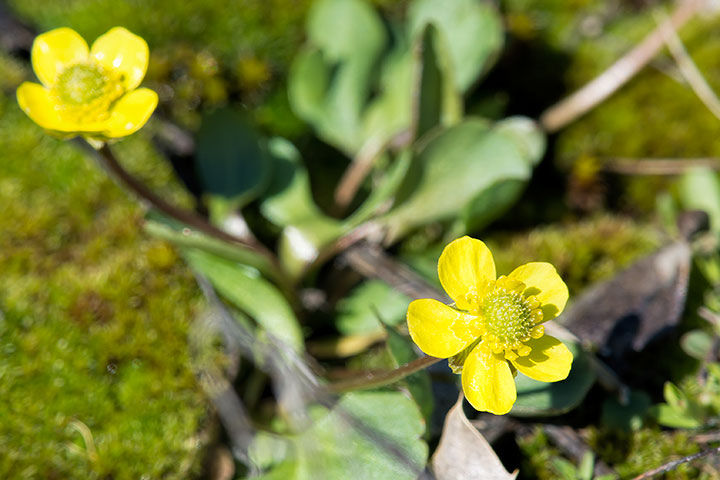
In a lovely example of a seasonal transition, I saw ice extrusions and subalpine buttercups within three metres of each other at an altitude of about 800 metres on a mountainside above Kootenay Lake. 

Typically, ice extrusions are seen when the daytime temperature is above 0C and the nighttime temperature is below, so this is not a midwinter phenomenon. During daytime, water drains into the cavities within a porous soil; during nighttime, the freezing water expands forcing little columns of ice up through the ground (often capped with dirt). Those of us who remember the home delivery of milk to a cold doorstep in the winter are already familiar with the process whereby the cap of the milk bottle was lifted atop a column of frozen cream. When I wrote about these a year ago, a commentator noted that geologists refer to these as ice needles, a name that has a different meaning for meteorologists.

About three metres away was a crop of a dozen (what I suspect were) subalpine buttercups (Ranunculus eschscholtzii), an early sping flower — lovely.

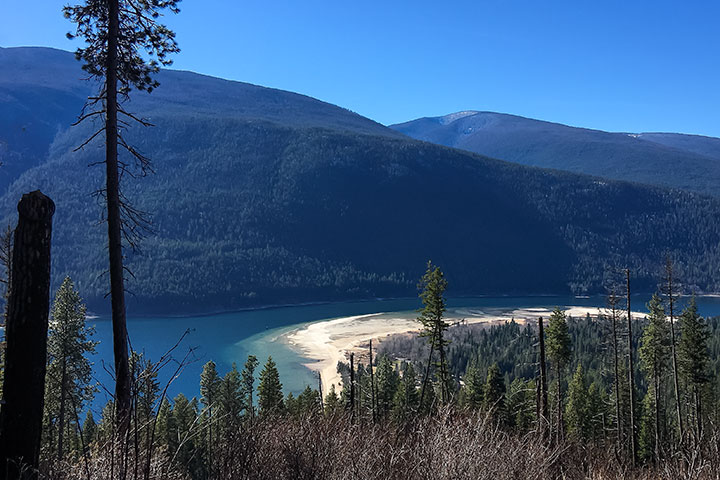
And for fun, I include a picture from the same spot, but looking down towards Kokanee Creek Peninsula.

Posted in weather, wildflowers | 3 Comments