Ruff practice


The winter has passed without any of the Ruffed Grouse in my yard displaying their ruffs. Now that the mating season is approaching, a male grouse was seen to flash some of his ruff without ever opening it completely. What seemed half-hearted now should get serious soon when the grouse’s display is used to both intimidate other males and attract females.

A male Ruffed Grouse shows a bit of its black ruff as if practicing for the forthcoming mating season.

Posted in birds | 1 Comment

Psychedelic BOB


BOB is Nelson’s Big Orange Bridge.

Alas, its truss design is more functional than lovely. Even when built in 1957, I remember thinking that a more beautiful bridge would better suit its setting. Curiously, the bridge’s ugliness did not prevent it from becoming — indeed, may have encouraged it to become — a local icon. 

Although the truss design suffers from industrial unsightliness, it does offer some interesting mapping projections of a full-sphere image. I might explore these from time to time. 

The centre of this full-sphere image of BOB looks west towards the afternoon sun.


Posted in commentary, scenes | 4 Comments

Frenetic and languid


Two days ago in the Park, I watched one of the most frenetic of birds: a Golden-crowned Kinglet. By the time it was spotted and the camera pointed, usually the bird was gone. 

Then yesterday, four Trumpeter Swans were spotted far along the shore. They remained in place as I walked the kilometre and a half. While not completely unconcerned by the passage of humans along the beach, they were certainly nonchalant. 

The Golden-crowned Kinglet is caught in a rare moment between bursts of speed.

It is not that it even seemed aware that it was being watched, but that it had to hurry to the next delectable.

It is instantly off again.

Contrasting the frenetic kinglets are the languid swans, which hardly moved for an hour.
 

Posted in birds | 3 Comments

KCPP boardwalk


I went out this morning to take a picture of the boardwalk at Kokanee Creek Provincial Park. By happenstance, this proved prescient for I discovered that it is soon to be replaced — by what, I do not yet know. Mind you, having slipped and fallen on a wet boardwalk a couple of times, I can understand the desirability of replacement. 

Here is an overview of the boardwalk. On the left is the path from the bridge over the creek. In the centre is the path over the spawning channel leading to the Visitors’ Centre. On the right is the path leading along the spawning channel towards the creek mouth and Lake. It is interesting to speculate how this might appear in a year,

Posted in scenes | 2 Comments

Fifty years ago


Observe, photograph, interpret, publish. For fifty years I have been remarkably consistent with a procedure that I described for a forthcoming article in Wildlife Afield: Photography is my muse as I explore the natural world.

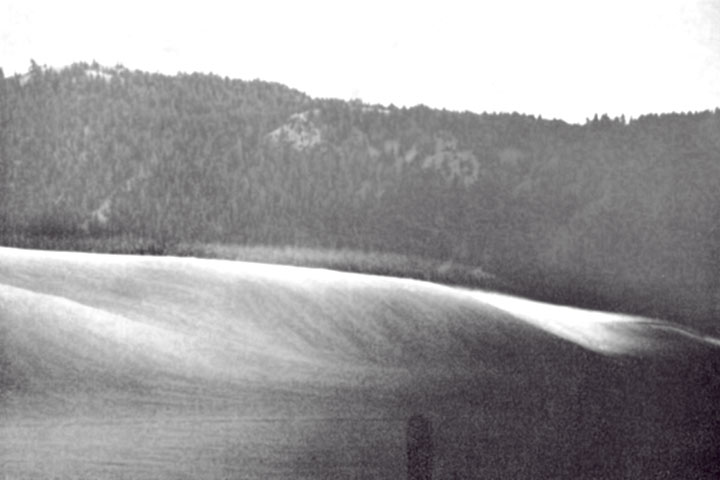
While the roots of this behaviour extend to childhood, this March marks the fiftieth anniversary of my having completed all the steps. It was on the 11th of January 1965 that I watched something interesting in the Grand Teton National Park (Wyoming, USA), took pictures, and speculated on the cause. The resulting article was published as SOME FOG, AN INVERSION, AND A THERMAL in March of 1966 in a magazine of the Royal Meteorological Society (Weather, Vol. 21, Issue 3, pp 76 – 77).

As I reread that article, I find the pictures and the discussion of the flow of air were good, but my discussion of the flog formation was wanting. What can I say? I was a student at the time and, not surprisingly, my skills in making sense of the natural world have developed over the intervening half century. Indeed, time has also improved image quality, and shortened the time for image acquisition and publication.

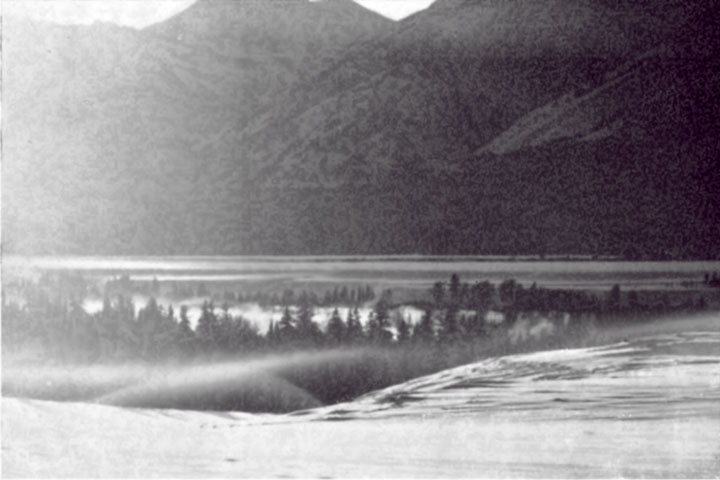
Now, fifty years later, I present the original images and use some of the original text for their captions.

— begin quoted material —

While driving through the Grand Teton National Park in Wyoming at sunset on 11 January 1965, I was intrigued by the way a thin skin of fog flowed down off the hills in the east, across the highway and on down to the valley floor. The fog, though no more than a foot thick, was gliding about 3 or 4 ft above the snow surface like a huge bed-sheet. It appeared to be a water fog and was moving at about 4 to 6 miles/hr. [This] is a view looking to the south-east. One can see the skin of fog moulding itself to the curves of the snow slopes as it flows roughly from left to right. The narrow ridge visible in the first picture provided an interesting verification that the fog was indeed drainage.

A fascinating aspect of the whole scene occurred after the fog sheet had flowed across the road and was making its way down to the valley floor where hot springs abound. Clouds produced by the hot springs are visible among the trees. One such hot spring apparently lay just over the bank from where the picture was taken. A moist thermal which formed over it was trapped from its inception under the inversion at the top of the drainage fog sheet. The thermal found, however, that it could flow up the side of the bank and remain under the inversion, but upon reaching the top of the bank it had nowhere to go but to try unsuccessfully to break through the inversion. The top of the thermal is outlined in fog due to mixing and cooling at its surface as it passed through the cold-drainage air. The second picture shows its maximum penetration into the inversion. The thermal would then collapse, only to reform and make another unsuccessful assault. The whole process was repeated every 1 or 2 minutes. So captivating was this battle between the thermal and the inversion, which was manifest by the thin fog layers, that I neglected to collect sufficient data to construct a sounding.

— end quoted material —

So, what was going on? I offered correct interpretations of both the shallow katabatic wind flowing towards the valley bottom and of the thermals rising from the hot springs to meet it. However, my treatment of the fog formation was muddled. The fog would have actually resulted from vapour mixing at the interface between the shallow layer of cold air draining down the slope and the overlying air. The same is true of the fog in the shell surrounding the thermals. 

While my original interpretation was uneven, it was a good beginning to a lifetime of using pictures as an aid to making sense of the natural world — a practice that persists in this blog. 

Posted in commentary, weather | 4 Comments

Beach source


Two months ago, in winter tranquility, I noted that most treatments of the seasonal changes of beaches consider only those around oceans or flatland lakes, but ignore the rather different behaviour of mountain lakes.

At the risk of whingeing, this posting picks up on that theme and considers the source of the sand. A way to assess the problem that might be faced by a local science teacher is that authoritative sources on beach formation, such as Wikipedia, says that:

Beaches are the result of wave action…. Beach materials come from erosion of rocks offshore, as well as from headland erosion…

So, the claim is that waves pound the shoreline and break up rocks and headland into small particles that then form our beaches. Alas, that just does not seem to describe what happens around here. Rather, it is the many creeks flowing into our Lake that carry the sand that produces the beaches, each of which sits in the vicinity of a creek mouth.

A mountain creek scours its bed. It certainly smashes rocks creating fragments, but then transports smaller particles downstream to the Lake. It is this debris that forms our beaches.

Mind you, once this sediment arrives, waves move it along the shore by a process that is referred to as longshore drift. However, the source of the sand is not the bashing of that shoreline by waves (which are rather small anyway), but the deposition of the multitudinous creeks that flow into the Lake. It is during the spring freshet that creeks transport most of the sand that gets added to beaches. But, any significant rainfall will swell creeks and do likewise, as is seen in the picture, below. 

 This tiny creek is one of hundreds that transport sand down the mountainside to the Lake and then spread it along the shore to create our beaches.

Posted in weather | 3 Comments

Bohemian Waxwings


The Bohemian Waxwing is an ephemeral delight. It forages in large winter flocks that briefly visit some berries only to then vanish from sight for weeks. It is two months since I last managed images. At that earlier time there was snow on the ground and the birds were eating waxberries (waxing alliteratively). This time, a flock of perhaps two hundred, focused attention on rowan berries (mountain ash). 

The flock picked a staging tree (cedar, in this case) from which it would fly to the berries in waves.

These birds can be remarkably acrobatic as they avoid branches and each other.

Pleasure in observing comes from the antics, the forms and the colours. The white streaks are from a light rain.

“I’ve got mine.”

Posted in birds | 4 Comments

February marmot


For the previous four years, I have used the title, March marmot, to signal my first marmot sighting of the year. This year the title had to be revised.

Yellow-bellied Marmots hibernate through the winter and emerge when it becomes warm. In 2012 and 2013, I noticed my first marmot during the last third of March. In 2014 and 2015, it was the middle third of March. This year it was the last third of February (the 24th). 

Now, these observations are made casually; I don’t go out of my way to be systematic. Yet, there does seem to be a trend whereby emergence has moved earlier by over a month.

This marmot tried to attract my attention. It wanted me to provide a recommendation to an agency that needs…

animal models for a hood ornament.

Posted in mammals | 6 Comments

Downy ear & tongue


The Downy Woodpecker is the smallest woodpecker in North America, a feature that gives it an advantage in the access of some bugs. That this one is a male is evident from the red patch on its head.

When hunting for beetle grubs eating old wood, the downy often listens for them. At this time of year, I suspect that the listening tactic works best during the warmth of midday when its prey would be most active.

Having heard activity and bored into the wood with its bill, the downy extends its sticky tongue to snare its prey. In this picture, the woodpecker’s tongue is the beige object extending from the short dark bill.
 

Soon the downy is off to scour another tree (as seen in this composite).

Posted in birds | 5 Comments

Merganser planing


I had no idea that I was wrong.

Planing or Hydroplaning: Typically the term, planing, is preferred by boaters, while, hydroplaning, is preferred by drivers of land vehicles who encounter water on a road.

As recently as last week, I suggested that a surface-swimming animal lacked the muscle power to make the transition from displacement mode to planing mode. Yet, on Sunday, I watched Common Mergansers planing. Granted, they only maintained it for about four seconds — but they did do it. 

An object (animal or boat) floating on water is in displacement mode: it displaces water such that its weight is supported by buoyancy. If it begins to travel across the surface, a bit of its weight may begin to be supported by the movement of the water against it, but displacement remains the primary support. However, if the object moves quickly enough, its weight can be primarily supported by the flow of water against its surface. It is now said to be planing. (It is analogous to an airplane being supported by the flow of air against the underside of the wings.)

Planing allows much greater speeds across a water surface than does displacement. (The fastest boats are those that can plane.) It seems reasonable that if a swimming animal wanted to move quickly, it too should plane. However, it takes considerable power to break out of displacement mode for it has an effective speed limit. I say, effective, because there is an energy barrier which takes considerable power to breach. (In like manner, an aircraft travelling faster than the speed of sound did not encounter an absolute barrier, but rather an energy barrier that had to be overcome.) 

The issue of the effective speed limit during displacement mode was discussed in the posting, muskrat hull speed, and then further explored in ogopogo insights. The problem is that an animal swimming along the surface of the water makes a bow wave that moves at the speed of the swimmer. The faster the animal swims, the longer the wave. When the animal tries to swim so fast that the wavelength becomes twice its body length (hull length), an animal finds itself continuously swimming uphill from wave trough to crest. This requires considerable power, something that strains the musculature of most animals. 

This problem is familiar to boaters, whether they be in a kayak, sailboat, or power boat. It takes considerable power to climb the bow wave so as to make the transition from displacement to planing. The power required to make the transition increases with the weight (and thus also the number of passengers) of the boat attempting the feat. A way to express this is that the ability to move from displacement to planing depends upon the ratio of power to weight — the larger the ratio, the easier it is.

The interesting thing is that if this power is supplied by muscles, the smaller the animal, the greater the ratio of power to weight. This is because with decreasing size, weight decreases faster than strength. So, smaller animals might be able to accomplish what larger ones cannot. But, how small is small enough? Based on Sunday’s observation, an adult Common Merganser makes the cut.

Some mergansers were foraging with their heads tipped down as they looked for fish. They are in displacement mode as is evident by bow waves at the front of their heads. They are travelling at about their hull-speed limit.

When a lead merganser spotted a fish and dived for it, another merganser then tried to steal the catch. Excited by the kerfuffle, two others accelerated and began planing. This is evident by the lack of a bow wave and the nature of the wake. They accomplished this without the use of their wings.

Meanwhile the merganser with the fish (dangling from its bill) also began planing but did so using both its feet and wings. The chasing merganser planed briefly, but is now giving up and dropping back to displacement mode.

That other swimming birds have been seen to do this is clear from the paper Hydroplaning by [mallard] ducklings, published in 1995. This is consistent with my realization that making this transition should be easier for the smallest swimming animals.

Buoyed by this, I looked through all my mallard pictures, but found none showing ducklings planing. Next, I searched through old pictures of merganser chicks and found a couple showing planing merganser chicks, the significance of which had initially gone unappreciated.

I even found an earlier shot of adult mergansers planing in my posting, merganser’s warning.

A 2013 paper told of a Common Eider planing. This bird is over a third heavier than the Common Merganser, and it needed help from its wings. It may be that our merganser is about the heaviest bird to be able to plane using propulsion by its feet alone. 

Now, what about the muskrat, our Lake’s smallest aquatic mammal? It has about the same average weight as the Common Merganser. I have neither seen nor heard reports that it can exceed its hull speed. I speculate that it lacks the power to plane. The muskrat is (substantially) a vegetarian and will have had little pressure to develop the burst of speed of a predator such as a merganser. The two may have comparable weight, but they lack comparable necessity. Similarly, although a Mallard is smaller than a Common Merganser, it lacks the need for planing speeds when hunting plant material. Certainly, I haven’t seen one plane. Here is a muskrat travelling at about its hull speed, which seems to be the best it can do.

This exploration was inspired by asking about an otter’s occasional need to exceed its hull-speed limit. The otter’s workaround is to swim underwater, a tactic discussed in ogopogo insights. It seems that otters are much too heavy to be capable of planing. Yet, it was enormously good fun to discover that some smaller animals (birds, actually) can do this. 

Finally, I note that I have long known that a bird landing on water has the initial speed to plane, as illustrated by the planing dipper, below. However, the issue here has been whether an animal swimming in displacement mode has the power to start planing. It seems that a Common Merganser has, but neither a muskrat nor otter does.

Posted in birds | 5 Comments