Convergent waters


How is it possible to use the first picture to discuss surface-water convergence and not even mention the word, cute (oops)? Well, there is something interesting here that illustrates both water flow and flexible feeding. This Mallard hen and her nine chicks are feeding on detritus in a region of surface-water convergence.

We are used to thinking about a Mallard dabbling in the shallows. Rather than diving, it will tip up and forage on the bottom with its bill.

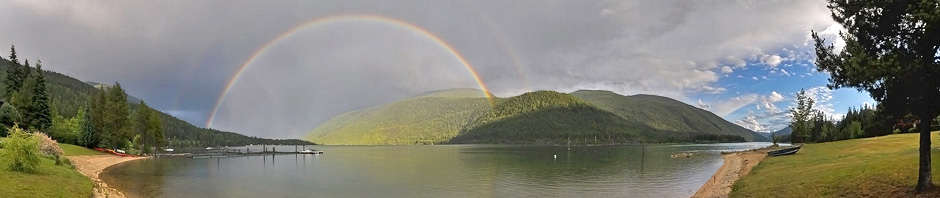
Yet, sometimes Mallards can be seen feeding in waters that are much too deep for dabbling on the lake bottom. They are feeding on organic material on the water’s surface. As can be seen in this image, this material has collected some places and is absent in others. The clue to this is the convergence or divergence of surface waters. The width and depth of Kootenay Lake varies greatly along the West Arm (where these pictures were taken). The flow along the arm is fairly gentle, taking three or four days to travel the thirty kilometres. Owing to the variable width and depth, sometimes deeper water must rise to the surface where it spreads (diverges), sometimes surface water converges and sinks. Any floating debris becomes concentrated in regions of surface water convergence. For Mallards, this is a bonanza, a wealth of accessible food even in deep water.

Return to the family introduced in the first picture. The small chicks cannot dabble in shallows an adult would use. However, where a convergent surface flow has concentrated food, all can comfortably feed.

Posted in birds, weather | 3 Comments

June goulash


June ends with a stew made from images that did not manage to get their own postings.

While walking in Kokanee Creek Park early in the month, I saw a Common Yellowthroat,

and an American Redstart.

Our local Garter Snakes are comfortable on land and in water.

I often see hummingbirds battle for access to the feeder, but it is difficult to get a shot of it.

Somewhat easier (but not much) is a portrait of a visiting Rufous Hummingbird.

The season of damselflies has arrived. This is a Northern Spreadwing,

and this dragonfly is a male Common Whitetail.

A pair of Bald Eagles was hanging out in a tree near their nest.

And a female Osprey approached with an offer to share her fish—or maybe not.

Posted in birds, bugs, herptiles | 1 Comment

Tree Swallow chicks


A month ago, I showed Tree Swallows mating: tryst in a trice. Yesterday, I watched chicks clamour for food.

“We’re so hungry and haven’t been fed for days, maybe weeks.”

“Here is something tasty for you.”

“I’m off to get you more.”

“I’m back.” (This image may be destined for an end-of-the-year print.)

Posted in birds | 3 Comments

Hidden pond


In the West Arm Provincial Park (in the South Selkirks, above Kootenay Lake), there is pond known to few other than wildlife. Doug Thorburn watches it and has sent me pictures showing the visits of three cervids. 

White-tailed Deer

Elk

Moose

Doug Thorburn’s pictures are used with permission.

Posted in mammals | 1 Comment

White butt lives still


Much has appeared in the press in the last few years about the plight of bees. Usually the press makes no distinction between the Honey Bee (an invasive species) and the many native pollinators, such as bumble bees. 

The Western Bumble Bee (Bombus occidentalis) used to be plentiful throughout much of western North America. Over a decade ago, it began vanishing from the southern portions of its traditional range, particularly in the United States and much of southern British Columbia.

Yet, I and others still occasionally have seen it around Kootenay Lake (southeastern BC). I have shown images and written about it since 2009, more recently in 2012 as two bees or not to be, and in 2013 as white butt lives. Sadly in 2014, I failed to find it. Had it now been locally extirpated?

It was a delight to discover it yesterday as it collected pollen in my yard.

The Western Bumble Bee is easily identified by its distinctive white butt.

Posted in bugs | 2 Comments

Merganser fecundity


By my count, this preening merganser hen had two dozen chicks (23 here, but one had dived). Normally, a hen lays from 6 to 17 eggs, more commonly between 8 and 12. I had previously seen a brood with 19 chicks, but this crowd was a first. Are all these chicks hers? Might other hens have laid their eggs in her nest?

Posted in birds | 4 Comments

Clark’s Nutcracker


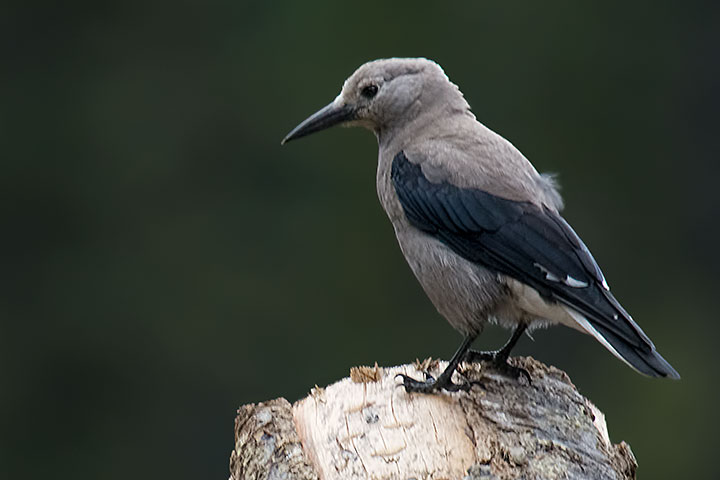
While Clark’s Nutcrackers are occasionally seen at lake level, they prefer subalpine forests where they (mainly) eat the seeds found in the cones of evergreens. I wouldn’t have known where to look, but Derek Kite drove me twenty kilometres up a steep logging road and, after seeing nothing along the way, nutcrackers appeared in a clearcut at an altitude of about 1700 metres. There were dozens of them feasting and flying from tree to tree.

Usually seen at a distance, this nutcracker came close enough for a portrait.
 

Never on one perch for long, each bird soon flies off.

Nutcrackers are monogamous and the relationship even involves mutual feeding.
 

The nutcracker’s diet even extends to small mammals.

Posted in birds, mammals | 2 Comments

Waxwing nest


We have two waxwings, nicely separated by seasons. The Bohemian Waxwing visits in the winter (see last November’s bohemian invasion). Consequently, we are unlikely to see it nest around Kootenay Lake. The Cedar Waxwing arrives in the summer, nests and raises chicks.

A small flock of Cedar Waxwings was seen on Wednesday, but rarely did any of them pose for a picture.

A female was seen building a nest, a task that takes most of a week and a few thousand trips ferrying in material.

Posted in birds | 1 Comment

Eyes of prey


The Ruffed Grouse is low on the food chain. A wide range of predators—hawks, owls, coyote, humans—find it tasty. Maybe only a tenth of these grouse makes it past its first year.

A recent posting, staring contests, explored the differences in vision of one prey (deer) and two predators (human, eagle). Even a casual observation of yesterday’s Ruffed Grouse revealed it to be prey.

This first picture was taken a year ago: a coyote finishing off what is most likely a Ruffed Grouse. Its tastiness clearly presents this bird with its biggest problem. Note the forward facing eyes of this predator. 

Yesterday’s grouse was foraging beside a back road where the vegetation is more suited to it than the deep forest. That the grouse is prey is immediately evident from the position of its eyes on the sides of its head. This enables the bird to detect a predator over a very wide angle of view.

Just how wide an angle it can monitor becomes clear with a view of the back of its head. The eyes are still visible. The grouse can probably see everything around it—front, sides and back—although its vision directly behind is probably limited to detecting motion.

Posted in birds, mammals | 1 Comment

Swallow nurseries


Bank Swallows are late migrants, so while other local swallows have chicks well underway, Bank Swallows are still preparing their nurseries. Still a month off is a view of chicks being fed as they peer from the openings.

The first thing seen was the frenetic activity of birds around the many holes in a sand bank.

Issuing from some of the cavities were plumes of debris as males excavate metre-long tunnels.

Females ferried in nesting material in preparation for chicks.

The activity of the Bank Swallows was extensive and frenetic. The bird in the lower left is carrying nesting material, and the bird above it seems to be trying to steal it. Others were coming from or going to their cavities.

Posted in birds | Comments Off on Swallow nurseries