In June, Mountain Goats look either shaggy or pristine: An adult sheds its winter’s coat; A kid sports fresh wool. 
In June, Mountain Goats look either shaggy or pristine: An adult sheds its winter’s coat; A kid sports fresh wool.
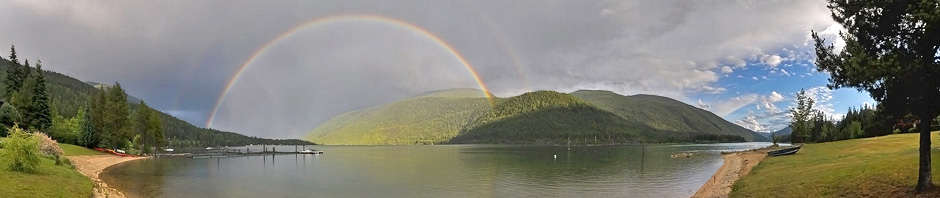
I have photographed rainbows over the Lake from May to September, but the best ones seem to occur in June. This one appeared last evening. It isn’t quite as good as last year’s bow, in which a reflection of the low-sun bow completed the circle. However, June is not over yet.

A staring contest is a game in which an individual stares into another’s eyes and attempts to maintain unblinking eye contact for longer than the opponent.
It is the rare human who can win a staring contest with a White-tailed Deer. 
Yet, it is trivial matter to win a staring contest with a Bald Eagle.
I was reminded of this curiosity in the last few days when I had two really close encounters with deer. The result of the contests was: deer 2, human 0. Why is there such a difference between deer, humans, and eagles? It probably comes down to the differences in their eyes.
The greatest spacial and colour resolution takes place in the eye’s fovea. The numbers are:
• Eagle: 1,000,000 retinal cells per mm2 , 4-colour vision;
• Humans: 200,000 retinal cells per mm2, 3-colour vision;
• Deer: 40,000 retinal cells per mm2, 2-colour vision.
Consider the eagle: its vision is much better than that of a human. It easily assesses a human as neither predator nor prey. Consequently, it quickly shifts its gaze elsewhere.
Consider the deer: it isn’t trying to outstare you; indeed, it isn’t really sure you are there. The deer’s (daytime) vision is sufficiently poor that it freezes as it tries to decide if there is a threat. If it cannot smell you (the wind is in the wrong direction), it takes its time assessing this possibly new feature in its environment. If the human does not move, and its colours blend well with the surroundings, the deer might as well not waste energy by bolting, but rather return to browsing.
This White-tailed Deer was seen in the same area as the doe, above, but a day earlier. We stared at each other as my camera clicked away. Apparently, deer have yet to evolve an understanding of digital photography.

Flicker chicks have hatched. Now, both parents spend their days foraging for insects, swallowing them, returning to the nest, and regurgitating into a chick’s mouth.
“It’s about time you returned. We are hungry.”
“Me first.”
“Look what Daddy brought you.”
“Enjoy.”
When it comes to styles of parenting, local birds run the gamut: Sometimes neither parent takes any interest in its chicks (Cowbirds); Sometimes only the female does (hummingbirds); Sometimes only the male does (Spotted Sandpiper); Sometimes both do (Osprey).
The male Common Merganser is a member of the love-’em-and-leave-’em school of avian parenting. After chicks leave the nest in summer, the female stays with them as they grow up while males head off in gangs.
At this time of year, mommy merganser and her chicks (some riding on her back) are a welcome sight.

Meanwhile, the males have gone off on their own. The noisy one in the back looks as if he is already moulting out of his breeding plumage—females are no longer an interest of his.

I was watching two Spotted Sandpipers. Each seemed to be taking a considerable interest in the other. Then…,
The female crouched, lifted her tail, the male landed upon her, wrapped his tail beneath hers, and they mated.
After a brief disengagement, they mated again.
Abruptly, she lurched forward; he fell off her back. She dropped her tail and lifted her wings to prevent his return.
It might be imagined that she was rebuffing an oppressor. Yet, I suspect the truth is rather different. The female Spotted Sandpiper is polyandrous—she mates with many males. She willingly mated with this one. Her subsequent rejection is likely her way of saying: “I now move on to my next lover; You’ve had your turn.” 
This is a stew made of photographic ingredients that didn’t merit individual postings.
This disheveled-looking bird is probably a House Finch.

A male White-tailed Deer was browsing along the lakeshore.

And then there was a (garter) snake in the grass.

This was the first Mourning Dove I have seen. It flew off within a moment.

A Tree Swallow flew right towards me.

Last year, this eagle’s nest produced two chicks. I wonder what it holds this year.

This muskrat seems to be a regular visitor.

A female Osprey is still bringing twigs to its nest, while others are already sitting on eggs.

There is a rule that you cannot have too many pictures of an osprey in flight—or at least there should be.

At this time of year, one can always play the cute card: Here is mommy mallard and her seven chicks.

Birds devote little time to mating. This sequence of four pictures showing Tree Swallows spanned two seconds.
The female Tree Swallow crouches low and lifts her tail as the male approaches.

He lands on her back as she spreads her cloaca.

The male wraps his tail under hers to align their cloacae. Each bird slightly everts its cloacal tissue.
Mating takes place with, what is known as, the cloacal kiss.

If a butterfly takes to the air, would it not be butterflying?
Well, that is my semantic position and I am sticking to it. Especially, as I am seeking to do a better job of taking pictures of small flyers in the air (see, flying birds, swallow love & war).
With its proboscis partially unscrolled, a Pale Swallowtail Butterfly flies toward a source of nectar. I was struck by the position of the legs which are tucked up behind its head in a manner I had previously seen with dragonflies.

A Western Tiger Swallowtail Butterfly is about to visit a lilac.
Summer arrives
You know summer has arrived when you see both a Western Tiger Swallowtail Butterfly and a Spotted Sandpiper.
Don’t be mislead by media automatons that parrot a claim about an official start of any season. That claim is nonsense. Summer is a meteorological event, the timing of which changes with location, not some fixed astronomical event. Further, no official ever proclaimed that it begins on the date of the summer solstice—and why would anyone believe any official (or commentator) who did offer such a silly claim?
A Western Tiger Swallowtail Butterfly sips nectar from some lilacs.

A (female) Spotted Sandpiper patrols the water’s edge for delectables,

and finds a grub to swallow.
