Bird reprise 2014


2014 brought this blog a plethora of satisfying bird images. The selected dozen appear chronologically.

A male Mountain Bluebird looks at the camera and fluffs its feathers. 

A male Wild Turkey displays his finery for the girls.

A Bald Eagle took a few days to consume a large Rainbow Trout that washed ashore during the freshet.

Harlequin Ducks were seen on Kokanee Creek for the first time in over a decade.

This odd-looking structure is the backside of a Common Loon adjusting eggs in the nest.

Wood Ducks nest around here, but it is rare to see this secretive bird with her chicks.

A Raven unsuccessfully tries to intimidate a sub-adult Bald Eagle into sharing its fish.

A Great Blue Heron swallows a Large-scale Sucker whole.

A juvenile Cooper’s Hawk scans for prey.

The hawk would have liked to have seen these Bohemian Waxwings as they enjoyed rowan berries.

A Pygmy Owl with a bloody beak shows its claw.

A Dipper tried to eat the egg of a Kokanee salmon, but fumbled it.
        

Posted in birds | 8 Comments

Mammal reprise 2014


Alas, my camera finds far fewer mammals for me than it does birds, so I must savour the few opportunities it gives me. Here are a few of the mammal shots I liked from 2014.

There are two local species of marmots. This is a Yellow-bellied Marmot parent grooming its pup.

This was the first year I managed to photograph a Pika. I had heard them before, but not seen them.

White-tailed Deer abound, but I was particularly pleased to manage this contemplative shot of a doe with its faun.

There are River Otters in our Lake; they visit occasionally. 

The Mountain Goat is skilled at avoiding predators by living on a cliff. Its ledge is even narrower than its hoofs. 

The Grizzly Bear is an icon of the wilderness. Here, a sow scarfs a berry of a black-hawthorn tree.

This is an image I have sought for some time: two Bighorn Sheep butting heads as they compete for a female. 

Posted in mammals | 2 Comments

Weather reprise 2014


This is a reprise of my favourite weather images from 2014. Tomorrow, I will treat the year’s mammals, and on new-year’s eve, birds.

Maybe once every winter or two, I get a decent shot of a steam devil. It can be thought of as a dust devil where the dust has been replaced by steam fog. The contrast in this scene is greatly improved by being able to shoot across the Lake towards a mountainside hidden from the winter sun.

Seen less often than steam devils are frost flowers. Unlike hoar frost which requires a cold surface (vapour cooling), frost flowers require a warm surface (vapour mixing—the same process involved in producing steam fog and contrails). As a result they grow above the surface as individual flowers. The petals point into a gentle katabatic flow of vapour.

Frazil is a collection of loose flakes of ice in water. Although the air temperature is well below 0C and ice is forming along the shore, waves have prevented the individual flakes from sintering.

Anchor ice forms on the base of a creek or river. We normally think that ice should form at the top of a water column, but that is only true when the water body is stratified. In a turbulent stream, it can form throughout the depth and then adhere to the bottom. Here, the (white) border ice is on the top of the more gently flowing sides of the stream, while the (green) anchor ice is on the bottom in the turbulent central flow. 

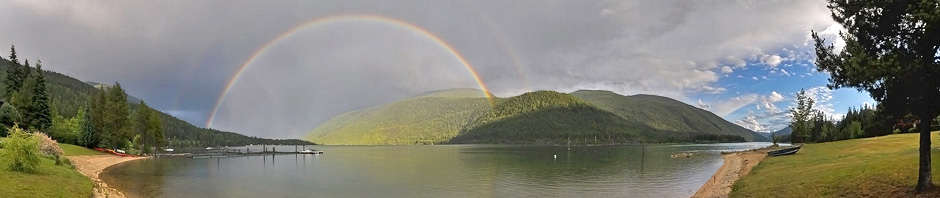
Then there is my perpetual favourite: a rainbow. This is a shot that I had sought for many years. A low-sun rainbow with the circle completed by a reflection in the calm waters of the Lake (normally a storm leaves the water too rough).

Perhaps my most unexpected weather shot of the year is of the total lunar eclipse of October 8th. Why do I claim that it is a weather shot? The Moon is in the Earth’s umbra so the red colouring is from light that passed through the Earth’s atmosphere after much of the blue had been scattered out. Even more interesting is the blueish rim. This is only seen as the Moon enters or leaves the umbra and is the result of light that passed through the Earth’s ozone layer (ozone absorbs reddish light but allows bluish light to pass through).

Posted in weather | 5 Comments

Loon of December


Most loons have left the Lake for the Coast by mid-fall. A few stragglers can sometimes be seen in the winter, but I had not seen one previously. (All my earlier loon pictures were taken from April to October.)

In its nonbreeding plumage, this Common Loon is one of four seen in late December. Its breeding plumage is seen from March to October.

A view of a coot and a loon in the same scene is an unusual local sight. Normally, the loon is here in the summer and the coot is here in the winter. Being gregarious, this lone coot had previously tried unsuccessfully to hang out with grebes; now, it approached the loon. The loon promptly dived and left a still lonely coot.

Six Horned Grebes watched from afar. They knew better than to try to hang out with a loon.

“I am loon; admire my finery. The only other species I need have fins.”

Posted in birds | 2 Comments

Rime line


Christmas dawned white, but the white on this mountainside was neither snow nor frost; it was rime. 

Yesterday’s dusting of snow was soon gone from trees. Then overnight, part of the ridge became white again, but only where a cloud had rested. The cloud was composed of supercooled droplets—liquid water, despite having a temperature below 0C. These drifting drops froze instantly when they bumped into trees. The sharp line between this rime and the lower bare trees marks what had been the bottom of the cloud. 

Posted in weather | 2 Comments

Precocious goldeneyes


The male Common Goldeneye Duck is in his breeding plumage from October to June. That presumably means that he is prepared to breed, not that he is about to breed. So, I thought nothing of it when three strapping lads swam by in mid December, each decked out in breeding plumage. What then happened was unexpected.

In December, three Common Goldeneyes swam by. Spring is a long way off.

Suddenly, despite the absence of females, they began to exhibit courtship behaviour: each tossed its head back.

This was followed by head pumping,

And water twitching. These actions are all courting behaviour.

Apparently satisfied that they now had their act together, they flew off: “OK, now let’s go and find the girls.”

Posted in birds | 4 Comments

Roadside sheep


Two perquisites of rural living are the occasional presence of megafauna alongside a road, and the ease with which one can pull over to watch them. So it was that I was able to offer my compliments to some Bighorn Sheep. 

Sometimes the sheep were highly visible, such as this ram striking a classic pose on a cliff.

Sometimes they were much less obvious, such as this one peeking through the grass.

One ewe passes another on a cliff face.

And a juvenile ram bounds up the slope.

All in all, each seemed to enjoy an unhurried life. 

Posted in mammals | 6 Comments

Fetching birds


I usually oblige my camera when it asks to be taken for a walk. Unfortunately, my camera does not always reciprocate my kindness by fetching an interesting variety of subjects. On recent jaunts, it has retrieved only birds, but at least it was fetching fetching birds. A dozen are below.

The Great Blue Heron is a favourite of mine—maybe I identify with its cragginess.

The Canada Goose is not a favourite. While it is lovely at a distance, it is messy on one’s lawn. Here are two of over a dozen flying by.

Nearby perched a goshawk. Etymologically a goose hawk, our local goshawk seems to lack a taste for geese.

The American Coot is an easy bird to find in the winter, but a difficult one to photograph. Pictures usually show featureless black plumage with an over-exposed bill. It is satisfying to capture both feather detail and bill shading.

Similarly, a distant view of the male Bufflehead Duck usually offers starkly black and white plumage. Only a closer look reveals iridescent colours on the head.

Black-billed Magpies prefer extensive meadows and grasslands, of which there are few around the Lake. This magpie was found in Harrop.

A Merlin hunts from a high perch.

It would have found these American Goldfinches tasty, but didn’t see them.

Ring-necked Ducks (male, female, male) float on the Lake.

While a Mallard leads Wigeons across the sky.

A pair of Bald Eagles sit in a tree. The larger (upper) one is the female. 

Finally another heron steps out during a snowfall.

Posted in birds | 5 Comments

Bubbles in ice


The stunning beauty of bubbles in the ice of a frozen pond could cow a fantasy artist. The accompanying pictures were taken by Irina Peters and Doug Thorburn in the subalpine high above Kootenay Lake.

Bubbles had formed in the ice when freezing had forced dissolved gasses out of solution. The gasses dissolved in the water had come from pond sediments that had outgassed as a result of the bacterial decomposition of algae and detritus: carbon dioxide from respiration, methane from methanogens, and hydrogen sulphide from sulphate-reducing bacteria.

There appear to be three different structures in these pictures: frost crystals on the surface, columnar bubbles, globular bubbles. The suspicion is that the columnar bubbles might be CO2, while the large bubbles could be burps of methane. Can anyone add insights?

(A posting two years ago showed pond bubbles in the summertime.)

Three structures are seen in the ice of the mountain pond: frost crystals, columnar bubbles, globular bubbles.

The columnar bubbles are possibly the result of COcoming out of solution.

This scene rivals a fantasy artist’s creations of alien cityscapes. 

The pictures of Irina Peters and Doug Thorburn are used with permission.

Posted in weather | 2 Comments

Dipper scoffs eggs


A dipper sat on the border ice of a creek. It used the ice as a platform to dive for eggs of a Kokanee salmon. 

The dipper’s forays were surprisingly successful. The dipper acquired a Kokanee egg on perhaps a third to a half of its dives. It brought the egg back to the ice shelf and devoured it there. The golden colour of the egg indicates that it has been fertilized; this is a Kokanee that will not swim in the Lake.

What was particularly interesting was that the dipper would often retrieve a string of eggs from the base of the creek, but would then seem to initially deposit them on the ice.

It would then retrieve them individually and eat them one by one.

My favourite shot was of an apparently botched retrieval where the egg went flying though the air.

Posted in birds, fish | 3 Comments