Pygmy Owl


A month and a half ago, I posted my first pictures of the season of a Northern Pygmy Owl, and expressed the hope to see this winter visitor to the valleys again before the season was over. Indeed I did see it, but always from a distance that didn’t favour satisfactory images.

Today, towards the end of the season, I watched a Pygmy Owl hunting along the lakeshore. It would perch and watch from one spot. If it found nothing, it would fly maybe 30 metres along the shore and look again.

When spotted, this Pygmy Owl was hunting beside the Harrop Ferry landing.

It soon shifted to the other side of the landing, hunted for few minutes, and then moved on again.

I suspect that I won’t see one many more times this winter.


Posted in birds | 2 Comments

Surface hoar


I was struck by the extensive and beautiful hoar frost covering a field of soft snow. Yet, the location of the frost was oddly selective: extensive on the snow, absent on adjacent ice and wood. Why might this be?

Hoar This word originally meant old, or venerable, but as older people generally have grey hair, it became an adjective to describe a shade.

All surfaces were equally exposed to the sky and so would have experienced about the same net loss of infrared radiation. They were probably all at about the same temperature. If the water vapour had come from a moist atmosphere, one would expect the resulting frost to have formed similarly on these other surfaces. But, if the air were dry, and the water vapour came from within the snow itself, the pattern makes sense.

The temperature through the depth of the snow was below 0C. However, the coldest snow was at the surface where there had been a net loss of infrared radiation. At warmer depths, evaporation of snow produced water vapour that then diffused upwards to the colder surface. Here it condensed to form the beautiful crystals. Hoar frost formed on a snow surface in this way is called surface hoar.

Surface hoar has formed on a field of snow as a result of water vapour that diffused upwards through the snow pack. Here, the delicate crystals are lit by yellowish winter sunlight; the shadows are exposed to bluish skylight.

Posted in weather | 2 Comments

Wild Turkeys


I would rather have Wild Turkeys roaming my yard than Canada Geese. Alas, the geese are the far more likely visitors. Yet, turkeys are here, having begun their colonization of the area from the south nearly a half century ago. Most locals merely view them as a delightful curiosity. 

Sunday, I watched three toms foraging about a kilometre from my home. I am sure they were aware of me, but as long as I didn’t crowd them, they seemed comfortable.

Our local Wild Turkey is a Merriam’s, a subspecies with dark iridescent feathers. The long feathery beard that hangs from the breast is a characteristic of all male turkeys. 

Usually, the turkeys kept their heads low as they foraged. This one looked up.

It was after the snowberries that abound in the woods at this time of the year.

I suspect that in a beauty contest for birds, the Wild Turkey would lose big time—this bird is not a swan.

Posted in birds | 5 Comments

Contested carcass


Doug Thorburn and his trail camera have done it again: produced a remarkable sequence of images. Last time, they were of a bull elk preparing for a date. This time, they are of a carcass being contested by a marten and a goshawk. The marten spotted the deer carcass first, but it seems that once the goshawk spotted it, the marten began to lose out.

I said that the marten spotted the carcass first, but probably Doug did—and so set the camera.  I have not seen either of these two animals of the deep forest before, (although, I have previously seen a deer carcass or two).

The deer carcass is under the snow just behind the marten.

The marten turns and helps itself to a piece of the carcass.

The marten leaves; an hour later a Northern Goshawk arrives. 

Twenty-five minutes later, the marten returns (top of picture) to discover its find has been usurped. 

Unwilling to tackle a goshawk, the marten leaves it with the carcass.

An hour later, the goshawk has left and the marten returns to feed.

That is the last that is seen of either of them until the goshawk returns three days later.

And apparently finishes off whatever is worth eating.

Posted in birds, mammals | 4 Comments

Some passerines


Some of the most interesting birds to be seen at this time of year are waterfowl. However, the only satisfying bird pictures I have taken of late are of passerines—birds with feet adapted for perching, such as songbirds.

The Song Sparrow is with us year round. This one is consuming a desiccated berry of the red osier dogwood.

Similarly, the dipper is with us year round. It is easy to see diving for food in creeks, but I have never managed a shot such as this before. It was caught just as it surfaced, still covered with a film of water, which an instant later drained away. It looks rather like robodipper keeping the creeks safe for all.

In Canada, the Chestnut-backed Chickadee is seen only occasionally and then only along the West Coast and in the Kootenays. As such, it is distinctly less common than its cousin, the Black-capped Chickadee, which is a common bird across the country. This was one of four flitting about in Douglas-firs. 

The Bohemian Waxwing is only seen around here during the colder half of the year. But, as the birds roam in large flocks, spotting them is either feast or famine. Here, over forty of them are in the tree. Why they are all looking in the same direction is unclear. Soon they were off again.

Waxwings are named for small red waxy extensions on some wing feathers, easily seen here as this bird preens.

Posted in birds | 2 Comments

Blue cloud


Now and then, usually in the winter, one sees some cloud that is strikingly blue. It is cloud that is only receiving direct illumination from the clear blue sky—neither from the Sun, nor higher clouds. I am always impressed by just how deep a blue can be seen.

Posted in weather | Comments Off on Blue cloud

Otter haven


I see river otters a few times a year, but only when they are wandering. This week, I saw them at home. 

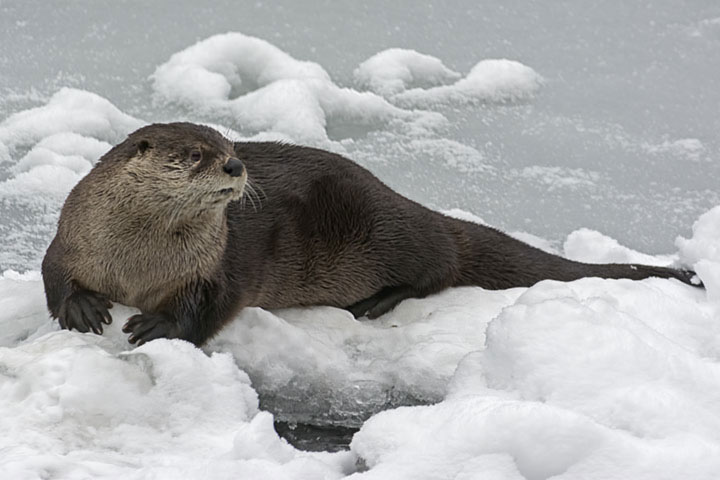
Tracks across the ice, local piles of snow, and openings in the ice, all hinted at a haven for otters. Soon there was confirmation as heads poked through the ice; some otters lounged on top, others hunted in the open water.

The first otter spotted was sitting beside an opening in the ice and lazily looking around.
otter131227as

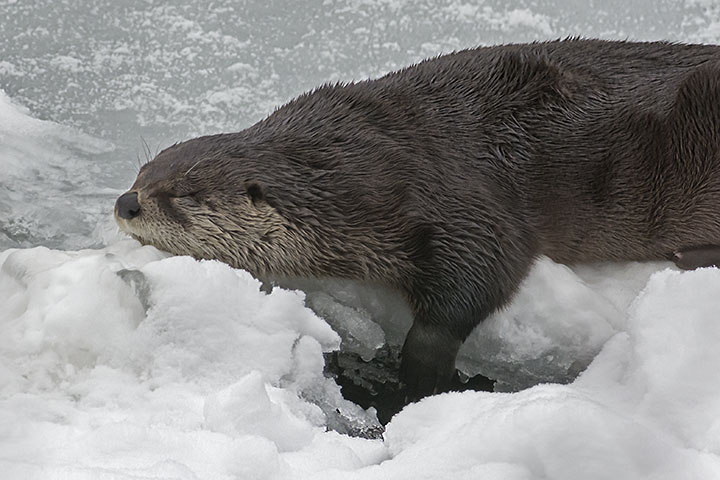
Although it eventually vanished down the hole, first there was time for a snooze with a forepaw in the ice water.
Elsewhere, a mother groomed her kit.
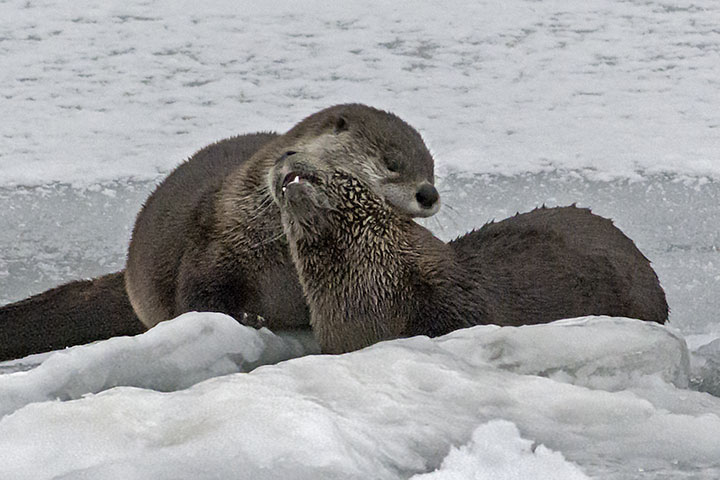
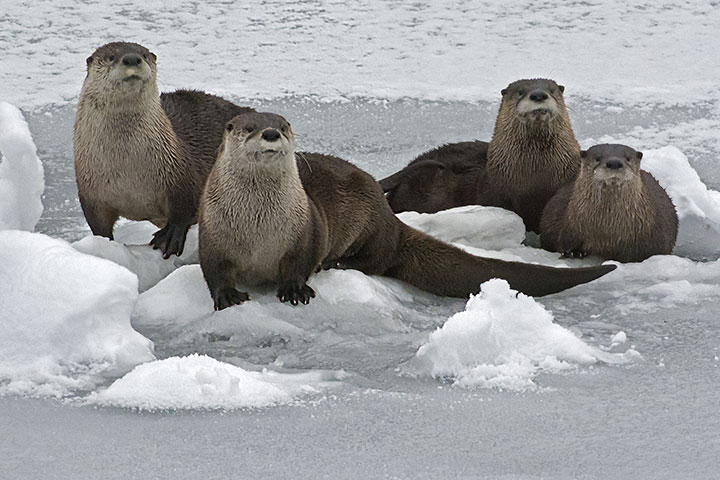
Best of all was a small group posing for what appears to be a family portrait. One kit has only half emerged.

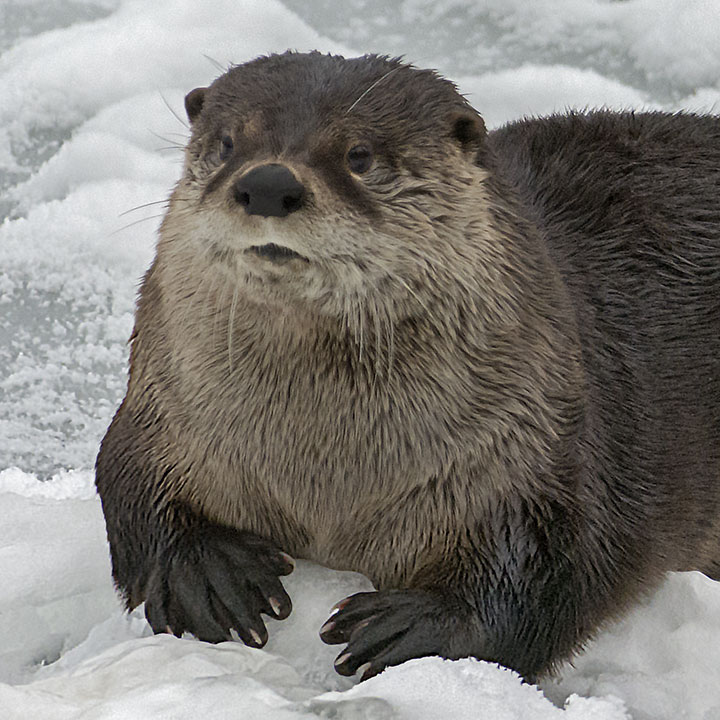
Ten meters from this otter, a sign reads: This area contains historic [sic] mine wastes with elevated levels of arsenic, lead, and other metals; and may be a health hazard. The otter might ask, “Why?”
Posted in commentary, mammals | 6 Comments

John Ross Matheson


John Ross Matheson, the man Prime Minister Lester Pearson said was most responsible for Canada’s flag, has died at the age of 96.

It is impressive that a man who, half a century ago, played such a prominent role in the creation of Canada’s most successful symbol was still with us until yesterday. I will leave it to the major news organizations to tell his story, but note that I knew him. I met and chatted with him on two occasions: once at the Canadian Museum of Civilization, where he and I were both involved in a exhibition; and once at his home.

If there is anyone for whom it is appropriate to fly our flag at half mast, it is John Matheson. This blog does so in his honour.

Posted in commentary | Comments Off on John Ross Matheson

Spatially challenged


An interesting wildlife story on the CBC website demonstrates how geographically challenged are some CBC reporters. The headline reads:

We know we are in trouble immediately when the subtitle speaks of the “West Kootenays”. Alas, there is no such place. There is a West Kootenay and an East Kootenay, which together make up the Kootenays. (See a discussion at plural ascending.)

Ok, let us assume that the plural use of a singular place was just a lapsus calami. We are told that it is recovering there. But, where was it found and where is it recovering? The story tells us:

Huh? Neither Smithers (where it is recovering), nor Midway (where it was found) are in either of the Kootenays, let alone in the West Kootenay. 

The story is at Orphaned bear cub, but an editor may have fixed the text by the time it is viewed again, so I used images to preserve the original.


Posted in commentary | 1 Comment

Birds and berries


This is a season of visitors, so it was grand that Bohemian Waxwings arrived from afar to enjoy our local fare.

Most of the elderberries have been eaten, but there is still a good supply of rowan berries, aka, mountain ash, for the taking, and yesterday waxwings took advantage of them. 

One waxwing holds a berry while another watches. Only a few berries were taken from the overwhelming feast.

Indeed, the birds would sit still in the sunlight without feeding for quite a while.

When a berry was taken, the bird would first manipulate it in its bill.

The low winter sunlight made for strikingly warm colours.

Posted in birds | 5 Comments