A three-frog summer


This has been a three-frog summer. Indeed, as far as I have been able to tell, this region has only three distinct species of frogs: Columbia Spotted Frog, Western Toad, Pacific Tree Frog. (A toad is actually a frog, but a particularly warty one.)

While pictures of the first two species did appear earlier, to enable all three to appear together, one shot of each of the first two is included along with a link to its posting.

First to be seen was the Columbia Spotted Frog.

Second, was the Western Toad—or at least the toadlet—which was seen in great profusion.

Finally, the Pacific Tree Frog, which despite its name, breeds in ponds.

Posted in herptiles | Comments Off on A three-frog summer

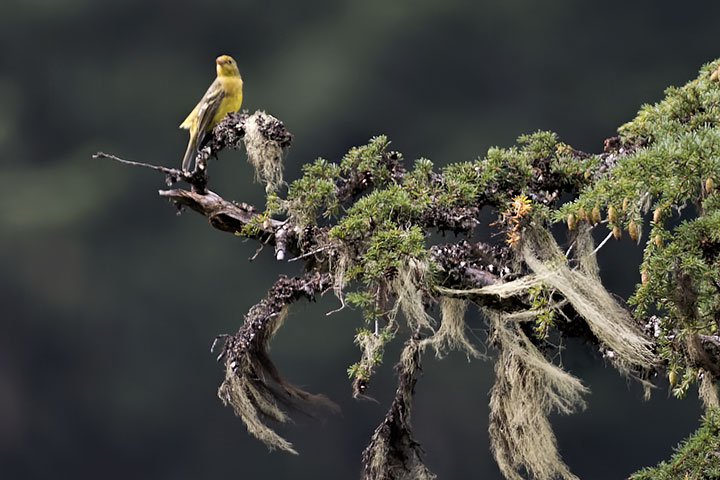
Yellow bullies yellow


A Western Tanager was sitting atop a tree, a perch that allows it to glean insects.

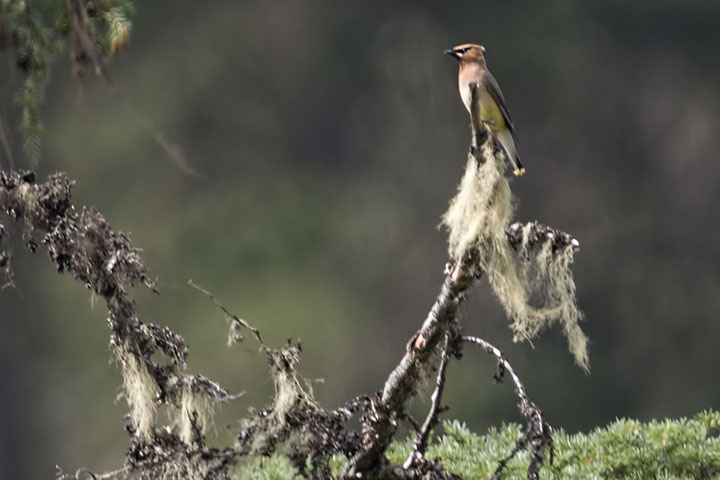
Elsewhere on the tree was a Cedar Waxwing, a slightly heavier bird.

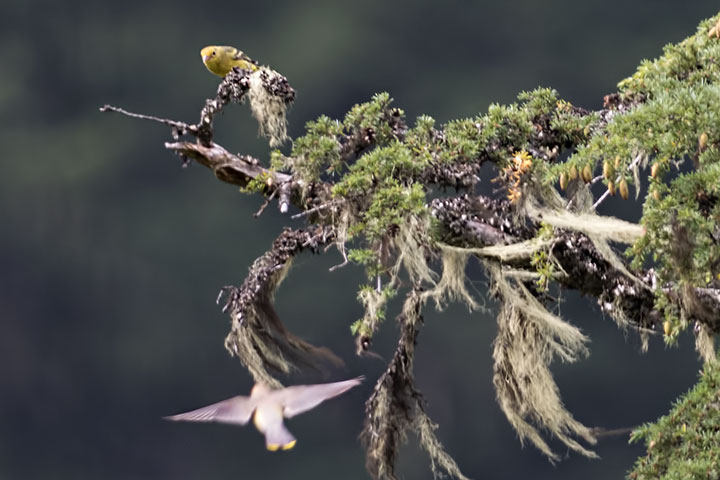
The tanager looked down and saw the waxwing coming after it.
“Hey, I know waxwings don’t eat other birds, and I thought that you aren’t even territorial—so, what the…?”

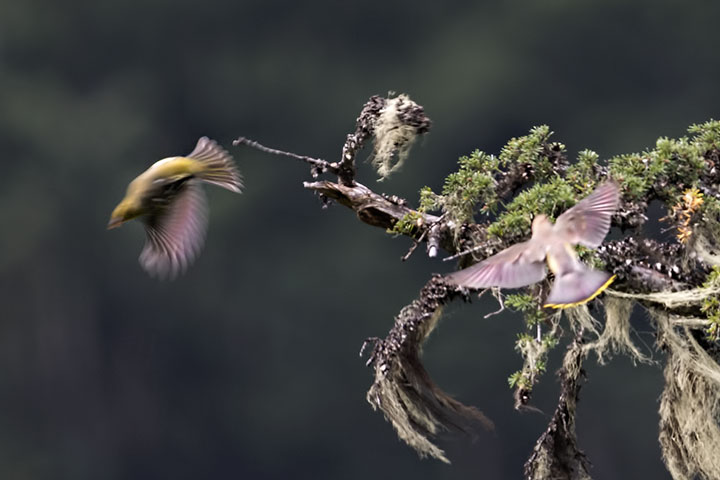
“Oh well, I’m out of here.”

Posted in birds | 1 Comment

Growing up osprey


A month after a previous visit, I stopped by an osprey nest on the West Arm of Kootenay Lake.

On July 19, I took this picture of an Osprey mother and her two chicks.

On August, 20, I took a picture of the same family. Now, the chicks (on the left) are much older and larger. Their plumage has evolved, and they are almost ready to fly.

I managed a satisfying shot comparing adult and chick. The adult, left, has yellow eyes and brown wing feathers. Its chick, right, has orange eyes, and wing feathers that look as if they have been dipped in cream.

The latter two pictures were taken on the same jaunt as was the chick surrounded by yellowjackets.


Posted in birds | 4 Comments

Bountiful nuisance


Wasps—particularly Western Yellowjackets—have been bountiful this summer. People who normally favour an outdoor meal have been driven indoors by the nuisance of them.

Yet, imagine the problem faced by an outdoor fish eater. Below is an Osprey chick that has no choice but to sit amongst the remains of many fishy meals.

ospreyswasps130820as3


Posted in birds, bugs | 7 Comments

No colour bar here


Male House Finches typically show a deep-red head and breast. So common is this that many websites only illustrate the male with a plumage of a strong red colour. Yet, it seems that it is merely diet (possibly genetics) that can change the colour from red to orange, or even yellow.

Non-red colours are not good—or at least not good when viewed from the point of view of the female House Finch. Females are typically attracted to the males with the deepest pigment of red to their head, much more so than to the occasional orange or yellowish-headed males.

Yet for the past few days, I have been visited by an orange-headed male House Finch. And more to the point, he has been accompanied by his inamorata. She does not seem to be bothered by the issue of red or orange—apparently, true love knows no colour bar.

A female House Finch visits.

She is hanging out with a distinctly yellow-orange headed (not red-headed) male House Finch.

Posted in birds | 2 Comments

Dangling tongue


Normally when a bumble bee is flying, its tongue, protected by a horny sheath, is folded under its head and body. Certainly, the tongue is extended when the bee is sipping nectar from a flower, but leaving it extended during flight would increase aerodynamic drag.

Yet, now and then, one sees a bumble bee flying with its tongue dangling—probably on jaunts between adjacent flowers.

Bombus vagans has already extended its tongue as it approaches a clover flower. Most of the tongue is covered by a sheath, but a drop of nectar hangs from the tip of the tongue protruding from the bottom.

Posted in bugs | 2 Comments

Buzzzz


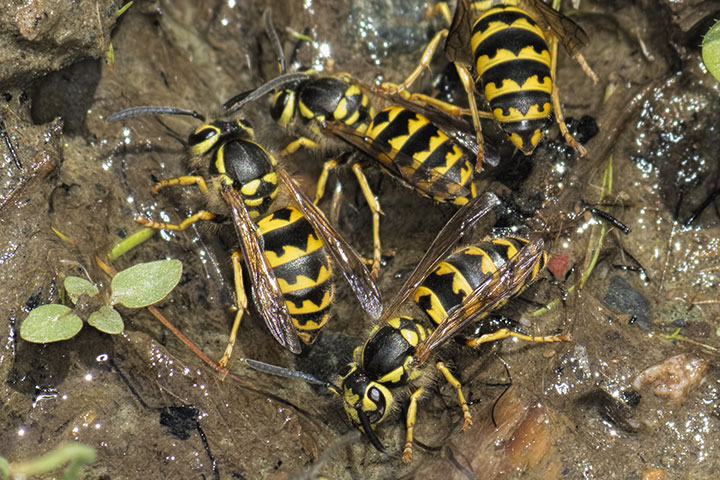
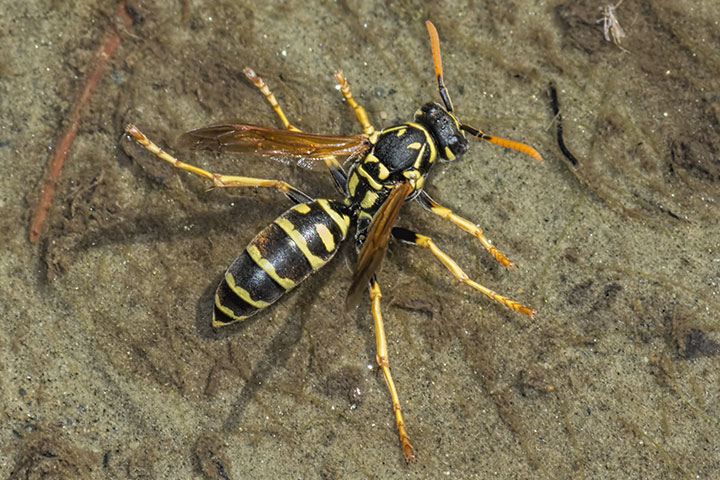
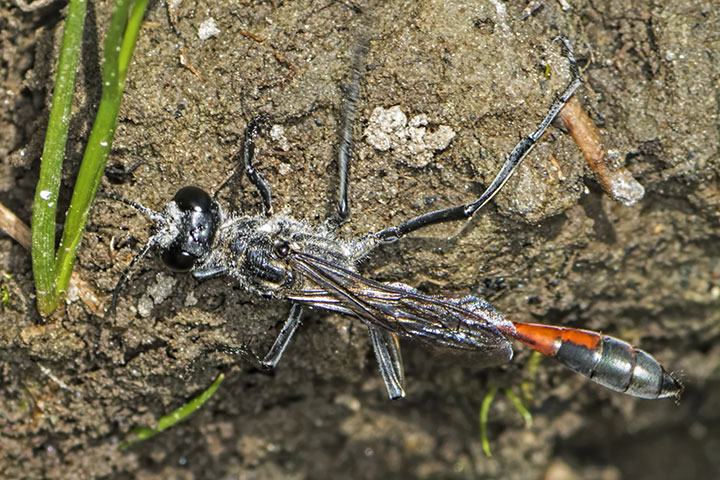
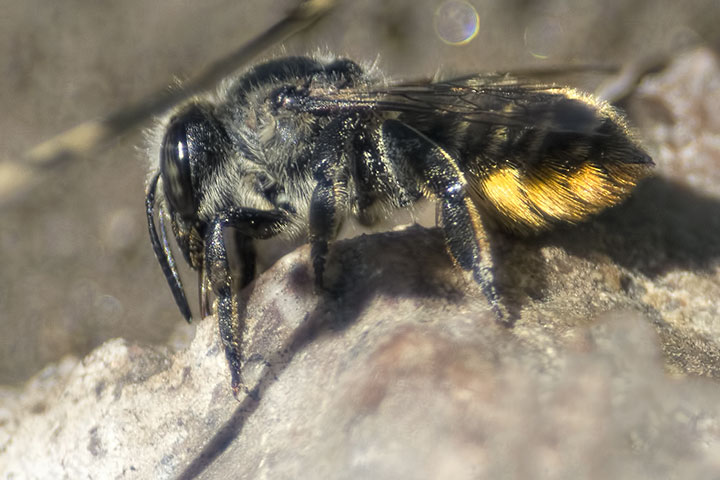
The buzzing was incessant as I sat still on a rock in the middle of a patch of mud. Around me flew hundreds of insects spread over dozens of species of wasps, bees, flies and butterflies. Although I watched their activities, the minuteness and speed of many of these beasties put them beyond my photographic skills. So the pictures, below, are but a peek into this world. As long as I moved my camera slowly, most seemed unaware of my presence.

Western Yellow Jackets abounded. It was probably the heat of the day that prompted them to be sipping. The yellow jackets seemed to favour the flowing water.

There seemed to be no such preference from the European Paper Wasp; it happily sipped standing water.

The Thread-waisted Wasp was a new species for me and I could not figure out what it was up to.

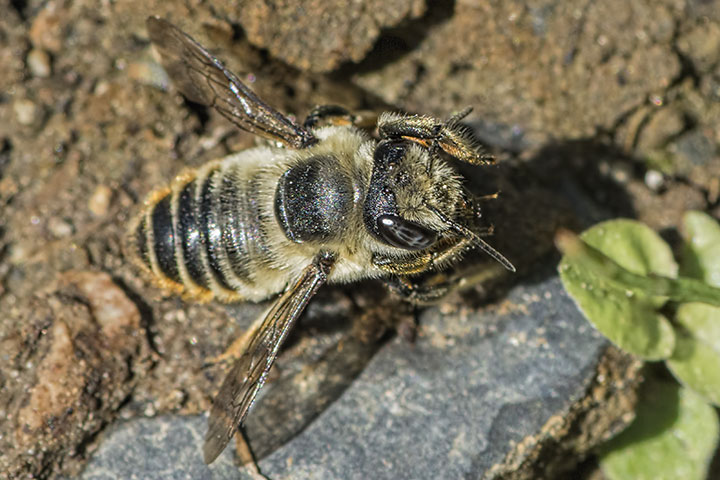
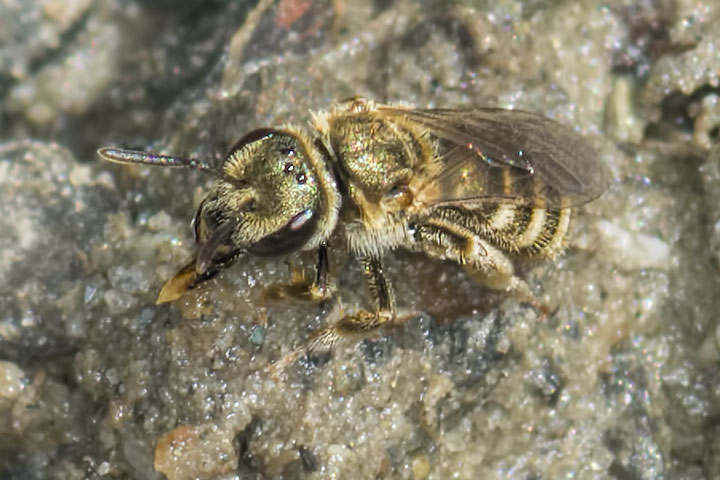
Also new for me was the Western Leafcutter Bee. This solitary bee carries pollen on the golden hairs on the underside of its abdomen.

This is the same Leafcutter Bee seen from above.

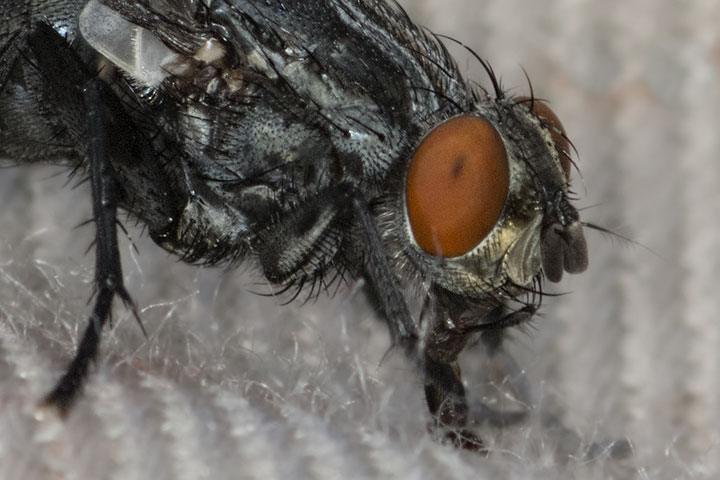
While wasps and bees largely ignored me, flies would land on my trousers. This is a female Flesh Fly.

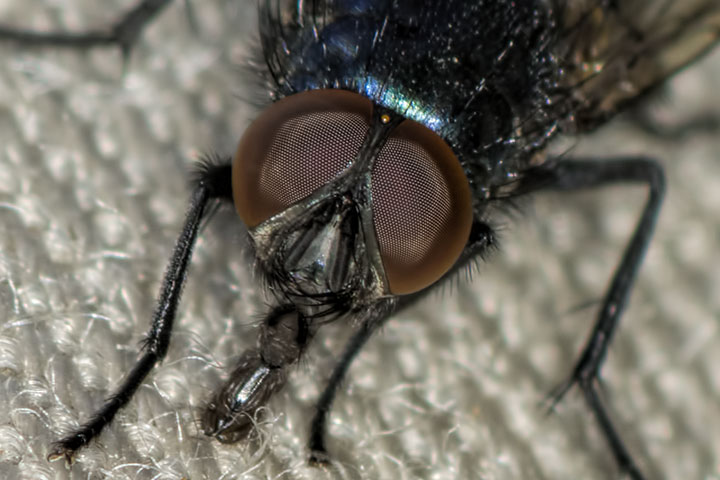
And this is a male Blue-bottle Fly.

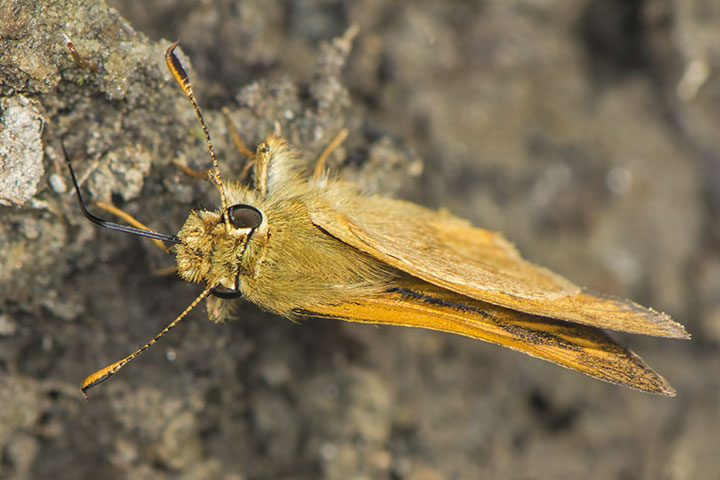
A Woodland Skipper sips nutrients from the moist surface.

Finally, this unknown bee was amazingly small. It has extended its tongue to the surface.


Posted in bugs | 4 Comments

Tick talk


High on the list of a forest walker’s unwelcome animals is the wood tick. An encounter with mosquitoes is a nuisance, a black bear on the path is merely fun (it is a bashful beast), but a tick—that’s bad. It is a disease-spreading blood sucker. (Mind you, I would prefer a tick to a cougar).

But, wood ticks are fortunately not all that common, and they are only encountered in the dry parts of the provincial interior in the Spring, typically from March to June. So, why did I find a wood tick on my clothes yesterday? Apparently, it had failed to read the instruction manual. Actually, while it is unusual to encounter one this late in the year, it is not unknown.

A wood tick on my trousers. It did not feed on me, and it was unceremoniously ejected.

As if to underscore my preference for bears over ticks, a few minutes later a bear wandered across my path. It then drifted away as I took pictures.

Posted in bugs | 2 Comments

Alpine wildflowers II


Herein are a few more wildflowers seen along the alpine trail to Idaho Peak. This follows the already posted Pink Mountain Heather and an earlier one on alpine wildflowers. While a number of other species were seen, these three postings provide a taste.

Although wildflowers are found on the mountainside, rather than on the windswept top of Idaho Peak (elevation, 2282 metres), the stage is set with a picture from the top looking down on Slocan Lake (542 metres). The lakeside villages of Silverton (centre left) and New Denver (centre right) are far below. Urban and flatland dwellers might be struck both by the clarity of the air, and by the other mountains, some of which rise another 500 metres above me. This is what the world is like here: high mountains, clear lakes, clean air.

A lupine is being visited by a pollen-packing bumble bee.

The arrow-leaf ragwort can be seen from the valleys to the high mountains.

The rocky-ledge penstemon (also called the oval-leaved penstemon) only grows above about 1200 metres.
 A hover fly is visiting a mountain arnica.

The bladder campion is not the most colourful of flowers.

This is the silky phacelia. Earlier, I had incorrectly labeled it as a wood betony.

I had never noticed the white rhododendron before.

The alpine paintbrush (also called the Indian paintbrush) is everyone’s favourite.


Posted in scenes, wildflowers | 2 Comments

Alpine wildflowers


Tuesday’s walk through alpine meadows (altitude between 2100 and 2260 metres) produced a feast of wildflowers and hundreds of images. Already shown was the Pink Mountain Heather; here are a few more.

The Harebell was easy to identify as it is also found in the valleys.

Although distributed over a range, the average altitude for the Yellow Columbine is about 1900 metres.

The striking seed head of the Western Anemone has earned many nicknames: towheaded baby, old man of the mountains, hippy on a stick, shaggy head, moptop.

A Leafy Aster is being visited by a bumble bee (Bombus melanopygus).

A Sitka Valerian is visited by a checkerspot butterfly (Euphydryas anicia ssp).

On the approach to the trail through the alpine flowers, a Red-tailed Hawk sat atop an Engelmann Spruce—replete with cones—as if it were the guardian of Elysium.

Posted in birds, bugs, wildflowers | 1 Comment