Pink Mountain Heather


The first time I saw Pink Mountain Heather (Phyllodoce empetriformis), I found only one small patch. But then, the altitude was below 1600 metres (Gibson Lake). Yesterday, I found it in great profusion, but now the altitude was over 2100 metres (along the trail to Idaho Peak).

It seems the flower has justifiably earned the name, mountain. But, should it be called pink? Not everyone agrees. Some call it Red Heather, some Red Mountain Heather, some just Mountain Heather. In sticking with Pink Mountain Heather, I am following the practice at eflora.bc.ca.

Two pictures are below.


Posted in wildflowers | 3 Comments

Bonaparte’s Gull

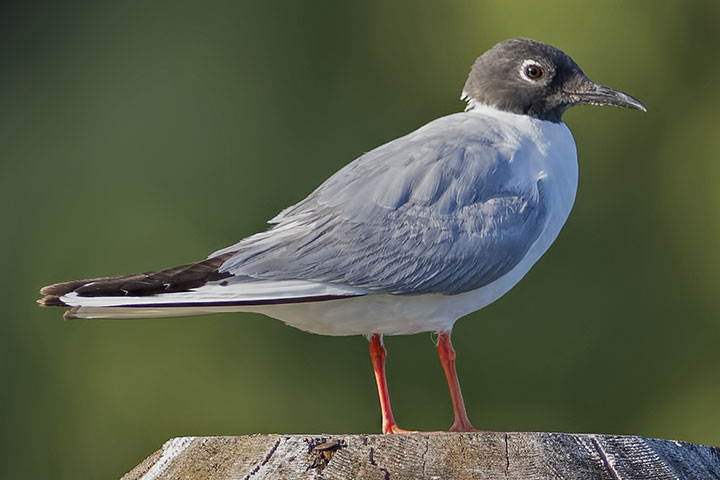
A Bonaparte’s Gull in nonbreeding plumage.


Bonaparte’s Gull is not one of the typical gulls seen daily around Kootenay Lake in the summer. Bonaparte’s breeds in boreal forests well to the north of the Lake.

As with other migrants that winter to our south and breed to our north, they are seen primarily as they pass through. The odd one is seen heading north early in the summer or heading south later. However, they might look different on the different jaunts.

The picture of the Bonaparte’s Gull on the right was taken in early June of this year. It is in its nonbreeding plumage: grey head with a black spot behind the eye.

The bird I saw yesterday was in its breeding plumage: a hood of black. This is the first year I have seen (well, noticed) the bird. Two pictures of it are below.

Yesterday’s Bonaparte’s Gull was in its breeding plumage.

Posted in birds | Comments Off on Bonaparte’s Gull

Toadlets aplenty


Toadlets abounded—a walk along the trail required care to avoid stepping on them. There were thousands of these newly metamorphosed Western Toads. Despite the great numbers, perhaps only one percent will survive to adulthood. A major predator is the garter snake, but birds also pick them off. I even saw a fisherman using them for bait. Three pictures of individual toadlets are below.


Posted in herptiles | Comments Off on Toadlets aplenty

Damselfly protection


Wherever aquatic plants broke the surface of the water, male damselflies (Tule Bluets?) were congregating. The centre of all this activity was a lone egg-laying female. Guarding her was her mate: he was there protecting his investment. Were he to leave, all those other males would promptly attempt to mate with her.

On the right third of the picture there is a lone female damselfly: the one with the distinctly golden hue and her abdomen bent down to the stalk of the plant. Holding her by the back of the neck is her mate. The other males in the picture would like to displace him.

Another egg-laying female is being guarded by her mate (the one extending diagonally upward from her head). However, one male is flying low across them, presumably trying to muscle in.

Now and then a damselfly couple have a moment of tranquility. Here are two pictures.

Posted in bugs | 1 Comment

Beach cusps


The interaction of the Lake and a sandy beach offers fascinating physical details: Water wets the sand changing both appearance and firmness. Waves move up and down the beach sorting sand and pebbles by size. Waves shift sand along the shore sculpting inlets and the sand points. Some of these topics are illustrated and discussed on the main website on the links at Beaches.

Although uncommon, one of the loveliest details is the rhythmic pattern known as beach cusps. I have somewhat more spectacular images of them on my page, Beach Cusps, from which I lift the following explanation:

If at one spot [on the shore], the velocity of the swash [upwash of the wave] is slightly less, either because of wave interference or even a pebble or stick on the beach, then that portion of the swash will drop some of the larger sand grains. This only enhances the slow down for the next wave, which also drops some of its sand. So, a small promontory is built which slows and deflects subsequent waves. The portion of the swash which is deflected to either side of this growing cusp swings around in an arc and creates the bays. Now, those bays cause velocity differences which produce the next cusp, and so on down the beach.

Although yestermorn’s pictures are not as grand as those on the other page, the phenomenon’s rarity justifies the present attention.

A view along the shoreline shows the pattern of small cusps and bays created by the waves.

And a view from above. The waves shifted and the pattern soon vanished.

Posted in weather | Comments Off on Beach cusps

Bank Swallow chicks


At this time of year, Bank Swallow parents are kept very busy ferrying insects to their chicks. Here are four pictures of the feeding of one group of chicks.

A parent approaches five chicks, each demanding that it be fed.

The frenzy at the opening is intense as the chicks kick up dust while they compete for attention.

And a little bit for you also.

The parent heads out to capture more insects. And so it goes throughout the day.

Posted in birds | 6 Comments

En passant


En passant is a French term used to describing something that happens merely in passing. It is a good descriptor for many of the things I see: I head out for A, and happen on B—en passant. Here are some examples.

I was watching chicks of the Spotted Sandpiper when I saw a Northern Rough-winged Swallow.

I was looking for the Three-toed Woodpecker when I saw the chick of a Roughed Grouse.

I was looking for Osprey chicks when I saw a Yellow-bellied Marmot (who had been feeding on flowers).

I was looking for some more Osprey chicks when I spotted a Barn Cliff Swallow chick in its nest.

I was hunting the familiar crab spider (Misumena vatia) on flowers and I encountered its even smaller (and hairier) relative—possibly a Misumenops asperatus.

Upon returning from the Osprey expedition, I watched a Song Sparrow capture a dragonfly larva.

Again, the trip to look for Osprey chicks, revealed the landing of a Great Blue Heron.


Posted in birds, bugs, mammals | 4 Comments

Heron heels


Herons stand on their toes—indeed, all birds stand on their toes. The joint halfway up the leg that looks as if it were a backwards knee, actually corresponds to the ankle of a mammal. I have never seen a heron, or any other bird, rest on its heels—never, that is, until yesterday.

This is how a heron, or any bird, normally stands. Its toes touch the ground, but its ankle (the tibiotarsal articulation) is high off the surface. Its knee joint is close to the body and hidden by the wing. This heron is hunting.

This younger heron is also hunting. But, (what would be) its heels are resting on the rock—a stance unknown to me. This position is sufficiently odd that when I saw its distant silhouette, I thought I was looking at a dog.

This picture of the earlier heel-standing heron is included merely because I like it among the fireweed.

Posted in birds | 1 Comment

Osprey family


I long wanted to get pictures of an Osprey family with downy chicks in the nest, but until yesterday success eluded me.

The problem is that the nests are usually well above eye level and nestlings rarely stick their heads high enough to be seen. There seems to be only a short time when chicks are still in their down, but are sufficiently adventuresome to peek over the nest edge. Added to this is the need to stay far off so as to offer minimal disturbance; thus, it is not surprising that satisfactory shots have been a while in coming. All pictures, except the first, are associated with one nest.

This mother has two chicks.

While this mother has only one.

A chick tries out inadequate wings as its parents look on.

A father flies overhead with a fish as it heads for its nest.

He manoeuvres near the nest.

And delivers breakfast to his family.

Finally, a family portrait.

Posted in birds | 5 Comments

Vole begone


Vole: “Are you really going to go through with this?”
Heron: “You can bet your life.”

Posted in birds, mammals | 5 Comments