Grizzlies in the mist


In the growing fog at twilight, four Grizzly Bears were grazing in a meadow. They looked like huge, distant, spectres in the dim light. While fog, darkness, and distance, offered me safety, they added little but mood to my images. Ah well, how often does one get to see such things?

Apparently sated, the two cubs (seen together on the left, above) began to frolic. “Let’s play.”

“This is fun.”

The fog drifted and the light faded, and they carried on.

They played for about twelve minutes.
grizzlies130602gs

Finally mommy approached and (apparently) suggested it was time to leave.

Disinclined to do so they started in again, until she spoke more firmly. At that, all departed.

I watched the event with Derek Kite. Here are some of his shots.

Posted in mammals | 5 Comments

Shaggy mammals


Sometimes local mammals can look markedly shaggy. I offer two local examples.

The first one is sad: a mangy squirrel. The squirrel is scrawny, shaggy, and bedraggled. Mange is a skin disease caused by parasitic mites that tend to congregate in regions that the animal cannot groom, such as the back. It typically causes severe itching, hair loss, and the formation of scabs and lesions.

The second illustration is shedding: merely a seasonal moulting of fur.

This squirrel (apparently) has the mange. It is losing fur on its back.

This (female) bighorn sheep is going through a seasonal shedding of its coat.

I am reminded of the famous (alas, almost certainly, apocryphal) remark by Winston Churchill. Winston was accosted by Bessie Braddock with:

Winston, you are drunk, and what’s more you are disgustingly drunk.

To which Winston Churchill’s reputedly replied:

Bessie, my dear, you are ugly, and what’s more, you are disgustingly ugly. But tomorrow I shall be sober and you will still be disgustingly ugly.

The relevance of this is that next week, the squirrel will still be mangy, but the sheep will be looking good.

Posted in mammals | Comments Off on Shaggy mammals

Bird bites bug

The dominant foraging technique of the Yellow-headed Blackbird is to prowl through the grass looking for bugs and seeds (May, 2011)

The dominant foraging technique of the Yellow-headed Blackbird is to prowl through grass looking for bugs and seeds (May, 2011)


Predatory birds and insects often use one of two strategies for finding food: one group sits and waits, only to sally forth after prey is spotted; the other group actively forages.

The two species of dragonflies I watched last Sunday (both skimmers) were perchers. They would sit on a reed or blade of grass and only take to the air after spotting another delectable insect.

A bird I watched (Yellow-headed Blackbird) usually hunted by foraging, albeit it on foot in the grass.

What was interesting was that the bird changed its tactics when hunting the dragonflies: it hunted the dragonflies in the same way that the dragonfly hunted others.

A favourite in marshy areas in the springtime is the Four-spotted Skimmer. This one is waiting and watching. If one wonders how to count the spots (which seem to be eight in number on the wings), one must ignore the ones near the wingtips—the stigma—which appear on most dragonflies.

Who could resist a profile of this same delightful creature as it waits to pounce?

And then there was a female Hudsonian Whiteface. (All of the dragonfly identifications are tentative.)

There appeared a Yellow-headed Blackbird. While it is normally out foraging, on this occasion, it merely sat quietly amongst some reeds. It was not clear to me what it was up to. Apparently, it was just watching.

It seems to have spotted something and promptly headed out.

After capturing a dragonfly, it headed back to another island of reeds to consume it.

After downing the dragonfly, the blackbird settled into another island of reeds. From there it headed out to capture yet another dragonfly and so it went from one island of reeds to another. The striking thing was that the dragonflies were being captured using the same tactic they used to captured others.



Posted in birds, bugs | 5 Comments

Kingfisher hovering


The Belted Kingfisher may be the largest bird in North American capable of (true) hovering.

Hovering flight is energetically expensive and only small birds can manage it. To stay in one spot in still air, the bird must generate lift solely by flapping its wings. Regular flight, where lift results from the bird’s forward motion through the air, requires only half the power of hovering. Large birds (with their lower ratio of power output to mass) just cannot sustain the energy output needed to hover. Sometimes a large bird appears to be hovering, but is actually holding a fixed ground position by flying into a strong wind.

I regularly watch hummingbirds hover—they are the masters of it. I knew that the significantly heavier kingfisher occasionally hovered when fishing, yet I had only ever seen it hunt from a perch. Hovering is exceedingly hard work; why do it when it isn’t needed?

Sunday, I watched a female Belted Kingfisher hover.

There was no wind, but the bird stayed fixed in space over the water. To enable details to be seen, separate images were first combined and then displaced—time moves like text on a page. One interesting detail is the bird’s use of alulae (Latin, for winglet). The kingfisher only deploys them on the downstroke, but retracts them during the upstroke. Unlike a hummingbird, the kingfisher is incapable of generating lift on the upstroke, only the downstroke.

Ten pictures in two seconds. Wings are folded during upstroke and spread during downstroke. The alulae are the extensions midway along the leading edge of the wing. They perform the same function as slats on an aircraft and allow the wing to achieve a higher than normal angle of attack. This maintains lift without resulting in a stall.

A detail of the final image is included to make it easy to spot the alula along the leading edge of the right wing.

The following composite does not show a kingfisher hovering but landing on a tree branch. The bird flies upwards using gravity to slow itself (images get closer together). At the last moment, when it has a particularly high angle of attack, the alulae are deployed.

Posted in birds | 6 Comments

Harlequin Ducks


There are no Harlequin Ducks in Kootenay Lake.

Gaining its name from the male’s almost comical plumage, this small diving duck prefers a cold turbulent stream to a warm tranquil lake. Although the harlequin does not visit the Lake, it can be seen from a road that links West and South Arms. Well, all of this is true in the summertime; in the wintertime (and in drabber plumage see comment, below), harlequins head to Pacific coastal waters.

The plumage of the male harlequin is almost gaudy—it is important to look good.

And this is true whether one is seen coming or going.

Posted in birds | 6 Comments

Blue cirrus


We have entered the season of the circumhorizontal arc—one of the most brilliant and colourful of all the haloes. Indeed at its best, it outclasses the rainbow.

The circumhorizontal arc forms a horizontal line low in the sky, when the Sun is high in the sky. The solar elevation must be greater than 58°, although at that cutoff elevation the arc is so faint as to be of marginal visibility. The arc is at its best when the Sun is close to an elevation of 67°, at which time it can be truly spectacular. At significantly lower or higher solar elevations, quality deteriorates.

Unfortunately at the latitude of Kootenay Lake, the highest that the sun climbs at solstice noon is about 64°. So, the circumhorizontal arc will never be seen at its best, but nevertheless, can be quite good and very much worth observing.

I was reminded of all this midday Sunday while birding at Leach Lake (south end of Kootenay Lake): a so-so circumhorizontal arc appeared in the southern sky. My camera lens was equipped for distant birds, so Brian d’Eon obligingly took a picture for me (below).

Now, the picture does not show a well developed arc: the solar elevation is only 62°, and there is no cirrus in a position that would give colours other than blue. Nevertheless, it is clear that the season of the circumhorizontal arc is upon us. Over the next six week or so, I will watch for colourful cirrus low in the sky around solar midday (about 1 pm DST).

Blue cirrus was all that was seen. In the coming weeks with a higher Sun and more extensive cirrus, the circumhorizontal arc could become really nice.

Brian d’Eon’s picture is used with permission.


Posted in weather | 1 Comment

White Pelican


The White Pelican is huge, endangered, and here.

The White Pelican has an impressive wingspan of 2.4 to 3.0 metres, greater even than that of the Trumpeter Swan. Mind you, the swan outclasses the pelican in weight by about forty percent. However, a bird sighting reveals size not weight, so when the White Pelican flies low overhead, you know you have encountered an aerial giant.

This North American bird is not broadly endangered, but it is so in British Columbia where there is only a solitary breeding colony. That colony is in White Pelican Provincial Park, about 70 kilometres west of Williams Lake. Indeed to help survival, the Park is closed to the public during the pelican breeding season.

The White Pelican sometimes passes through our area during its migration. This May, it has been seen around the Lake from Creston north to Lardeau, and west to Nelson.

White Pelicans in the distance appear blurry and wiggly as a result of the intervening turbulent air.

Although the pelicans in the above picture were distant, fourteen others obligingly flew overhead.

You have to be impressed when one giant flies low overhead, but when a flock of giants does—wow.
I am indebted to Peter Mciver for showing me where I might see some White Pelicans.
 

Posted in birds | 2 Comments

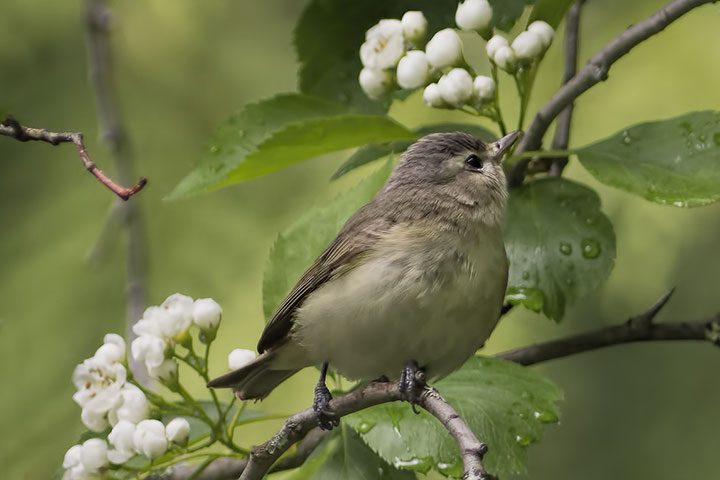
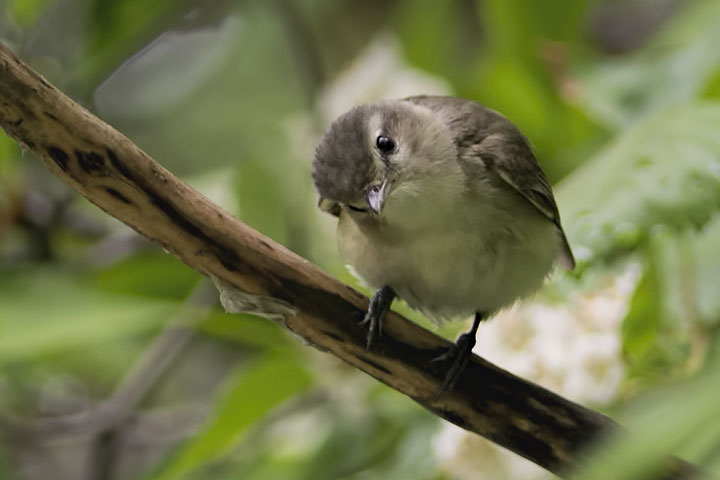
Warbling Vireo


No sooner than you think you are beginning to get the hang of watching nature, than an unknown species appears and sets you adrift. This was the case yesterday when I noticed that a black hawthorn tree had become alive with the twittering of small, plain, but melodious songbirds.

But, what was the bird? I took pictures (of course) and posted them to a birding group. It wasn’t long before Stanley Walens (in California) explained: “warbling vireos. They should be migrating into your area about now.”

And so it was. Here are two of my pictures of the Warbling Vireo as it entertained Kootenay Lake—what is missing is the delicious singing.

Posted in birds | 3 Comments

Inconsolable worm


Posted in birds | Comments Off on Inconsolable worm

Bumble bee shots


A bumble bee (unknown species) was working the flowers of the deer brush and produced three interesting shots.

The anthers and stigmas of the flowers extend well above the rest of the flower, so as this bee inserts its tongue into the nectary, its body cannot help but pick up pollen to be transferred to another flower.

There are mites attached to the thorax of the bee (lower left). However, most mites associated with bumble bees are phoretic: they are not bee parasites, but merely hitch a ride to the hive where they feed on wax, pollen, and small arthropods. In short, they come along to the nest and then help the bumble bee clean house.

I merely like this portrait of the bee with its tongue and wings extended as it is about to lift off.

Posted in bugs | 1 Comment