“Just ignore me, I am merely another one of the yellowish buds of May.”
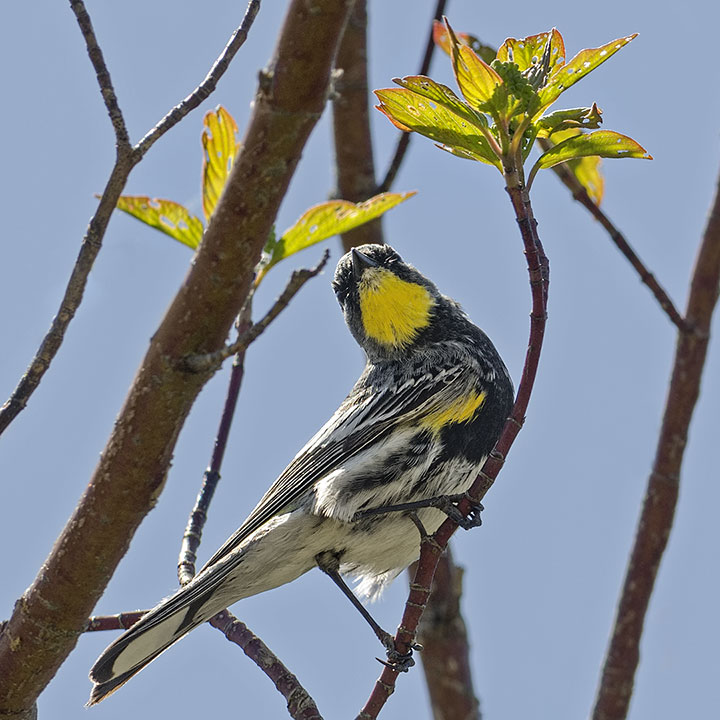
Yellow-rumped Warbler
(Last January, I posted a picture of a Pygmy Owl blending in.)
“Just ignore me, I am merely another one of the yellowish buds of May.”
Yellow-rumped Warbler
(Last January, I posted a picture of a Pygmy Owl blending in.)
The Kaslo Trailblazers had an interesting problem: how to join trails on opposite steep banks of the precipitous Kaslo River? The Society’s beautiful solution is a covered bridge, 34 metres long and 15 metres above the turbulent stream.
Sunday’s visit to the bridge presented me with an interesting problem: how to photograph a structure that would not yield to the approach used for birds and bees? My solution was to stand in the middle of the bridge and take a 360° panorama.

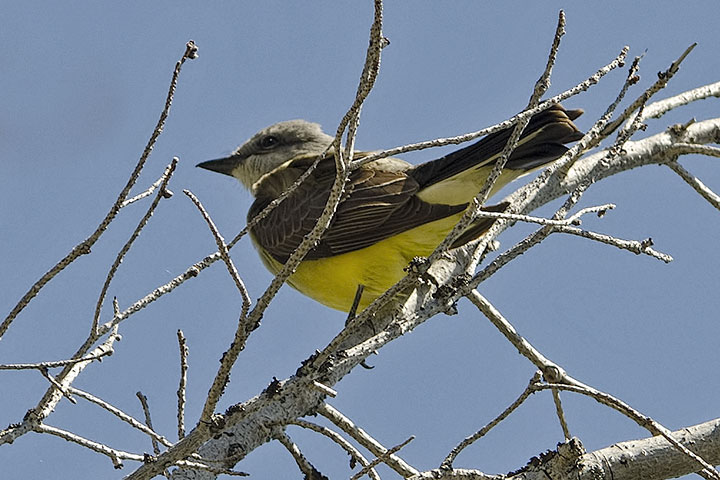
Last August, I saw my first Eastern Kingbird; last week I saw my first Western Kingbird.
With geographically inspired names, one might think that the eastern bird would be found exclusively in eastern North America, and the western, exclusively in the west. However, the Eastern Kingbird is found across the continent, and while the Western Kingbird is predominantly in the west, it is also found in the east, especially during migration.
Both eastern and western birds are flycatchers, albeit rather large ones. They perch and watch until the prey is spotted and then fly after it.
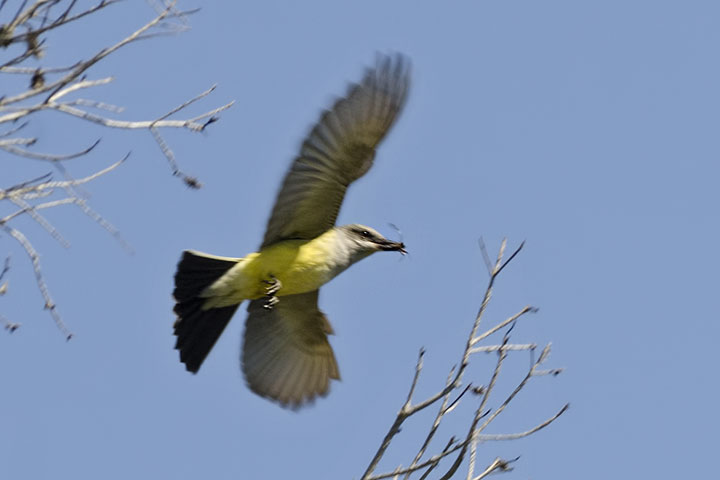
This Western Kingbird is carrying a twig—probably to serve as nest material.
Flowers produce nectar for one reason: to entice insects to brush against their reproductive organs and, in doing so, to transfer pollen from one flower to the next. To accomplish this, flowers are structured such that the insect must pass the anthers and stigma to reach the nectary (where the nectar is produced). That is the contract: insects pay for the nectar by providing pollination.
This system works for the benefit of both flowers and insects. It works, that is, until the coming of larcenists. These break-and-enter specialists bypass pollination and just steal the nectar. The only local nectar robbers I have spotted are wasps.
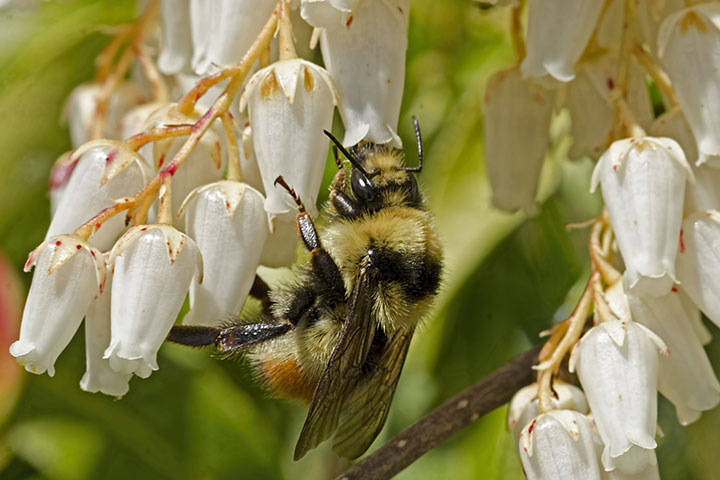
Most bees and flies are either small enough or have long enough tongues to reach the nectar from the lips of a tubular flower and so rub against the flower’s reproductive organs. This Bombus melanopygus is thrusting its tongue into the opening of a Pieris japonica. The bumble bee is living up to its contract with the flower.
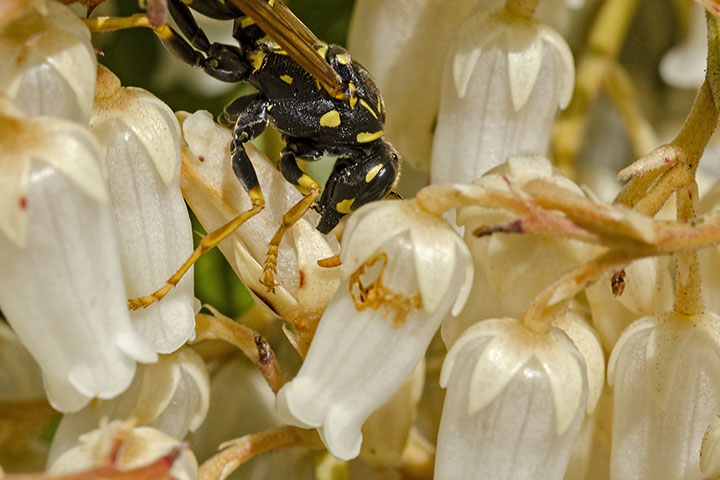
Not so, this paper wasp. It is about to rob the flower—to take nectar and give nothing in return. Wasps lack the long tongue needed to reach the nectary from the flower’s opening, but they do have powerful jaws. Their solution is to break and enter: to bite a hole through a petal. This Polistes dominula has just started to bite. Seen on another flower (below its head) is a older hole carved to reach the nectary.
An aerial yellowjacket (Dolichovespula arenaria) demonstrates the entering portion of break and enter: it sticks its jaws though the hole it created and takes the nectar, bypassing the flower’s reproductive organs.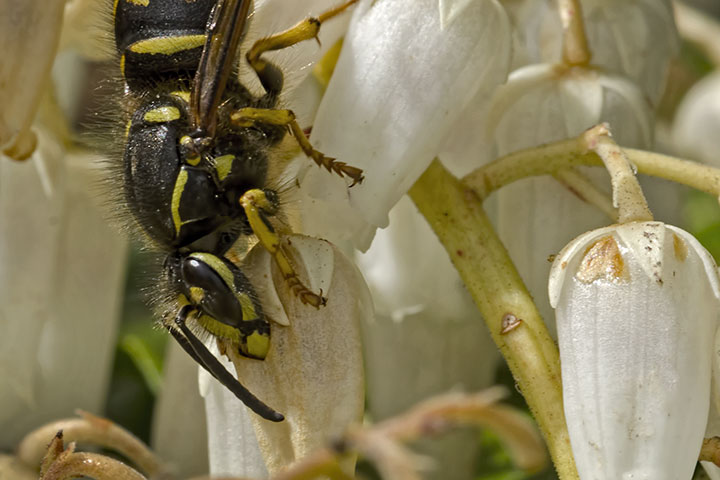
Yesterday, when I posted pictures of three wildflowers, I had wanted to post a fourth. Alas, I couldn’t find the other flower, even though I knew it should be in my lawn about now.
Today, there it was: the thyme-leaved speedwell (Veronica serpyllifolia). In fairness, this is a tiny flower and easily overlooked. But, if one lounges on the grass with a magnifying glass, its beauty becomes evident. Two pictures follow.


Of course my yard has dandelions.
But, these pictures show three other flowers, all of them wild, that have volunteered to hang out in the vicinity of my house. By merely knowing these species, a botanist could deduce much about my habitat.
Each spring, I find a dozen or so stream violets in the same area.

The forget-me-not is a small, and variable wildflower. Most have blue petals, but the colour can range through pink to white. There is one pinkish flower in this group. Most references say the centre is yellow. So, why do I often see some with a white centre?

The skunk cabbage is not everyone’s favourite wildflower, but it is part of the local landscape.

An unexpected pleasure this morning was an item on the CBC’s radio programme, Daybreak South. It was about bugs (well, arthropods, actually). Listeners had sent in pictures which were then posted and now entomologist, Hugh Philip, was naming and discussing them. What fun; who would have expected a treatment of bug identification on the radio?
As a tribute to that effort, I post a half-dozen bug shots taken in my yard over the last few days, along with my own tentative identification. Others (even Hugh Philip) are welcome to correct my identifications.
The Mourning Cloak (Nymphalis antiopa) is common throughout the Province and the butterfly season.

The Bombylius fly (possibly, Bombylius major) is only seen early in the season (April and May).

The bumble bee season is underway. This is possibly Bombus bifarius.

I suspect that this bumble bee is a Bombus melanopygus.

The wasp season is just beginning. The European Paper Wasp (Polistes dominula) is an invasive species that arrived in the Province a decade ago. It makes those open-faced, disc-shaped hives which are particularly interesting to watch.

The closed ball-shaped hives are made by either of our two long-faced wasps. One of the two is the Aerial Yellowjacket (Dolichovespula arenaria).

A year ago, I took pictures while a pond skater went in for the kill. Now, I have watched two of them—er—make friends. That may well cover the gamut of pond-skater behaviour: food and sex.
“Will you be my friend?”

“Sure, just climb aboard.”

I photographed my first Rufous Hummingbird of 2013 this morning. It was a male—the sex which has the strikingly iridescent gorget. I attach three pictures of this visitor.
The gorget of a hummingbird owes its colour to iridescence. As such, the colour depends greatly on the direction of the light source and the viewing angle. Here, the gorget looks dark brown.

Six seconds later, this bird turned his head. There is a striking transformation in the appearance of its gorget.

About 15 seconds later, the bird stared into the camera allowing a portrait.

The story of the western bumble bee (Bombus occidentalis) is a sad one. At one time this bee was the familiar accompaniment to spring and summertime flowers throughout the western cordillera. Common and widespread, its range extended across Alaska and Yukon, all of BC, half of Alberta, and many western states. That was only fifteen years ago.
Then, in the space of a few years, the western bumble bee vanished from most of its former range. Some populations survive in Alaska, along the Rockies, and—TA-DAH—around Kootenay Lake. (Efauna.bc.ca shows a far broader distribution, but its data are old).
As the Sun warmed the Pieris japonica yesterday afternoon, I watched a few different species of bumble bees, among them I was delighted to see, one or two westerns. This bumble bee is distinctive: it is the only local one with white hair covering the tip of its abdomen. I and others have seen it occasionally around the Lake in the last few years. I will look for it again today.
Old white butt is no longer common, but it is still here. Below, two pictures from yesterday afternoon. Further information on the western bumble bee is available from the Xerces Society.
Welcome back

