Portrait of a fawn


Posted in mammals | 1 Comment

Western yellowjacket


The western yellowjacket is a versatile wasp. It will nest in the ground, in tree trunks, or under the eves of porches. As with most of the creatures around, I tend to adopt a live-and-let-live approach. However, when this yellowjacket bars entry through an occasionally used doorway by attacking visitors, I draw the line: the hive has to go.

Western yellowjacket wasps are building a hive on the lintel above an entrance doorway, and then terrorizing all who dare to pass by. This is war.


Posted in bugs | 3 Comments

July goulash


This is a collection of a dozen images from July, none of which has had a posting of its own.

Where have all the male Mallards gone? They are here, but are in their eclipse plumage, which makes them look somewhat like females for a few months. That this is a male is evidenced by its yellowish bill. The female’s bill is much darker.

Has the hot dry weather been hard on megafauna? This white-tailed deer looks a tad scrawny. 

A common wood-nymph rests while foraging.

An eagle just ignored the magpie’s request that it find itself another tree.

Some Indian pipe was posted earlier. This is another find.

There seem to be fewer dragonflies this year. This is a cherry-faced meadowhawk.

There were plentiful snowshoe hares last year, but this is only the second one I have spotted this year. Something has taken a nick out of this one’s ear.

The cheetah is billed as the world’s fastest land animal. However, when measured by the biological standard of body lengths traveled per second, the hare is fifty percent faster than a cheetah.

A hedgerow hairstreak stops for a rest.

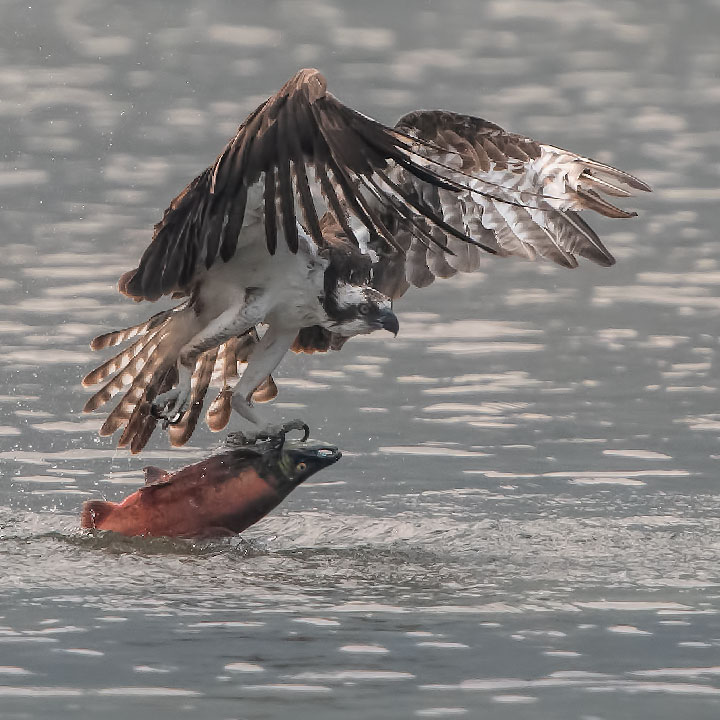
An osprey frequently flies around with a headless fish. It might be that the male stopped and ate the tasty head on his way back to the nest. However, this fish has already been to the nest — see the grass stuck to its tail. When its nest is threatened by an eagle, the osprey takes to the air with its fish so as to better defend its meal.

A northern crescent feeds on a daisy.

Both Northern Flicker parents tend their chicks. Earlier I showed the mother caring for this pair. Here the father provides a mouthful of ants’ eggs.


Posted in birds, bugs, fish, mammals, wildflowers | 3 Comments

Spotties


The Spotted Sandpiper is the first summer bird I became aware of as a small child — the little bird that roamed the water’s edge. Spotties arrive at the Lake in May before school is out for the summer, and leave again as children return to class. Its time at the shore coincides with that of children. While not as spectacular as the Osprey, which maintains much the same schedule, for a child wading in the shallows, the Spotty was more fun to watch.

Mind you, I wasn’t told of the Spotty’s non-standard marital arrangements, nor do I suppose that the adults in my family were aware of them. To make up for this lacuna, this blog has featured Spotty’s antics many times.

July is the time to see the sandpiper’s chicks scouring the shores.

“Just because my wings don’t work yet, doesn’t mean that I shouldn’t flex them.”

This is the chicks’ father — or at least he thinks that he is, so he broods and protects them. (As his mate is highly promiscuous, he probably is wrong.) Here the male is flying past a couple of beach walkers in an attempt to draw them away from his non-flying charges. 

Farther along the beach a juvenile Spotty (hatched a bit earlier) practices its dance routines.

For a week or so, the Spotted Sandpiper chicks rival anything around for cuteness.


Posted in birds | 6 Comments

Past-prime orchid


Normally, I attempt to post a picture that shows something at its peak of perfection. 

I am willing to make an exception. It is, after all, the Giant Helleborine. This flower is one of our local wild orchids, but one that I have not managed to see for eight years. Yesterday, I was told of hundreds of them having bloomed a week ago along the lakeshore. So today, I headed out to see them. They were there, as claimed, but were now past their prime. 

Ah well, it is the Giant Helleborine, I now know where to look for it next year.

These are a few of the many Giant Helleborines that were spotted along the lakeshore.

One of the flowers looked a tad bedraggled. 

As a reference, I include a shot I took in 2010. Maybe next year, I can capture this orchid again. 


Posted in wildflowers | 4 Comments

Persistent eagle


It was the third time lucky both for the eagle and for me.

Bald Eagles and Ospreys each have a taste for fish. Of the two, the osprey is the better fisher. The osprey can dive into the Lake and bring up a fish through a depth of about a metre. The eagle’s access is far more limited as it stays airborne and merely presses its claws into the water and grabs a fish that is swimming just below the surface. (This difference, along with other larcenous tendencies, often prompts the eagle to try to steal fish from ospreys.)

On Kootenay Lake, there is a problem even getting to see an eagle grab a fish, let alone photographing the sequence. The event can happen anywhere on huge body of water and is remarkably ephemeral: under two seconds from approach to departure. With no way to anticipate the event, how can one possibly know where or when to look, let alone where to point a camera. (Good published shots of an eagle grabbing a fish have usually been taken at a fish farm, not over open waters — those images are spectacular, but a bit of a cheat.) 

However, at sunrise this morning, an eagle twice warned me of its pending fish grab. That was all I needed. I prepared. The first warning came when I saw a surface-skimming eagle drop a fish in the Lake. The thrashing fish was just too big to have been lifted into the air. I grabbed my camera, knowing the eagle would try for it again. 

Despite this warning, I only managed one crummy shot before the eagle again couldn’t lift the big fish into the air on its second try. Would it try again? I would be ready. Alas, nothing happened for ten minutes — presumably the eagle was resting before its next attempt, and the now-battered fish wasn’t going anywhere.

Finally, the eagle tried a third time, and both it and I were now up to the task.

As the Bald Eagle approached the fish’s location, it lowered its legs and claws.

When close to the fish (the white smudge ahead of it), the eagle moved its claws forward. It must dig its claws into the fish and swing its legs back at a much higher speed than it is flying forward.

A quick grab and the eagle and a rather large fish were airborne. Alas, the eagle’s problems had just begun. The eagle raised the fish from the water with a powerful downstroke of its wings. But, it has much less lift on the wing’s successive upstroke, during which time the weight of the fish will again drag it down.

During the wing’s upstroke, the eagle has less lift and so the heavy fish drops back into the water. With the fish back in the water, there is increased drag, which further decreases flight speed, and so also lift. This problem occurred three times until the eagle finally prevailed. In the meantime, the eagle had another problem in the form of a restricted downstroke.

The movement of the eagle’s wings is limited by the surface of the water. So, although the full downstroke should be able to support both eagle and fish, the eagle can make only a half stroke before the wing tips touch the water. The eagle must get well clear of the water before it can successfully fly off with the fish.

Here, the eagle has finished its powerful downstroke and has shifted to its less effective upstroke. It is clear from the adjacent splashes that both wings had entered the water. Fortunately, the bird has lifted high enough this time that the large fish can be seen clearly. It is a largescale sucker.

After two earlier failed attempts to lift the sucker from the water, and then a few struggles during the third attempt, the eagle finally succeeded and was able to fly off with its prize. It might be simpler merely to rob an osprey the next time it is hungry.


Posted in birds, fish | 10 Comments

Feed me


“Feed me, Mommy.”


Posted in birds | 1 Comment

Deer fly eggs


A half-dozen deer flies, Chrysops figidus(?), were laying eggs just above the waterline on a long-decommissioned piling. In their preparation for laying eggs, it is these female deer flies that inflict painful bites as they seek blood that is ultimately used to feed their larvae. (The non-biting males don’t bother with blood, but stick to nectar.) 

A deer fly on the same region of an old piling in 2010

A sighting of egg laying seems to require looking at just the right time on just the right day. By the following morning, the flies are gone and the egg casings have all darkened.

Yet, beyond a fortuitous observation, there was something rather odd: eight years ago, deer flies laid eggs on the same small portion of the same piling. Two observations do not establish a pattern — yet, might something explain it? In each case the eggs were laid on the shady side of the piling about 30 cm above the waterline.

Water is the destination of the larvae that emerge from the darkened eggs. Once there, they eat aquatic insects. Presumably, this is why this area of the piling gets chosen: it is the moister shady side just above the water which will be the larvae’s new home.

A deer fly positions its eggs so larvae can drop into the water.


Posted in bugs | 3 Comments

Small fliers


It is difficult to capture the passage of small flying birds. Large flying birds are fairly easy for a camera to record, but small ones — ah, there’s the rub. 

Below are three picture of two species showing the flybys of small birds.

While the Wild Turkey is a large bird, its chicks are not, and I have rarely even seen one fly. Here is a Wild Turkey chick flying in the shade against a sunny background.

The same chick then flew into the sunlight. 

A small bird that is always difficult to capture mid-flight is the Spotted Sandpiper.


Posted in birds | Comments Off on Small fliers

Indian pipe


Indian pipe, aka ghost pipe, is a flowering plant that lacks chlorophyll. It evolved to survive in the sunless world of the deep forest floor, and acquires its energy by parasitizing surrounding trees.

These Indian pipe plants were found at the same spot as last year’s pipe.


Posted in wildflowers | 1 Comment