Duck weights


Ducks seen along the lakeshore over the last few days ranged in weight from about 370 to 5000 g.

A duck of our winter waterways the Bufflehead Duck, at about 370 g, is second in tininess to the slightly smaller Green-winged Teal. This bufflehead is a male.

Still a fairly small duck, but at about 600 g, the Wood Duck is 60% heavier than the bufflehead. The female is on the left and the male is on the right.

At about 1100 g, the Mallard is about 80% heavier than the Wood Duck. There are a number of male and female mallards in this picture, but the giant in the centre is a Rouen Duck. At about 5000 g, it weighs over four times that of the mallard, but is a domestic breed of its smaller cousin. This escapee was also seen hanging out with mallards about two years ago (Rouen Duck).

Posted in birds | 2 Comments

Danse macabre


In … Mount Revelstoke Park, mortality of siskins and other winter finches … has been seen frequently enough over the last 25 years that they are called “grill birds” by the local inhabitants, in reference to their propensity to be collected by the front end of moving vehicles.   http://iceandsnowtechnologies.com/articles/WildlifeSD.pdf

When I saw hundreds of Pine Siskins feeding on highway salt, I knew some would become grill birds.

As a vehicle approached, the siskins would take to the air.

But, depending upon the speed and size of the vehicle (which never slowed) the grill collected some.

No problem, the rest alighted again, sometimes continuing to feed amongst their fallen colleagues.

“In exchange for road salt, we happily do the danse macabre.”

Posted in birds | 4 Comments

Katabatic wind


A recurring theme of mine over the years has been that of a katabatic wind: the gentle stream of air that flows down a mountainside overnight. Indeed, I wrote about it fifty years ago, again this year with 23 cm/s, and with many postings in between.

Barney Gilmore, who has a grand view across the North Arm of the Lake, today sent me a wonderful picture illustrating a katabatic wind. It was taken in the light of dawn and shows smoke (from slash burning) being transported down the mountain slope and out over the Lake by a katabatic wind.

I am really impressed with such compelling illustrations of a physical process as this.

Barney Gilmore’s picture is used with permission.

Posted in weather | 4 Comments

Lakeside dipper


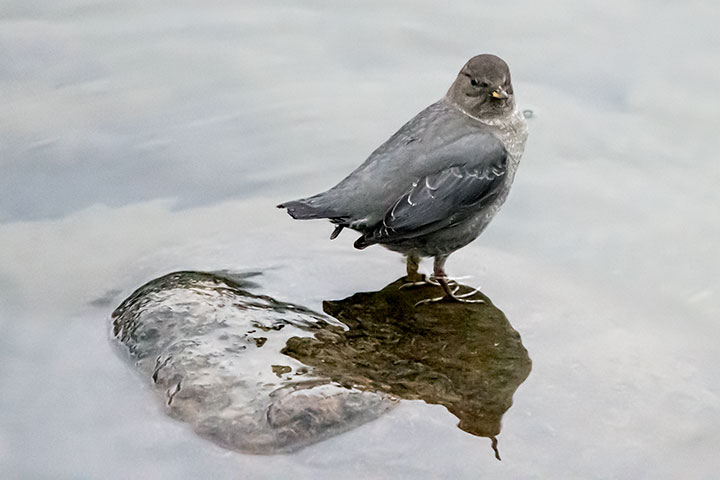
The bird sources are consistent: the dipper is a bird of clear mountain streams where it dives and scours creek bottoms for comestibles. Yet, with the approach of winter, this unusual songbird often moves downstream to lower elevations — presumably to avoid freezing creeks. Around here, that means that dippers spread out along the shore of Kootenay Lake each fall. This behaviour seems to have been baked into them: Whether or not the creek freezes, when the weather cools, many start to hunt along the lakeshore. 

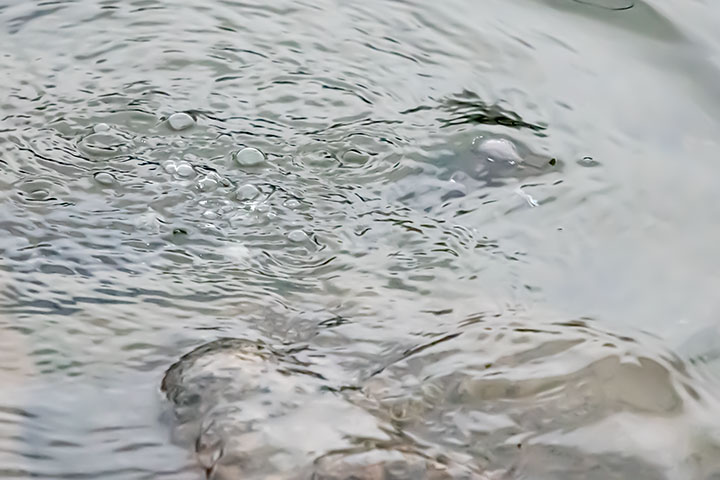
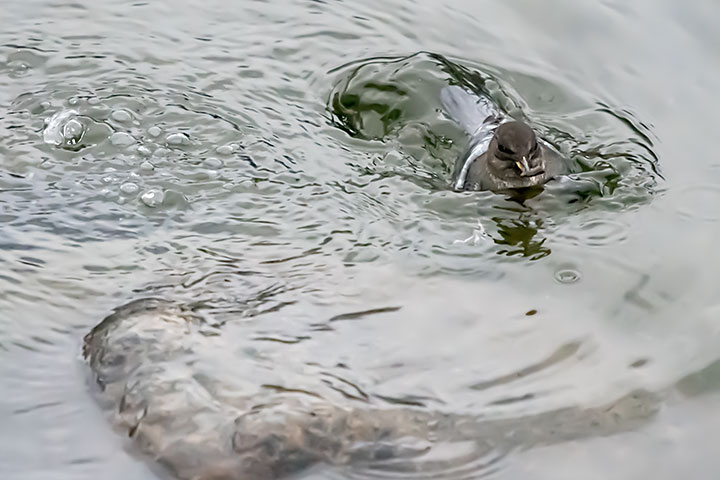
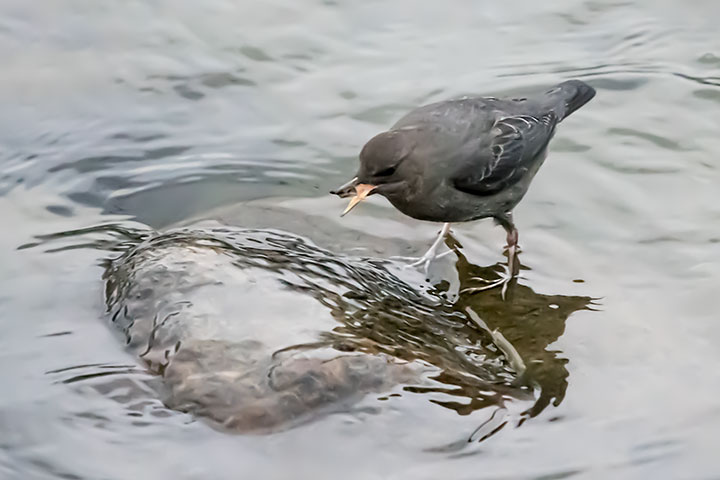
This is one of a number of dippers seen hunting along the lakeshore in recent weeks. It first dived from the rock at the picture bottom. It disturbed the water on the left, and then began to surface, upper right, having captured something in its bill.

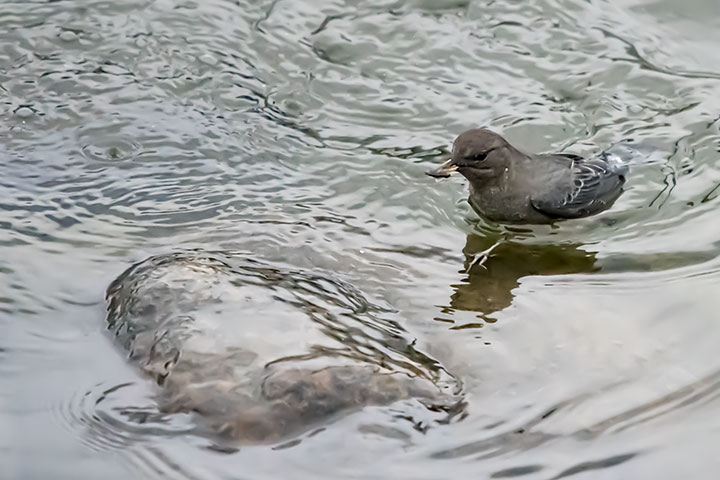
Arising out of the depths, it clutches what is probably a caddisfly larva in its bill.

It does not swallow it in the water, but takes it to a rock in the stream.

And there downs its prize.

“Burp.”

Posted in birds | 5 Comments

Not a waterbird


The West Arm waterbird count has been conducted since 1974, but I am only a recent participant. Yesterday, most of the interesting birds were seen far out on the Lake and so did not produce good images. However, one land bird did.

A (fist-sized) Pygmy Owl was hunting from a tree branch in Kokanee Creek Park.

Posted in birds | 7 Comments

Making waves


It may seem odd that I consider the picture below to be special. As a shot of a muskrat swimming, it is distinctly ho-hum. But, as a shot characterizing water waves, it is long-sought superb. This demands an explanation. 

Almost any disturbance of a water surface, such as that caused by wind, swimming animal, or boat, will cause waves to travel out from the disturbance at some speed that is dependant upon the wavelength. For most of the waves we see — ones that buffet our boats — gravity is the restoring force and the longer the wave, the faster it travels. For the ripples (wavelength less than 1.7 cm), surface tension is the restoring force and the shorter the wave, the faster it travels. 

This dichotomy of wave behaviour has some strange consequences: 
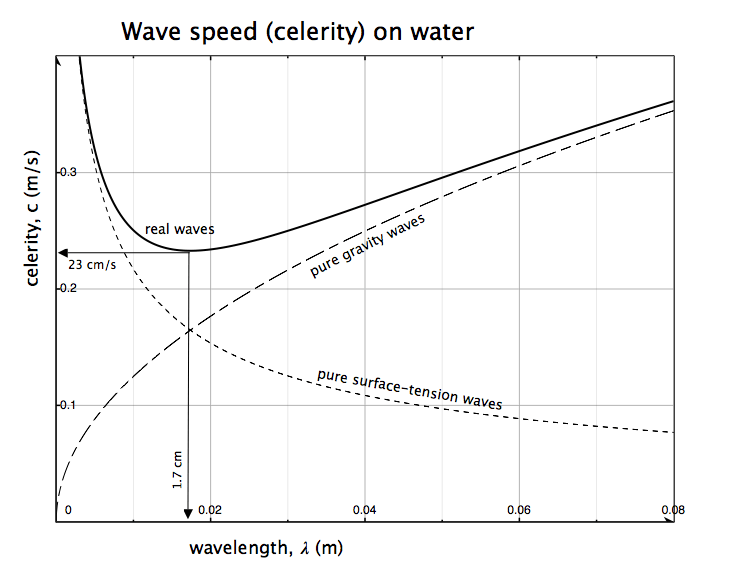
Real water waves (heavy line) are a combination of gravity waves and surface-tension waves. They must travel at greater than 23 cm/s.

• As the wave speed decreases owing to one mechanism, the other mechanism takes over and increases wave speed. Consequently, wave speed never drops below some value: 23 cm/s. So, something moving across a water surface at less than this baby crawl cannot produce waves that keep pace with it and so do not build and spread. The result is that such a slowly moving object leaves no spreading waves on the water surface. This behaviour was explored in a posting about katabatic winds, 23 cm/s.

• A disturbance moving faster than 23 cm/s will produce two types of waves: gravity waves and ripples. They are easily distinguished by having markedly different wavelengths, one much greater than 1.7 cm, the other much less. Mind you, if the speed of the disturbance is quite large (brisk wind, fast boat), the wavelength of the ripples may be so minute as to pass undetected.  

I have wanted to get a picture showing both types of waves simultaneously. A rapidly moving object, such as a dragon boat, would produce inconspicuous ripples and so won’t do. What is needed is something that moves only a bit faster than the no-wave cutoff: a muskrat. This misleadingly named aquatic vole is an inveterate surface swimmer as it searches for delectables to eat. It typically swims at slightly under its hull speed of about 70 cm/s (see, muskrat hull speed) and so is accompanied by easily distinguishable gravity waves and ripples.

Even though both wave forms are always present, it has proven difficult to obtain a picture that shows them equally. It is strictly a problem of good lighting and reflections to provide the necessary contrast needed to highlight both at once. Such a picture was achieved last Tuesday and is shown here.

A muskrat is swimming at nearly its hull speed of about 70 cm/s. The black bars on the right, and (not as striking) on the left are the crests of the gravity waves in its wake. Superimposed on these waves are the ripples. They are seen as the fine filigree ahead of the muskrat’s bow wave and nearly at right angles to the wake. A close examination of these ripples reveals their characteristic behaviour: the shortest wavelengths have travelled farthest as a result of having travelled fastest.

Posted in mammals, weather | 2 Comments

Swan harassment


When we are lucky, we are visited by swans twice a year as they migrate to the Arctic in the spring and return south in the fall. By the time they arrive here, they have flown far and need to stop in the shallows of the Lake to refuel on aquatic plants. 

Two different species will stop by to rest and feed: the smaller Tundra Swan and the larger Trumpeter Swan. I believe that today’s visitors were trumpeters. 

Something I have seen frequently when swans visit is their harassment by dogs. It is as if some dog owners view sicking their charges on weary swans to be good exercise for the dogs and good fun for all. 

Three adults and a juvenile stopped by to rest and feed before continuing their journey.

This is one of three dogs that beach strollers loosed on the panicky swans. What amazingly good fun.

Posted in birds, commentary | 6 Comments

Cattle Egret


The Cattle Egret is a small heron that is a rare visitor to this region. Yet, given its expansionist history, it just might become more common in the future.

The Cattle Egret is remarkable in the way, in modern times, it has increased its range. Initially it was adapted to feeding among the large grazing herds of Africa where it picked up disturbed insects. However, it began to take advantage of ranches where cattle now provided the insects, both by disturbing the grass and by having parasites. In its search for new cattle herds, this egret spread to the ranches of South America by the 1930s, to North America by the 1940s, and eastern Canada by the 1960s. Along the way, it discovered the similar advantages of mechanical grass munchers, such as lawn mowers.

The Cattle Egrets shown here were not photographed here, but in time they maybe could be.

A Cattle Egret had been foraging on a cow’s back when a tail flip drove it off.

This egret waited for a passing lawnmower and after a brief chase, grabbed disturbed insects.

“If you have lawns to mow, I have a service for you.”

Posted in birds | 2 Comments

No lollypop


I tried, but I didn’t win the lollypop — but I did manage something almost as good.

I rarely fly anymore, but when I do, I ask for a window seat away from the wing. There are things that one can see from the air that one cannot see from the ground (and they aren’t the inflight ads or movies). A view from either side of the plane holds delights, but on this occasion I was on the shady side.

A promising feature delivered a remarkably undistinguished picture: the shadow of a contrail from my own aircraft travelling across a water surface far below. Low flying jets do not make contrails, but when seen from the ground, neither the plane nor its contrail will cover the whole sun. The shadow of the plane is too small and diffuse to be seen here, and even the larger contrail appears diffuse. But, it was a start. Now, I would hope for a glory.

A glory is a set of concentric pastel coloured rings seen around the antisolar point (your shadow) then the shadow falls on a cloud of fairly uniform water drops. This glory was seen a few years ago.

So, with the contrail shadow as the stick and the glory as the candy, one gets the uncommon sight of a lollypop moving across the landscape as it chases the plane. This is the only picture I have ever managed of the lollypop, and it was taken so many years ago that it was on film and had to be scanned. This is what I hoped to see again.

I failed: No lollypop emerged. The plane did fly over clouds, but they were (mainly) composed of ice crystals. Yet, being at a high altitude, they presented a sharper shadow. The contrail has resolved into two vortices and the fuselage, wings, and tail of the plane are visible. There is a faint brightening (a hint of a glory) behind the wings, where I was sitting.

Posted in scenes, weather | 2 Comments

Fairy ring


He wha (who) tills the fairies’ green
Nae (no) luck again shall hae (have)
And he wha (who) spills the fairies’ ring
Betide him want and wae (woe).
         Traditional Scottish verse

 It is now difficult to recapture the mediaeval mindset of those who saw doom in stepping inside a ring of mushrooms. These fairy rings were presumed to be places inhabited by fairies, pixies and elves, all of whom lived, danced and carried on inhuman rites therein. A human who stepped inside, or damaged, the ring was doomed to want and woe. 

There are about sixty species of mushrooms capable of producing such rings merely by starting somewhere, depleting nutrients at that spot, then propagating outward to nutrients beyond the depleted zone. This simple natural process would seem an unlikely one to produce widespread and long-lasting supernatural angst. Yet, it did just that. 

In the spirit of tomorrow’s date, I caution trick-or-treaters who might come my way: Entering the ring on Halloween (even inadvertently) was considered especially dangerous.

The mushroom may be the Violet Webcap; the architects are undoubtedly the (invasive) Celtic pixie.

Posted in commentary, wildflowers | 2 Comments